Wednesday, December 30, 2015

A Wild Year


Well, how do I choose the highlights from 12 months of foraging? Impossible.

So I close my eyes and point. I have thousands of images from 2015, have filled another Moleskine notebook with new recipes, and have spent more hours than I know hunting, collecting, cleaning, cooking, reading, thinking and writing about wild herbs, vegetables and fruits. Plus a mushroom or four. Apart from the heavy duty fiction I love to read, I can think of nothing that has given me as much pleasure as discovering plants, their flavours, and how to use them in the kitchen.

January - that was a shoot for Edible Manhattan's 2015 Alcohol Issue, using pickled field garlic
February - spicebush-naartjie cordial for Kaia Wine Bar
March - quinces, in South Africa
April - back in New York: Japanese knotweed tips and field garlic
May - upstate wood nettles
June - American burnweed
July - elderflower cordial fizzing over
August - suuring, Oxali pes-caprae, in Cape Town again
September - Cape vermouth making, with indigenous herb and garden flowers
October - yippee, mushroom season in New York: puffballs and maitake, with mugwort
November - a snack for a walk: barberry-spicebush loaf, quails eggs and mugwort dipping salt
December - cold-season oyster mushrooms

A new year of foraging is just around the corner...

 ______________________________


Tuesday, December 29, 2015

Sorry, Sylvia Plath


In a solid week of grey skies, rain and icy drizzle (winter, at last?) parrot tulips light up our ground floor darkness. Nobody tells you how delicious they smell.

$8 a bunch at Whole Foods - quite a deal. New Jersey-grown.

(Here's Ms Plaths's poem.)

 ______________________________


Sunday, December 27, 2015

House cleaning


The Jora composter on the Harlem terrace

Before 2016 dawns - or dooms - on us, a tying up of unspoken loose ends. Old, new, confessional, revelatory, mundane, evangelical, edible, or just plain horticultural.

1. First up:

I gave the fancy Swedish composter away.

When I returned to the Harlem terrace from a four week trip in March and April, the vegetable scraps that I had been feeding to the bin daily for six weeks prior had turned into a sewage-like sludge whose stench was eye popping. Despite being fed the prescribed wood pellets and being turned daily by the increasingly alarmed and incredulous Frenchman, the compost could not be saved.

The fault was mine: not enough brown matter added initially (we had no leaves, hence the purchase of wood pellets, but still not enough). But also, we should not have begun a batch in winter, especially not that winter, despite the manufacturer's assurances.

You knew this wasn't going to work, didn't you?

The chopped salads of vegetable and fruit trimmings simply stayed frozen, not generating enough heat to break down gradually until they did so en masse in spring, and with microbial ill effect. And for me the daily prescribed shredding of vegetable bits for the very small compost return became a form of tyranny which I felt relieved to end.

So the composter was cleaned thoroughly and donated to the Urban Garden Center in Harlem for their educational programs. For me, it was The Flop of 2015. I am not proud.

But I am free.

The brown bins

2. But!

In October, in Carroll Gardens, these brown bins appeared like magic, at our doors. Part of a pilot project for a zero waste future (in addition to New York City's established paper, metal, plastic and glass recycling), Mayor De Blasio's administration, carrying on part of Bloomberg's legacy, provided these organic waste collection bins to every residential building in our neighborhood, along with small kitchen bins. I tip our little kitchen bin into the big one every couple of days. The brown bin is then emptied twice a week by the Department of Sanitation when they collect regular trash. It will be turned into compost.

It is the best thing, ever.

Fava bean bruschetta

3. When Anne Raver wrote a story for the New York Times about our Harlem terrace in June, she asked me for some fava bean recipes. So I made this bruschetta for fava beans and garlic scapes. There was no space to run it with the article, so there it is (Southern Hemispherians can make this now...).

Winged euonymous, Woodstock

4. Invasive plants. I have not mentioned just how much I would like all eastern seaboard gardeners to dig out their Euonymous alatus - commonly known as winged euonymous (it has those wings on the stems), or burning bush (which sounds like a porn star name and an STD): Stop admiring it and yank it out.

Euonymous alatus fruit

While it turns famously scarlet in the fall, this shrub's seeds (above) leave your garden via birds and are then spread into woods and thickets where the plant crowds out natives and alters the ecology of your local wild areas. Grow an alternative, like North American native blueberries (which turn red and orange in full sun), or fothergilla (orange and yellow and handles shade). Both will appeal to pollinators, both have flowers, and of course, with the blueberries, you get...

...blueberries. Yes.

Alliums and Camassia bulbs

5. There are 60 Allium bulbs buried in the garden. Lots of small (and cheap) Allium sphaerocephalon, quite a few A. aflatunense 'Purple Sensation,' and a handful (expensive!) of white 'Mount Everest.' All from Brent and Becky's. I think the bees will like them.

Also buried, Camassia leichtlinii 'Semiplena.' This is new, to me - an American bulb of the plains, and a Native American edible going way back. While I planted them for their flowers, I have a growing collection of forageables in the garden, a living lab.

Too soon!

6. In late fall I carefully dig up my containerized lily bulbs and store them with some peat moss in unsealed plastic baggies (per the recommendation of Judith Freeman, of The Lily Garden) in the crisper drawer in the fridge. I have found that my lilies rot in very snowy winters (the snow in the pots melts while the water is unable to drain, as the pot bottom stays frozen).

But when I dug up the last lilies yesterday (their leaves had still been green, and feeding the bulbs), I discovered that they have already made new green shoots! Great confusion, all over.  In late March, or early April, I will plant them out again. I hope they last in the fridge.

Great northern flicker. Photo: Julia Miller

7. Somewhere in these back gardens there is a great northern flicker - the ground-feeding woodpecker that I first encountered in a large migratory flock in Green-Wood Cemetery. Julia Miller told me that her garden two blocks over attracts one, where there are a lot of back yard trees (our back gardens have few). But the other day I realized that the unfamiliar, penetrating bird call I have been hearing nearby belongs to the flicker (it's the "kyeer" call in this Cornell link).

Maybe I'll see it one day.

Arugula, mâche, red mustard

8. The results of the soil sample I sent to Cornell came back just before Christmas: Happy Christmas, you have lead! 560mg/kg, while the acceptable level is 400mg/kg.

We also have low pH (acidic soil), and too much phosphorus (the middle number on fertilizer bags - probably from previous fertilizing, affecting runoff, and the environment, not us directly).

Naturally, the lead result provoked flat panic and a firing off of uninformed questions, followed by days of calmer reading and learning.

The takeaway: the solubility of heavy metals is pH dependent. Low pH allows lead to be taken up by plants. Raising the pH to about 6.5 prevents that from happening. I really had not appreciated the role of pH in soil processes before, despite knowing what relative pH specific plants liked.

The consensus seems to be that the health risk with lead in the soil lies in direct contact with the soil itself, either by breathing in the dust, or ingesting it (as children might, or from unwashed hands or leaves) - rather than from eating the plant, where lead does not accumulate readily. Plants affected most (in low pH, and with high lead levels) seem to be taproots (like carrots), then leafy greens; fruiting parts, like beans and tomatoes are not affected.

That said, I still want as little as possible sucked into my leaves. I have ordered crushed oyster shell to add to the soil to raise pH.  I am not choosing lime, because our magnesium levels are fine, and lime would raise them, too. I did not know that either.

This 2013 research paper based on work done at Cornell was very helpful to me. And yes, it could be worse. We could have a lot of arsenic, instead.

If you garden in-ground, I recommend a soil test. It is money well spent. My soil health assessment plus additional heavy metals screening was $80, and comes with pages of results as well as management recommendations for your situation. If nothing else, it provides an intense learning curve.

Daffodils, Christmas Day

9. There are daffodils poking up in Prospect Park and in our garden, and the smallest Alliums have made wiry leaves. In keeping with our crazy non winter, and in response to a Cornell suggestion to use green manure cover crops to improve our soil condition, I have ordered crimson clover and more fava beans to plant in our central vegetable plot.

Yes, I will plant them in December. No, they might not make it, but at this stage anything goes; two days ago the two rows of garlic I planted broke the surface.

 ______________________________


Thursday, December 24, 2015

The lights in the hood


It is Christmas Eve in New York City and the bells are ringing.


The only sign of snow in this town is in the blow-up snowperson on our street. I like the twinkly lights but the inflated decor is lost on me. These decorations went up as soon as the Halloween ones came down (and those went up in late September). They play carols. All day. And night.


Same block. Merry Christmas! Beware of the Dog!


The Moonstruck bakery. Time to watch the movie again. I recite the lines, by now.


The dark afternoons are lit by many trees. 

We have a small, fat tree. 

For Christmas dinner we'll eat what my parents are eating 8000 miles south and east, in Cape Town: lamb roast on a rack over a bed of potatoes which catch the drippings and become crisp. My mother will use rosemary, and I may use mugwort. 

The temperature in Cape Town's summer today was the same as ours, in midwinter.

May your Christmas be merry and bright. Even if it's just you. 

Feed yourself well.

 ______________________________


Tuesday, December 22, 2015

Seeds of the Month Club Winner


For everyone who entered the Grow Journey Seeds of the Month Club giveaway, the winner is Denise Maher, a Californian whose favorite winter crop is fava beans, and whose blog is A Growing Obsession (check it out - very nice images).

The winner was chosen by an online random number generator, out of all the eligible entries.

Denise, please get in touch so that we can set up your account with Grow Journey.

If it's any consolation to non-winners, Grow Journey is offering a 30-day free trial of their Seeds of the Month Club - this will give you a month's-worth of organic seed, but also access to the online support and horticultural information that I find so interesting.

Today it was so warm that I went mad and planted garlic. Then I delivered Christmas cakes in a warm Brooklyn blanket of mist. Coat not needed.

 ______________________________


Saturday, December 19, 2015

How to make a magnetic spice rack, and why

The finished magnetic spice rack (and the mysterious microwave)

I like our kitchen in Carroll Gardens. There is a glass door to the garden, a little sash window beside the oven, two work surfaces, a good fridge, an oven that works, and just enough storage space. True, I'd rather have storage where the microwave is (can someone tell me what to use it for?), but that is a tiny niggle.

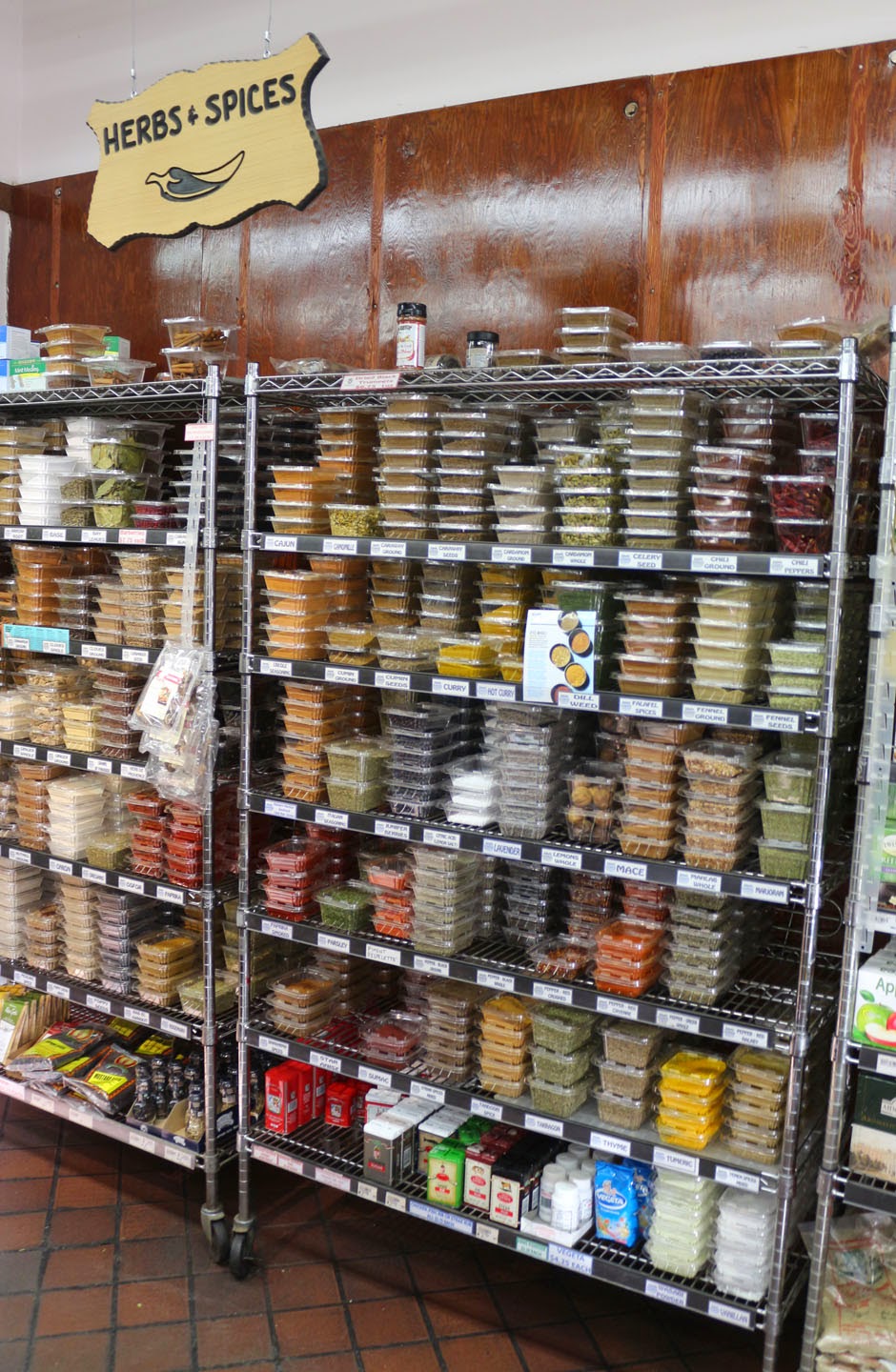
Spices at Sahadi's 

The real problem was my spice collection. In Harlem the spices lived stacked on a lightweight wire shelf that stood on the floor beside a kitchen island, but we have no space for the island, here, and it is dismantled and stored. Before that, in Cobble Hill, they were hidden in a cupboard above the oven. Most of them were from Sahadi's, and stayed in their clear plastic containers, but some were irritatingly miscellaneous jars for the extra spices I make myself from foraged ingredients.

The old spice shelf

But in this new kitchen, despite the increased work space, the spices did not fit. They sat on their floor shelf on the wrong side of the kitchen counter in the living room, for weeks, while I pretended they weren't there (inbetween bursts of online searching for solutions). The Frenchman said nothing, and waited. He is good, that way.

I looked at the walls. The spices would have to go Up.

There were two wall spots in the kitchen - a wide one beside the sink, and a long narrow one between the stove and the door.

I searched for shelves that would fit either space. Nothing was quite right.

I had seen many articles and posts about magnetic spice racks, where a small magnet holds individual containers to a wall-mounted steel sheet. I found many links to ready-made magnetic spice racks, from Target and Ikea's el cheapo versions to nicer ones on Etsy. But none was right for me - too small (just 12?), or too heavy (small glass jars), or too small, too heavy and too few, or just poor product reviews.

I would have to make one.

For wall-mounting we had the added challenge of metal struts in the dry wall on one side (so not every spot was good to drill), and brick beneath the dry wall on the other (which we did not want to penetrate and damage). I started to focus on the idea of  a stainless steel sheet light enough to be glued - rather than screwed - to the wall, but thick enough to attract magnets. I figured a large enough surface area would provide enough grip to keep the sheet in place, plus a host of lightweight containers.

But what did I need? The best starting point was The Kitchn's How To post (see link), but the post is now dated, and has key missing elements. The comments section, however, was very helpful and I investigated about every suggestion, from magnet size to glue for fixing magnets to type of steel.

It was time consuming.

But by the end I knew that I wanted very lightweight containers, and not glass (which I would have liked), because of support issues. I wanted clear lids so I could identify a spice by appearance, rather than by label. And I wanted 8oz containers because perversely they hold a 4oz volume of ground spices, which is how I buy and cook. And I understood more about which magnets hold what.

Eventually, I ordered each element, one by one, and finally put the whole thing together. It is not the cheapest spice rack ever. But in terms of satisfaction, I love it.  I smile every time I see it.

The stainless steel sheet arrives

So, if you're interested in making one for yourself (save space! reduce clutter!), here's what I did and how, which I hope will spare you hours of research and head-scratching.

This was made for a collection of 40 spices.

Stainless Steel Sheet:

Important: you want lower grade, 430 stainless steel. Higher grade 304 is NOT magnetic.

My custom-cut sheet came from Stainless Steel Supply, in North Carolina.

Use this form to specify the details you need.

Mine were:

Size: 16" x 38"
Thickness: 20 gauge
Slightly rounded corners: ABCD Radius: 1/8" (the letters refer to the corners - the form above will clarify)
Cost: $59.63, plus shipping ($20)

An aside: Customer service at Stainless Steel Supply was superb. Scott Huggins answered an email within four minutes of my sending it (I panicked about the gauge and changed it from 16 to 20 within a few minutes of ordering - no problem). The sheet arrived impeccably packed and protected a week later.

Spice Containers:

From SKS Bottle and Packaging (which sells fascinating supplies - you can get lost, there).

48 containers, 3"W x 2.25"Deep - 8oz deep metal tin with clear lid
Cost: $50.40, plus shipping ($23)

I had to order more than I needed, but I figure some will be damaged in time and I might need extra containers as my wild spice collection grows.

The Magnets:

To hold my containers I chose 1/2" x 1/8" neodymium magnets from Apex Magnets

I bought 5 packs of 10 magnets, so 50 total
$44.95, plus shipping ($10)

If you are curious about how much a magnet can hold, that link is helpful.

And wow! Those magnets were weird - they arrived all stuck together with crisp warnings about the damage you could inflict upon yourself and others: in their massed form, don't let them near pacemakers, credit cards or metal. Or computers or electronics. Or steel pins in legs.

Total Cost of Supplies?

$207.98 - not cheap. But in this case, I bought happiness.

Magnets affixed with glue

Then What?

1. I glued one magnet onto the base (inside) of each container, using a single drop of Super Glue. (They will stick of their own accord, but they tend to drag about, and I didn't want that.)
2. I sanded the wall lightly where I was going to place the stainless steel sheet, and then washed it and let it dry well.
3. I traced a pencil outline on the wall around the steel sheet as I held it in place, to know exactly where to apply the glue (do this with someone to help; I did it on my own, which is not ideal).
4. For gluing the sheet I used Gorilla Epoxy, which combines resin and hardener as you squeeze, and which you must stir together in a little tray. I brushed that onto the wall with the ice cream stick-like trowel provided, placed the steel sheet against the wall inside the stencil lines, and pushed with all my might. For 30 minutes.

It said: "Clamp time, 30 minutes."

I was the clamp. Sorry, no pictures.

This is where you need that friend.

That was the hardest part, and worse than any workout session (this is where in-wall screws would have been useful). I had to exert constant pressure on the sheet.

So for 30 minutes I leaned in plank position with my palms against the steel sheet, against that wall, till every muscle trembled. Thank god I do push ups.

It may have been overkill. But it stuck.


I let it cure for 24 hours. Next day I filled my containers with spices, and transferred them to their gleaming sheet, arranging them in an order that makes sense to me: by cuisine, by botanical family, by frequency of use... You will have your own method.

Mostly filled

And there it is. When the Frenchman came home he found me grinning like a Cheshire Cat (with wobbly arms).

When I am cooking, they are right there next to me, and I take one from the wall, use what I need, twist the lid back on, and hum a little.

But I'm out of red pepper flakes.

Time to shop.

 ______________________________

                 Book a Frigid Forage - New Year's Day

Wednesday, December 16, 2015

The leaves of winter


Today's garden leaves.

Left to right, top to bottom, more or less:

Red mustard (three sizes), parsnip, radish, mâche, frilly lettuce, hairy bittercress, fava bean, radish, arugula, fenugreek, sheep sorrel, mesclun lettuce (no idea what kind), baby kale, pea shoot.


     ______________________________

                 Book a Frigid Forage - New Year's Day