Showing posts with label Garden writing. Show all posts

Monday, August 25, 2025

Milkweed, fennel and lablab beans - late summer's compensation


Very, very late summer and the tall things are bending in the breeze. The South African milkweed and the fennel are irresistible to pollinating insects. So many bees, iridescent hover flies, wasps and hornets visit them. The creatures with stings don't bother us, so we don't mind them. It's good to see their free, flying life while the wider world's confusion and collapse press on us.

Beyond their airy stems, the lablab bean is in bloom. Yesterday we saw a hummingbird buzz its flowers. It's usually sold as an ornamental, as hyacinth bean or hyacinth vine, with occasional and vexingly ignorant warnings of toxicity. This is an ancient crop, hailing either from East Africa or South Asia (so far, its very early domestication has made its origin hard to pinpoint). 

I can't wait to have enough pods to make the two early fall bean dishes I've come to anticipate: a Southeast Asian-style curry made form from the sliced young pods, and a spicy and addictively good dish laced with berbere (an Eritrean and Ethiopean spice mix). 

You'll find both those recipes, and more about lablab beans, via the Gardenista story below.

Lablab Beans: An Ancient Crop and Stunning Vine

Tuesday, March 4, 2025

Shrubs with White Flowers


It's early March. No new leaves, yet, in Brooklyn, but the Asian witch hazels are in bloom and little past bloom. Snowdrops have been out for weeks, as usual. Crocuses have appeared. It's a good time to dream of gardening.

Viburnum, above, the scented snowballs belong to a V. carlesii cultivar. I make a fizzing cordial from them every mid-spring.


One of the sweetest garden fragrances I know belongs to daphne.


 And a fat rhododendron on our terrace in very early summer.

I made a list of 17 shrubs with white flowers for a Gardenista article, because who doesn't want their garden to gleam at night?

__________________

Friday, October 21, 2022

What's easy to grow, unusual, and edible? Myoga!

One forgets how good pears can be. This farmers market Bosc sat on the counter for over a week, ripening. Then I sliced it, tossed with lemon juice and slivered myoga buds from the potted plant on the terrace, and added some chopped, roasted apricot kernels (they taste a little like almonds, and are from Ziba Foods, who source heirloom foods from Afghanistan). The fruit was creamily juicy and fragrant, the myoga buds spicy and floral.

Myoga is one of my favorite plants. It is completely undemanding. When its leafy stalks are long and lush in October, I begin to hunt daily for these rosy, crunchy buds.

I wrote about this hardy ginger for Gardenista, and you can read the article and get my two salad recipes, there. 

___________

New November Walks

Wednesday, August 3, 2022

Aronia - good for what ails ye

As late summer arrives in waves of humidity, with a side of cicadas, Aronia begins to ripen. The dried fruits above were added to a batch of roasted beets, for a savory spread (I call it a pâté) that I make for forage picnics.


I also preserve the antioxidant-laden fruit in a chutney that is flavored with juniper and spicebush, and which is very good with soft cheese.

The chutney recipe, and much more about superfood Aronia, is over at Gardenista.

____________

Edible Plant Walk, Queens Country Farm Museum

10 August 6pm

Friday, July 8, 2022

Serena Bass's Garden


Serena Bass's garden in Brooklyn begins on the sidewalk. I didn't know that, the first time I visited, almost exactly a year ago, on a sticky summer evening. I had parked several doors down but began smiling when I saw the pots overflowing with flowers and shrubs. I knew I was close.


On a recent visit the sidewalk pots included lilies, a serviceberry tree, echinacea, grasses, sedums, clematis, honeysuckle, boxwood and ivy.


These vivid flowers on three-foot stems intrigued me. Dahlias? I queried, hesitantly. "I loathe Dahlias. They're Helio-somethings," countered Serena, who speaks only botanical Latin. They turned out to be Heliopsis, and quite new to me. But no longer.


The front garden - sidewalk and stoop - is drenched in warm colors and there is a strong petunia presence.

Few people know how to deploy coleus this effectively.

Don't you just want to lick those black petunias?

And that's just the front. 

You'll find my story about Serena Bass's gardens on Gardenista, with lots more pictures, including the cool blue inner sanctum. Plus cats.

Also, her cookbook is wonderful. I knew I had to buy it after having supper that steamy summer night last year. It is very funny, too. Laugh-out-loud funny. It's called Serena, Food and Stories (Stewart, Tabori and Chang).

______________

My Gardenista Stories

Friday, February 18, 2022

Jaftha's Flower Farm


Recently I wrote about Jaftha's Flower Farm, for Gardenista. There is a lot more to it than pretty flowers. I visited the farm in Cape Town in December and January, when its fields were bright with dahlias, cornflowers, the first sunflowers, and sweet William. Here are some pictures that I didn't use for the article.


I gleaned this dinner-plate sized dahlia from between the rows, where a gardener was deadheading. And yes, dahlias are in fact edible!

_______________

Saturday, September 21, 2019

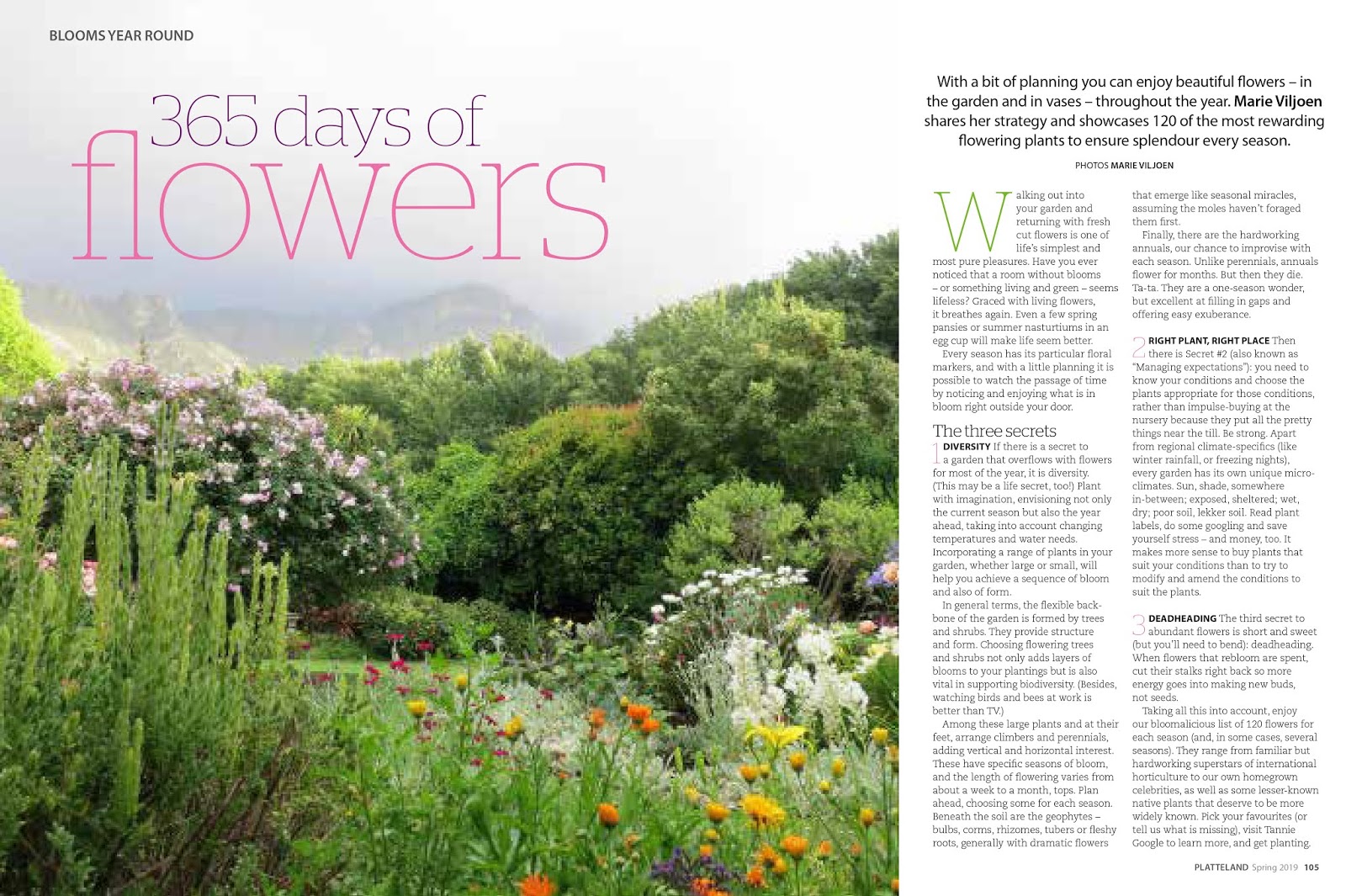
Flowers for all seasons


My story about how to have a flower-filled garden (almost) all year is in the spring edition of South Africa's Platteland magazine, available now. The double page spread above features - of course -  my mother's garden in Constantia.

_________________

Thursday, August 16, 2018

Wednesday, October 19, 2016

Edible plants for shade


It was very satisfying putting together this list of edible plants that can grow in shade, for Gardenista - my answer to a reader's plea for help. There were more than I thought.

In the garden new garlic is sprouting, the self-seeded mâche is up, very late season fava beans are leafing out, the arugula keeps on trucking, and the squirrels are in an acorn digging frenzy, tipping over my Italian dandelion plants and uprooting baby kales. I inadvertently contributed to their stash, and for the squirrels Christmas came early, More about that, tomorrow.

The sun has left our garden altogether, now, and while I have always loved seasonal changes, I am bracing myself for the dark months ahead. Indoors, my work spot will shift soon from the darker living room to sunny bedroom, where the two Thai limes are in the windows, soaking up the rays. I have found signs of scale on them, probably a pest they brought with them from Tennessee, and which I never noticed when they were outside. I have been spraying them with Neem oil. They will be indoors through April. Which seems very far away.

Earlier darkness or not, New York is destined for record high temperatures, today. Mid October's nip has melted to a balmy 88'F. (Oh, hi, Global Warming!) And my mosquito bites, acquired in the line of gardening duties, tell stories of high summer.

Thursday, October 13, 2016

Fall garden chores


I have been planting garlic and lifting lily bulbs. And maybe I will order more bulbs for spring.

Read about some other autumn garden chores in my story for Gardenista.


What are you doing in your garden (or is it spring, where you live?)

Friday, September 30, 2016

Basil ice cream and other garden wonders


The Grow Journey Thai basil that I planted out in late spring grows in two huge troughs (gifts late last year from my friend Julia Miller, who lives a few blocks away) right against the house. Apart from mid-June and till mid August, when they receive an welcome hour or so of direct sun, these troughs are in full shade. The basil is three feet tall and forest-like. I also planted some ginger rhizomes in the same deep troughs and their bamboo-like stems and long peppery leaves lean out above the Thai basil. The feeling is Edible Jungle.

So. You can grow Thai basil in shade. Yes, you really can.

What do do with so much basil? In Cape Town in August I tasted the most delicious ice cream I have eaten. Connie Finnemore served it at the end of a dinner and I was mesmerized by its flavor. Can you guess what it is? she asked. I got the lemon right, but I missed the basil and thought it was mint. It was so unexpected. And green. In short: Lemon curd, basil, cream and gin (recipe here). I was converted to ice cream eating on the spot. Back in Brooklyn I mowed down the Thai basil to take upstate to friends for the weekend, and whipped the ice cream up quickly when we arrived (I use home made lemon curd), so that it would be frozen by that evening. Everyone hummed with pleasure.

I made it again last week. The gin stops the cream from setting very hard, so it can scoop quite well. Even better, no ice cream maker required.


In the last few days New York decided to turn from an unseasonably hot 'n humid (yet rainless) September to chilly gusts with rain. I am wearing a sweater. And thank goodness, because I am thinking about mushrooms; it is hen of the woods season. Speaking of which,  the founders of Grow Journey, Aaron and Susan are into foraging and mushrooms, big time - you can see some of their finds on their Tyrant Farms blog. Another reason to like them.

So, it's time to plant fall greens in my garden where the glorious sun of summer has retreated to the very rear of the long plot, again. We have lived here for one year, and I remember how worried I was about the light, this time last year.

What is coming up? Here are the baby greens, all from those seeds of the month packets.


Bok choy - this cultivar is 'Prize Choy.' I have never grown it before and am hoping for the best - the birds have left it alone, and while I see some nibbles, mostly the bugs seem to stay away from brassicas. The online Grow Guide that you can access as a Grow Journey member tells me 30 days till baby harvest, 50 days till maturity. With my sun situation it may be a little longer. Cross your fingers.


Kale 'Dazzling Blue,' above.


Very tiny chard. But not Swiss: "‘MacGregor’s Favorite’ is touted as the best tasting of all chard (unlike Swiss chard, this variety has small veins like regular beets — beets and chard are the same species bred for different uses but you can also eat the young beet-like roots of this variety). The glossy, tender leaves are a deep, antioxidant-rich red with darker burgundy veins. An improved heirloom variety from Scotland, this plant can be “cut-and-come-again” all season long in most areas.' 

May it be so. I love chard, I love eating beet leaves (borscht season is almost upon us), and I love harvesting crops when the living world seems to be retreating.


And finally, 'Dragon' carrots are purple-red, and the Grow Guide says they have the same lycopene content as tomatoes. Good for hearts. Carrots are also a new crop for me. As a longtime container gardener I never felt I could offer up pot-space to carrots. Only 30 days for baby carrots, 70 to 85 for full size. And if the roots fail, there are always the leaves - very good in soup.


Tuesday, July 19, 2016

A garden's story


While I have posted here on the progress of our 1st Place garden, I recently charted the 12-month process in one story for Gardenista:

Rehab Diary: A Year in the life of a Brooklyn Garden


We have been in Carroll Gardens for almost a year, and this July is very different from the frantic one we did not enjoy last year, looking at endless potential apartments with a wide array of outdoor spaces, packing, and getting ready to move.

As I type I look out of a window into the new garden and see at its farthest edge some sunchokes (Helianthus tuberosus) growing eight feet tall. Yes, I measured them this morning. Superchokes. I planted them late last year for their edible tubers and late summer flowers, but also for some botanical privacy, as a leafy screen against an ugly fence. They seem happy.


Last night as we ate pizza (rare take out from Lucali's, nearby) we saw two raccoons trotting after one another along the white birch pole fence.

Bolted leafy greens have been taken out of the farm (the central vegetable plot), many more seeds been sown.

I will travel far south soon, to the southern tip of Africa. While I am away the Frenchman, and then when he joins me, two gardening friends (Julia and Kirstin) who live in the hood, will look after watering. But no one is expected to weed (frowned upon by the United Nations Agreements on Human Rights) and I wonder what I will find when I return. As the weather changes, new species of weeds emerge in waves.

In a brutal age (but would the methods of Genghis Khan, the Spanish Inquisition, the Thirty Years War, the First World War, Vietnam, be less brutal? - we had no social media then to broadcast everything to everyone in real time; humans are not worse, we are just connected) a garden - where sorrow and delight coexist on a botanical plane - becomes an even greater privilege and refuge.

If you can, find one, or help make one.

Tuesday, June 28, 2016

Home


After a weekend away for work, visiting other peoples' gardens (in Buffalo), it was good to come home again, and find the Formosa lilies in bloom. And we still love our umbrella.

The garden is not there, yet, but it is so much more there than it was, when I first saw this space last August.

When I am impatient, I remind myself...


And...


So, then this feels better.


Thursday, June 16, 2016

The Gowanus Nursery


I was happy to be able to write at last (for Gardenista) about an inspiring place that is dangerously within reach: the Gowanus Nursery. Follow that link for more photos and the story.


What does its owner, Michele Palladino do every day? Water. For one-and-half hours. And then she works. She keeps a remarkable collection of plants in the nursery, and designs and plants and maintains gardens on the days when the nursery is not open. A lot of labour.


And the 'g?' Dutchman's pipe - Aristolochia tomentosa, a species with petite flowers.


Tuesday, May 31, 2016

The gardens around us


In this week's article for Gardenista, I wrote about gardens in the hood. It is called Carroll Gardens, after all. Click that link for lots more pictures. A little local colour, literally. And I met some neighbors.

The garden above belongs to Polina Siterman, who grew up tending strawberries in the family's dacha garden in Russia.


Sadly, the pink flamingoes did not make the cut for the story. That is perhaps a whole other story. Every third or fourth garden in Carroll Gardens is stuffed with statuary. Flamingos, gnomes, Catholic saints, the virgin Mary, Jesus, baby sheep, mangers...

Tuesday, May 3, 2016

Read all about it


Since spring is springing and I have been writing (and making rhubarb soda pop, above), here is a catch-up post with links to some of the articles I have written recently. Follow the links for stories, and by all means leave comments.

Edible Brooklyn - my story about eating sweetfern (Comptonia peregrina), whose fresh, fragrant young leaves are just fluffing out, here in Brooklyn. Chances are it is growing near you, if you have a cabin or summer retreat almost anywhere east of the Rockies! This indigenous herb is unfamiliar to most people even though Native Americans knew it well.

Pelham Bay in the Bronx is a botanical hotspot? See why in my Secrets in Plain Sight story for Gardenista.

Weeds You Can Eat -  Japanese knotweed and why you should eat it (and-by-the-way-did-you-know-that-Scott's- Miracle-Gro-is-in-bed-with-Monsanto?). Plus a hummus recipe to take the nasty taste out of your mouth.

BBG in Spring - their Plant Sale begins tomorrow evening (for members) and on Thursday for the rest of us. Definitely worth a visit - plus petals.

It has been raining beautifully all night and is still drizzling. We really needed it. It will help push up new growth at Dead Horse Bay this Saturday - there are still spots on that wild foods walk, so come and join us. The moon will be new. The tide will be out. The rhubarb pop will be there, too.

_________________________


Tuesday, February 23, 2016

My Tiny Garden


I had no idea till now that our Harlem terrace provided the cover for Lucy Anna Scott's new book, My Tiny Garden. The black diagonal lower left is the bird feeder - it got in the way of a lot of my own photos. But how sweet to see the Harlem birds and scarlet runner beans, months - it feels like years -  after that space has been taken apart.


Lucy and photographer Jon Cardwell visited the Frenchman and me last year, and stayed for dinner (above) on the terrace. Apparently the birds cooperated.

I've been lucky to have had both our New York gardens immortalized in print (the Cobble Hill terrace has featured in several books and magazines). The pleasure I take in these spaces is intense, but of course transitory, subject to the whims of real estate and New York rental life. Lots of heartbreak when they are demolished, but so much joy when we live in them.

I don't know how long we will be in our current space in Carroll Gardens, or how this garden will look at its best. I have seen it only in my head, which is where all garden dreams begin.

We shall see.

 ________________________________________

Friday, September 25, 2015

Fall garden tips


I have two autumn gardening pieces on Gardenista this week.

One is about fall-beautiful perennials, to inspire a small move away from mum monoculture. Above, Vernonia photographed on the High Line. Read the story here: Fall Flowers

The second is one of my favorite topics - cool-season edible plants, especially pertinent right now as I prepare the neglected and uber-weedy in-ground beds I have inherited here on 1st Place.


Above - rainbow chard grown on the rooftop of the original 66 Square Feet. And yesterday I sowed more salads: mesclun, mustard, arugula and radishes.


It is rewarding always to include images from my edible gardening experiments - the picture of the arugula shows our first crop, here in Carroll Gardens, above (we ate this bunch last night, wilted in a warm potato salad).

Follow the link to see what other greens are best sown now, or in spring: The New Vegetable Garden.

___________________