
I like fruit as dessert, and winter is the best time to roast apples and pears. They fill the house with positive smells. Even better ones, when you add fir sugar and citrus to their cavities.

The whys and hows are in my story for Gardenista:

Our local greenmarket is just a five minute walk away from where we live. On Sundays and Wednesdays trucks arrive early in the day from farms in New Jersey and New York, filled with vegetables and fruit and flowers ripe right now. The farmers or their vendors unpack and set everything up. These harvests were sown months earlier, tended, gathered, cleaned, packed, made beautiful for New York shoppers who've seen it all. At the end of the market day, back it goes, back they go. Long day, New York traffic.
I don't know what the profit margin is or how real farmers survive. The produce is not cheap - it can't be. It's much more expensive than what you'd pay in a nearby store for similar (looking) and seasonless produce shipped hundreds or thousands of miles, and it's about double to triple what the equivalent quality would cost in markets in Europe.
I think a lot about food. How it is grown. How to grow it. Who grows it. Who harvests it. Who eats it. How little so many people know about the food they eat. How it is eaten. Who gets to eat it. How much of it there is, in the world. How obscene it is that it is kept from people by other people, who have the power to prevent death by famine.
This okra and these aubergines were very pretty.
______________


I grated one small quince and squeezed lemon juice across it. Salt, some chile/chili/chilli, and it was a quick sambal, ready for the lamb chops we cooked over coals under a shimmering southern sky. The sheep eat the bushes that grow in the veld we can see.
In this old house where we are staying, with thick walls, low doors, and and high gables and layers of thatch, I wondered how many hands had prepared quinces, before me.
________________


Seeing red. Well, deep orange? Amber? A rufous hue? This is the perfect stage, not in a renewed presidency, not in the world, but in the short, truncated life of a tulip. Full blown.
Supper began with snacks of olives that I salt-cured, given to me by the friend who came over last night to eat them. She grew them, just a few blocks west of us. Then, a couple of salads, drenched in a bright dressing of Thai lime juice (from the happier of our two trees) with fish sauce and some sugar: crisp endive, thin rounds of watermelon radish, a shaved heart of mustard, and tiny, vinegar-soused cucumbers. And another of peeled and naked pomelo sections, topped with fried shallots. After that, the duck legs, simmered forever in shoyu with many bay leaves (our tree, yay), on a starchy foundation of lacy lotus roots. With a side plate of chilled spinach stems, with shoyu and ginger and crisp sesame seeds. Followed by durian ice cream, just-churned, and cherimoya granita.
Life in the big, evil city, where dozens of cultures collide daily and (mostly) get along.
Cherimoyas (custard apples) are in season for another couple of months, in California. I highly recommend treating yourself to a box, if you live within shipping reach of Rincon Tropics (a small business with a real, live human owner) whose fruit is wonderful and whose shredded paper packaging makes unpacking it a treasure hunt.
My granita recipe is at Gardenista.
That's all I've got. But we're all going to have to do better than gape, as each new violence unfolds. It is beyond anyone's experience, but catch up we must. If you don't already belong to the American Civil Liberties Union, there has never been a more insistent need to join.
___________________

Buy some little guavas (from Mexico. Before those tariffs change their price).
It's OK if they are still rather green and hard. Release them into a bowl and leave them on a counter. In a few days, as they turn pale yellow, you will come home from the grey outdoors and you will be greeted by that very specific, very not-winter guava aroma. Like a Sauvignon blanc from New Zealand (or South Africa's Overberg), or very fruity and somehow appealing cat pee. But it's actually just guava, and wonderful. (Our cat is smell-free, he begs me to explain. I would explain right back at him that it is because we scoop his litter immediately, like the cat-servants we are...)
How you eat them is up to you. But I do have some ideas...
Here in Brooklyn these small guavas can be found at most corner grocers, fruit stands, and supermarkets. Right now they are clam-shelling at about $3.99 to $4.99 for around eight fruit per clamshell. Yes, I would like the plastic to be converted, toot sweet, into biodegradable packaging. It is possible.
_________________


Austere, like the flavor of autumn olives. Clear, tart, enough sweetness to keep your attention. But definitely autumn.
_____________
daily posts at Instagram


Crabapple season.

Birds prefer them after a real cold snap, when they are less tannic.


One forgets how good pears can be. This farmers market Bosc sat on the counter for over a week, ripening. Then I sliced it, tossed with lemon juice and slivered myoga buds from the potted plant on the terrace, and added some chopped, roasted apricot kernels (they taste a little like almonds, and are from Ziba Foods, who source heirloom foods from Afghanistan). The fruit was creamily juicy and fragrant, the myoga buds spicy and floral.

Myoga is one of my favorite plants. It is completely undemanding. When its leafy stalks are long and lush in October, I begin to hunt daily for these rosy, crunchy buds.

I wrote about this hardy ginger for Gardenista, and you can read the article and get my two salad recipes, there.
___________


September. Month of pawpaws. At least, in this zip code (October, for upstate, NY). The apartment smells like tropical fruit salad. I spoon up mouthfuls and cherish every bite.
Tomorrow I will de-seed them and freeze some portions of pulp, for future picnics and foodsploration. There will have to be just one batch of ice cream (which is indescribably good), even though the whole freezer will have to be unpacked to accommodate the bowl of the ice ream maker.
I think I'll make the pawpaw spicecake from Forage, Harvest, Feast for this Saturday's adventure in the wilds of Staten Island.
_______________


April.

August.

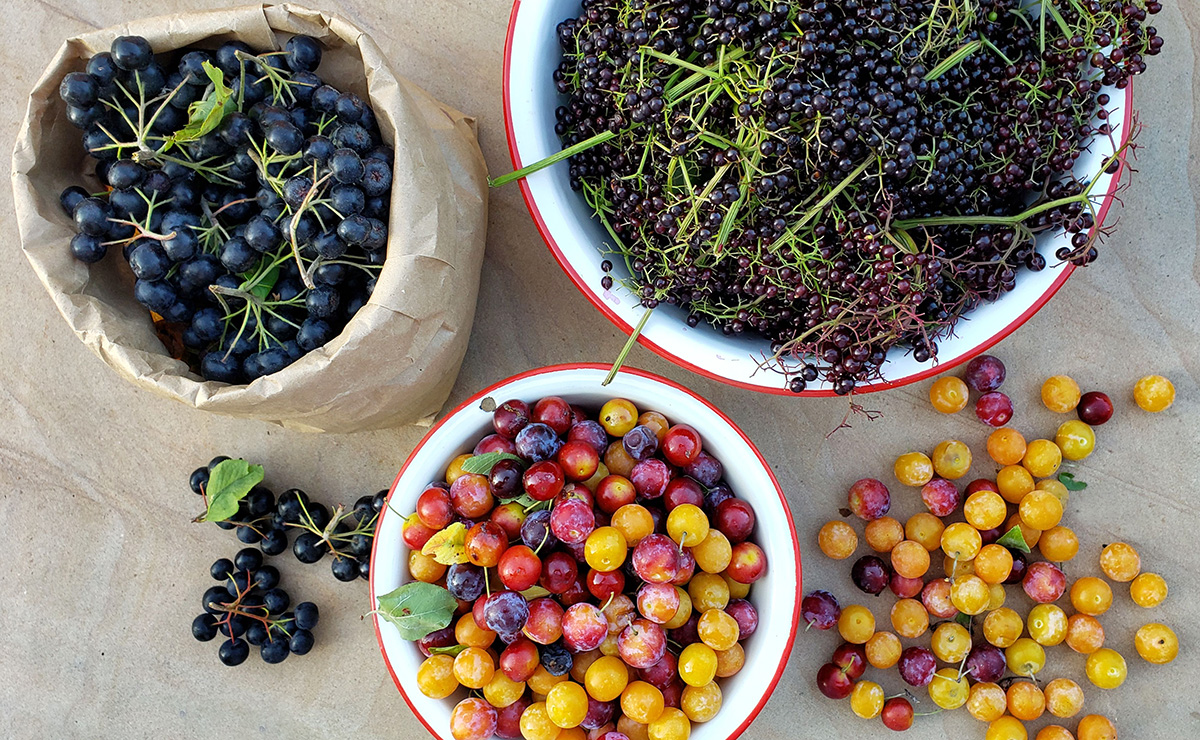
August in Brooklyn feels like January in Keetmanshoop, right now. Oven-hot. But New York also slings a bucket of soapy mugginess at you to make sure you will really, really look forward to September. And I do. Look forward to September.
There are compensations. For me, they are fruit. Beach plums are beginning to ripen. Elderberries (the ones that have not shriveled on the parched shrubs) are turning purple. And Aronia is ready, too.

I opened a 2020 bottle of beach plum gin the other evening. A maceration made in that first summer of pandemic. It is very good, but improved by a bitter strip of ruby grapefruit peel, with lots of dry tonic (Fever Tree Lite) and ice to make the glass bead. Perfect for this weather. This is the gin I refer to as Pits-and-Pulp, using the leftovers from a beach plum purée. I create another gin, too, that is redder and richer...
I explain that, with a recipe, in the recent story about beach plums I wrote for Gardenista, which you will find in that link. They are a wonderful East Coast fruit, and a very resilient shrub. I hope more people will grow them.
_______________
Find me @66squarefeet on Instagram

Tonight's cold supper is a cold lentil salad vibrating with the flavors of onion, garlic, carrot, salted anchovies and vinegar. I'll top it with nine-minute eggs, halved.
_____________

As late summer arrives in waves of humidity, with a side of cicadas, Aronia begins to ripen. The dried fruits above were added to a batch of roasted beets, for a savory spread (I call it a pâté) that I make for forage picnics.

The chutney recipe, and much more about superfood Aronia, is over at Gardenista.
____________
Edible Plant Walk, Queens Country Farm Museum
10 August 6pm

Slurp.
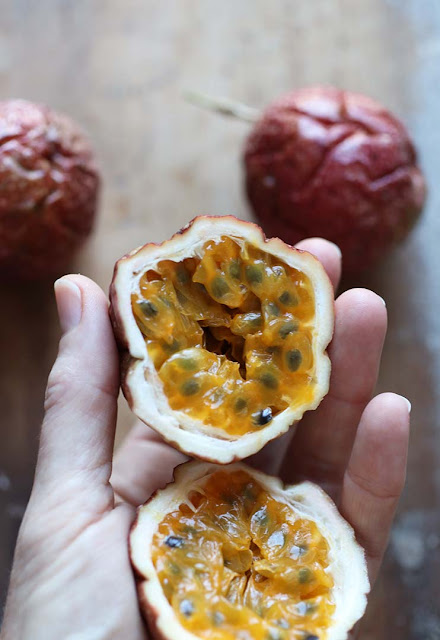
Where are all the US passionfruit? Find out in my story for Gardenista.
(I ate my way through pounds of passionfruit to answer the question. It was rough.)
________
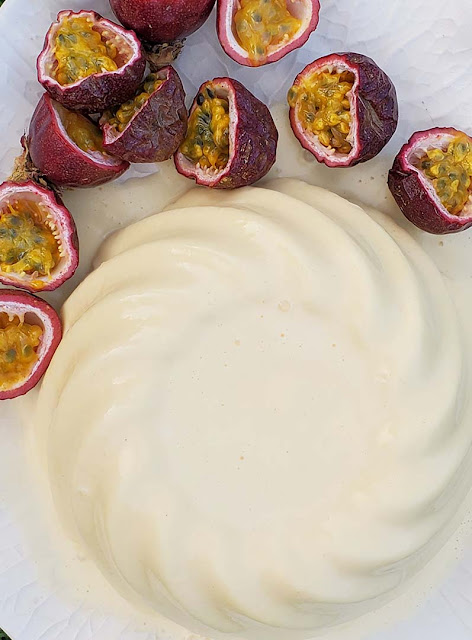
Passionfruit Mousse
Serves 8
You do not have to strain the passionfruit seeds out (in which case skip the food processing part). I strain from force of habit: My father used to crunch every single seed, instead of just slurping each mouthful down. It drove me nuts. But I digress.
Use a single jelly mould for a large mousse, or individual moulds if you're being fancy and giving everyone their own. An overnight chilling is helpful.
1 ¾ cups passionfruit pulp (from about 20 passionfruit), chilled
3 ½ teaspoons powdered gelatine
3 tablespoons water
3 cups whipping cream, chilled
5 oz sugar
Halve the passionfruit and scoop the pulp into the bowl of a food processor. Pulse for about 15 seconds to separate the pulp from the seeds. Place a medium-mesh sieve over a bowl and strain the pulp through the sieve, extracting as much juice as possible. Reserve a quarter cup and chill the rest for two hours.
Heat the reserved quarter cup of passionfruit juice with 3 tablespoons of water in a small pot. When it is hot (but not boiling) turn off the heat and sprinkle the gelatine onto it, swooshing the juice around to cover and soak the granules. Stir to make sure there are no lumps. When the mixture is perfectly smooth, whisk this gelatine-juice into the chilled juice.
In a large bowl whisk the cream until it thickens slightly. Add the sugar to the cream and continue whisking until the cream holds soft peaks.
Pour the passionfruit juice into the whipped cream, then fold rapidly using a spatula to blend the mixture well. When no bright yellow juice remains at the bottom of the bowl, pour it into your jelly mold/s. Cover, and transfer to the fridge. Chill until it is set (three hours, minimum).
To unmold, slide a butter knife carefully around the edge of the mousse. Dip for about 4 seconds in a bowl of extremely hot water (too long and the outer layers will melt). Invert onto a flat serving dish and shake hard. You should hear a satisfying plop as releases. If you don't, turn it right way up again, run a hot knife around the edges of the mousse, and repeat. Chill until needed.

It is time to make hoshigaki. Again!
These delicious East Asian delicacies, made by air-drying persimmons slowly, are now a late autumn ritual, for me. The dry fruit is intensely flavored and luxuriously rich, reminiscent of the best dates, but less cloying.

I made my first batch of hoshigaki in 2016, while researching and developing ways to use foraged native American persimmons (Diospyros virginiana) for Forage, Harvest, Feast - A Wild-Inspired Cuisine.


But I wanted to compare those with the traditional dried fruit, made with big, Asian persimmons. So when gorgeous, pointy-bottomed ‘Hachiya’s arrived at our local deli (owned by a Korean-Japanese couple) on Court Street I pounced, peeled, and strung up correct, hefty fruit. I used white kitchen twine attached to a screw in the ceiling to suspended them, and another, long stainless steel screw inserted into each heavy fruit to anchor the twine. In the US persimmon are not sold with a neat twig attached for the twine to loop around. When their naked skins were dry to the touch I massaged them, smoothing out the rough exterior ridges and feeling the pulp turn soft inside their drying shells. At night I cracked open the windows, because our radiator heat was too much for us. During the day the fruit basked in sunlight. These conditions, as it turned out, were ideal.

Two months later the persimmons were dark brown, their roundness now oblong, dusted in white sugar. Their texture was sumptuous, firm but yielding, their flavor sweet but more complex than the best ‘Medjool’ date.

Those sunny windows were the key to perfection, apparently. When we moved to our current apartment my hoshigaki operations transferred from airy windows to a high-ceilinged alcove near a skylight. The biggest difference is that they are draftless. The humidity is higher, here, too. First, because our overwintering indoor citrus jungle has grown (it actually raises the humidity!) and because we keep our central heat lower than those hot radiators. For the first few weeks the fruit tends to drip, stickily. Once, there was some mold on the Fuyus. A dip in vodka and a small fan installed below them soon fixed that. They are slower to dry by several weeks and the sugar bloom does not always form. But their flavor and texture remain delicious.

I eat the first couple extravagantly, like candy. And then I serve them with excellent cheese, cut up into salads with toasted nuts, macerated in booze (dark rum, brandy, and Calvados) before stirring into fruitcakes, or folded into that killer focaccia.

I still make the little native 'simmon hoshigaki, because they are so pretty and last so long.

How to Make Hoshigaki:
You Need: Firm persimmons. And they can be any kind. The ones above are Fuyu. But even astringent Hachiyas must be firm or you can't peel them. They will turn sweet, I promise.
A potato peeler and a very sharp, small knife.
Stainless steel screws, one for each fruit. If they are not stainless, they can actually rust inside the fruit. They are more expensive but you can re-use them. They should be about half as long as half your chosen persimmons.
Twine.

To Make: Sterilize the screws by boiling them, or cover them in high-proof liquor. This helps prevent mold.
Wash your hands (mold-prevention, again). Peel the persimmons. Twist the screws into the top of each fruit, drilling through the papery calyx and as deep as you can go, leaving the head and some shaft exposed for twine-tying.
Tie twine to the screw heads. You can tie several fruit in strands (like edible fairy lights) on a single piece of twine, just make sure they will not touch each other.

Before Hanging: Briefly dunk the whole stringful (or individual strings) of fruit into a pot of boiling water and remove at once. Or, use alcohol: Place the persimmons in a shallow bowl and pour a little vodka or other high proof alcohol over them. I reuse the same vodka for my whole batch. (Then I strain it and shake it up in a cocktail.)
Hanging the fruit: Ideally, hang the hoshigaki in a sunny spot with decent airflow. If the space is neither sunny nor breezy a fan is close to essential.
Massaging: When the exterior of the peeled fruits has dried to the touch - usually a few days after peeling (unless your environment is very dry), give them a gentle squeeze all around. With clean hands. As time passes you will notice the interior yielding more and more, until you can manipulate the whole fruit without damaging the exterior.
Drying times vary a lot, depending heat, humidity and airflow. Six to 12 weeks is average. The degree of dryness is also a personal preference. You may prefer them more sticky on the inside. Experiment.

Hoshigaki Tips:
Choose hard persimmons (I know, an exception to the super-ripe Hachiya rule). Soft, ripe ones will turn syrupy very soon. They may also slip right off their attachments and plop stickily onto whatever you have below.
Use stainless steel screws. They will not rust inside the moist interior and they are food safe (sheet metal screws are not).
Use a fan: If the indoor humidity is high or the airflow doesn't...flow...mold can form. If you see a very syrupy exterior, you need more moving air.
If you spot mold: Remove the mold with a pastry brush, then brush some high proof alcohol over the fruit. Hang them again. (Do not mistake the perfect sugar bloom for mold!)
Windows. If you can hang the hoshigaki in a sunny window, do it.
Hachiyas are more expensive. Go for Fuyus if you are on a budget. They taste very similar, dried.
_____________
