Showing posts with label Growing Food. Show all posts

Monday, September 8, 2025

Early autumn on the terrace

Funny that it takes a whole growing season for things to fill out this much. The moonflower vines are rampant, the African basil is a forest, and the lablab beans and South African milkweed have reached the arm-waving stage, tall flowering stems tilting in any breeze.


At the lower end of the terrace is an eccentric leafy collection. It includes Thai lime, calamansi, bergamot citrus and a spicebush tree grown from seed that someone gathered on a plant walk with me, then germinated, and later gifted to me before she moved to Germany. Beside the trees are galangal and myoga ginger (producing edible buds through these fall months), ferns, ramps (now dormant, having set seed), sand ginger and asters. Natives of the Northeast, of Southeast Asia, and of East Asia.


Both annual vines take a long time to take off, but they are worth the wait. Moonflowers open every evening, and now, in the newly cool mornings, they remain open to greet us before folding up and withering by 10am.

Tuesday, September 13, 2022

Flowers for feathered travelers

For two days in a row our small terrace has been visited by the tiniest of birds, making the mightiest of journeys. 

You hope, when you plant a seed, that something like this will happen at the other end of the growing season, but you never know.


It has been magical, watching from a few feet away as this miniature creature flashes from flower to flower, sometimes pausing in midair for seconds, suspended.

There are three vines, in two pots. One is grown from a seed given to me by our friend Don in Cape Town, two are from Botanical Interests. But I don't know which is which. I call them lablab beans, but most Americans know them as hyacinth bean. Lablab purpureus is African, so hardly a native food for the ruby-throated hummingbird. (Weeks ago we saw them feasting on trumpet vine flowers - native eastern Campsis radicans - out at Jamaica Bay. But our tiny terrace is no match for that perennial twiner's aggressive behavior.) 

Still, can a foreign flower be worse for hummingbirds than sugar water? It's definitely less problematic in terms of passing on pathogens. And much more photogenic.

If only we could pack them a tiny lunch, for sustenance along the way.

____________

Book a Walk and Picnic

Wednesday, August 3, 2022

Aronia - good for what ails ye

As late summer arrives in waves of humidity, with a side of cicadas, Aronia begins to ripen. The dried fruits above were added to a batch of roasted beets, for a savory spread (I call it a pâté) that I make for forage picnics.


I also preserve the antioxidant-laden fruit in a chutney that is flavored with juniper and spicebush, and which is very good with soft cheese.

The chutney recipe, and much more about superfood Aronia, is over at Gardenista.

____________

Edible Plant Walk, Queens Country Farm Museum

10 August 6pm

Tuesday, June 14, 2022

Nasturtium capers


Have you made nasturtium seed capers?  They are delicious, with a mild, horse-radish zing. I think they rival the better-known, bottled version. There is still time to sow the flowers and gather their seeds in early fall. (Remember to plant them deep.) 

My recipe for nasturtium capers is on Gardenista along with some other very yummy ideas for eating the leaves, flowers, and fresh seeds. They are also good medicine.

The capers above are still in the process of lacto-fermenting (the linked recipe explains this - it's very simple) and were photographed on the kitchen table in Cape Town. My mom's rambunctious nasturtiums were shedding seeds like mad, and I pounced. 

Here in Brooklyn, my windowbox seedlings have just popped up and should be blooming in a few weeks. Something to look forward to.

______________

Prospect Park Tangles and Trees Walk - 18 June

Tuesday, August 3, 2021

Summer in the jungle

And it's August. July slid by, filled with walks and picnics, and wild scents and red fruits. 

The terrace has filled out to its summer jungle voluptuousness. Fennel has shot up and is flowering and the South African milkweed is about to begin, too. Cardamom and galangal and black pepper and sand ginger throw tropical parties at night, after we have gone to bed.

What is missing is last year's lush screen of moonflowers on the birch poles, and also the raspberry along the railing (removed because of its incurable virus, and replaced with another, after scrubbing and sterilizing the pot). I regret the moonflowers, but an extremely late sowing of an unusual white lablab bean from Abbie Zabar's stash may still have time to climb. It's a baby. I also cut the Clematis 'Etoile Violette' right back to provoke more flowers in...guessing...mid September. (You can see the first one I grew here, in the original 66 Square Feet in Cobble Hill - funny, that post has an almost identical title.)


After a lavender hiccup (mistake, their roots needed more room) the windowboxes are fluffy with a yellow Agastache cultivar from the Gowanus Nursery, Nemesias that have not stopped flowering since spring (they are a wildflower from South Africa's Western Cape, in bloom there after wet winters, so it's fascinating that these can withstand intense New York humidity), and more South Africans: the daises are an Osteospermum, also planted in April. 


I made this warm salad that warm night by grilling tomatoes over coals, splashing them liberally with very good soy sauce (Ohsawa nama shoyu), adding crushed purple basil from the pot on the terrace, and a shredded sesame leaf (Perilla, but not the frilly shiso, which tastes a little different). 

Stuff? The pink sparkling wine is Graham Beck Brut rosé, a cold treat on a warm night. The kikoi is one of the endless collection that I stockpile after a South African trip (it's been 17 months, and counting) and the pillow covers I ordered online from A Love Supreme, also Cape Town-based. The ibis plates are from Anthropologie's discontinued Nature Table series designed by the whimsically wonderful artist Lou Rota (you can still find this series squirreled away on eBay).

So, there it is. Our oasis within Delta variant life.  Everything changes while it stays the same. We garden. we walk, we cook, we order in. Forage-picnics (for now) still happen, but proof of vaccination is required. We adapt, we wash our hands. We wait.

__________

Next Walks? - 5th and 7th of August

Saturday, November 28, 2020

Saffron in the house?

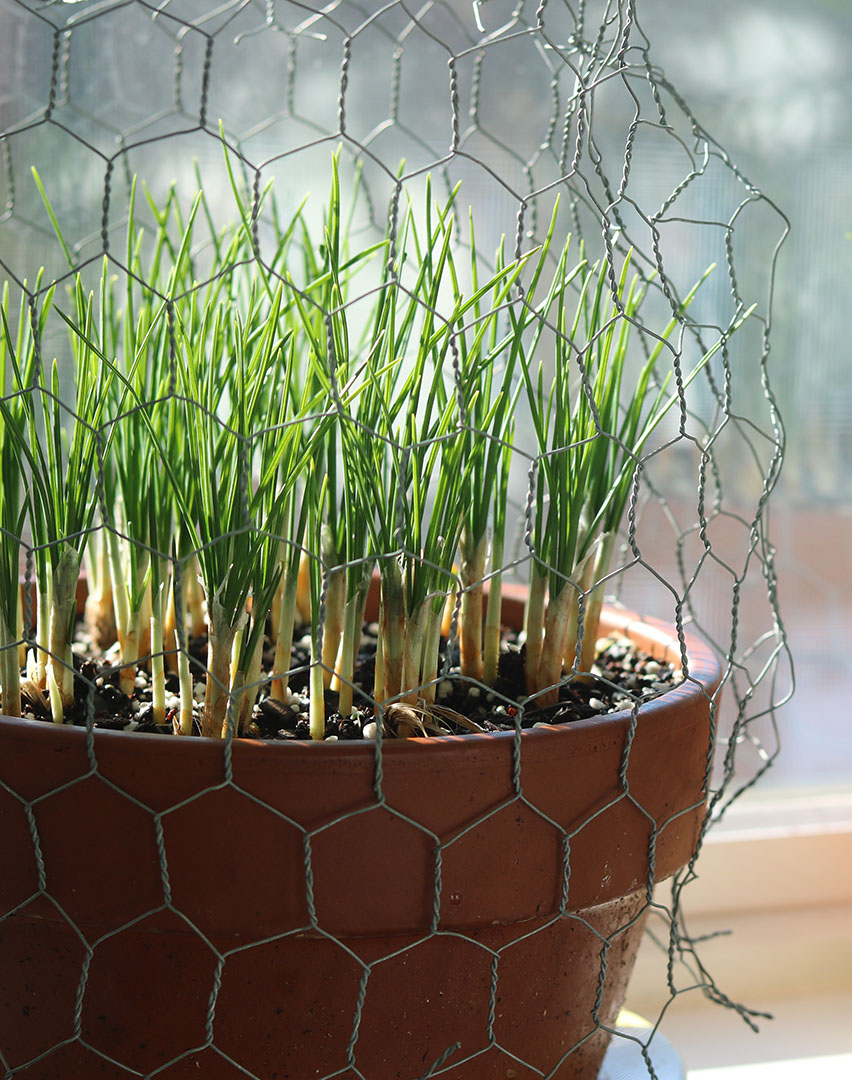
What's going on here? Confined crocus? 

It's just me, gardening by the seat of my pants. 

I planted saffron crocus corms in the last week of September. Unlike their cousins, the sweet harbingers of spring, saffron crocuses bloom in late fall slash early winter (when exactly does winter begin, anyway?). 

I last grew them at 1st Place, in-ground, in the last row of the vegetable plot, where I hoped they'd suck up the last inch of diminishing autumn sunlight. Those crocuses flowered (in early December), even though they lost the sun altogether. And I harvested their lady-parts. The famous red saffron is the pistil and style of Crocus sativus

But these pots are an experiment, like so much in my gardening life. More of a what-if than an I-know, although it often turns into an ah-ha. 


At first, the pots lived on the terrace all day and night, covered with some wire against the dastardly, digging squirrel. Then the leaves filled out and the squirrel gave up. Wire came off. Then the sun dipped, as it does, and swung south of its eastern summer rising, as it also does, and the terrace now sees only an hour of post-dawn sunshine. And the squirrel returned. 

So first the wire enclosure happened, and then the carrying indoors during the day to bask in the bedroom's sunlight. At night out they go to get a good nip of cold. Since Sq. Irrel wakes up earlier than I do I did not want him/they/her digging before the pots could be moved. Angry start to day.

So! I have no idea if this will work. Warm, bright days, dark, cold nights. Just like their Eurasian homeland, I keep telling them.

We shall see. 

______________

Thursday, September 17, 2020

Sesame leaf - stalked from behind


The secret undersides of sesame leaf. Backlit in the morning sunlight.

I use its toothed leaves as wraps for deviled eggs or spicy meatballs, or folded around quick-pickled vegetables. Or I sliver then soften them in good soy (try Ohsawa nama Shoyu) for 30 minutes and transform warm seven-minute eggs or steamed eggs with the aromatic dressing.

What's in a name? 

If it's a common name - that is, the lingua franca for a plant (or animal or fungus) in any given region, versus the Latin and Greek binomial, or scientific name - things can be confusing. Because sesame? This plant is not even vaguely related to sesame-the-crunchy-seed (that would be Sesamum indicum). Common names are notoriously confusing. Instead, the burgundy-shadowed leaf belongs to Perilla. Specifically Perilla frutescens var. frutescens

Nope, not shiso

Are your eyes glazing over, yet? Snap out of it! Because this herb is often sold incorrectly as shiso, and shiso it ain't. The plants above are sesame leaf, not shiso. Even the grower (at the Grand Army Plaza  greenmarket) got it wrong. Sesame leaf (above) sturdier and less aromatic than shiso, but its rose-petal flavor is very similar. 

This is shiso. Shiso is...tighten your seatbelts: Perilla frutescens var. crispa! I know! Just one door down from sesame leaf, in terms of classification. And she - shiso - has frilly leaf-edges. Forgive me for going Jar-Jar Binx on you, but if you think, "Shiso frilly," you'll know shiso when you see it. She may be red, or green. But she be frilly. 

And why does it matter? Because facts always do, despite Trumpiverse. 

Shiso is associated more with Japanese cuisine, is highly aromatic, but otherwise tastes similar to the rougher sesame leaf, which is traditionally beloved in Korean cuisine.

I grow both. 

_____________

Walk with me at the NYBG 

15 October

Friday, July 31, 2020

A lime's life (and near death)


marie viljoen terrace brooklyn

Can you spot the blue tape on the Thai lime (Citrus hystrix), middle left? That lime (one of two) has had a rough year. Who hasn't? And July was an especially eventful month. 


On July 5th I repotted. For the second time this year. Post possible fungal infection of roots, post root-pruning way back in January (that was to keep it down to size in the same pot that has to move indoors every winter). The tape was part of my follow up micromanagement of a persistent scale infestation, dating back to winter. So, yeah. It's a survivor. And I won't say post again.

The lime tree is stable, now. I can say it out loud. It's been nearly four weeks and no more dieback. New leaves formed and are maturing.

After the tree was repotted and the scale had gone to meet their maker ("Did he who made the Lamb [really] make thee?"- with apologies to William Blake) I had to think about ants. They returned, scurrying up and down the branches and triggering in me a severe case of OCD. Ants tend scale lovingly: they feed on the scales' honeydew (I've tasted it, it's straight up sweet), moving the little armored insects about and protecting them. So I had to prevent the ants from coming aboard to look after any tiny scale I had missed. 

tanglefoot on tape by marie viljoen

Enter Tanglefoot. It comes in a tub and is an outrageously sticky paste that you smear on tape wrapped around the trunk of trees affected by insect pests. Ants can't pass it to farm their scale flock. And it actually worked. The tip came from Nancy Lingnan, who offers - very good - advice at LemonCitrusTree.com. I turn to her via email when I have run out of ideas. 

In our incredible heat - weeks over 90'F, in direct sun, I found that the Tanglefoot melted and ran down onto the exposed trunk, so I repeated the initial operation, smearing just a little around the top of the tape this time, and bending a moat at the bottom to catch run off. Once it's on the trunk itself it's almost impossible to get off (or your fingers, or anything it touches - use mineral oil).

gin with lime leaf by marie viljoen

We won't enjoy the bumper crop of limes we did last December, but luckily the Thai lime marmalade I made is still going strong. And the beauty of these trees - and please call them makrut, or Thai lime, not the k-word - is that their leaves are famously fragrant and useful. They perfume water, and gin, and salad dressings featuring Asian terrace herbs and spicy pickled vegetables. And then there is curry.

terrace garden in summer by marie viljoen

The chimney swifts' point of view, all of our garden lives exposed below. In this image the tree is left-of-center, bottom, all fluffed out. Its sibling is far right, camouflaged in a subtropical thicket of galangal and myoga ginger. 

And no, no drone was involved in this shot - just a climb up the fire escape and a wide angle setting. 

This is the end of the lime's story, but it's also not the end of the lime. And it's one of those timeless reminders that we learn far more when things go wrong than we do when they go right.

So fail on. In the end, it's more interesting.


Saturday, July 4, 2020

Terrace life and an unhappy lime


Summer is here. And it is warm. Also wet (well, not in this morning picture). July has been as stormy as June was dry.

This weekend's project is to re-pot - again (it was root-pruned in January) -  one of the Thai limes: just to the left of the frame. Something is wrong. Some die-back on twigs. And it has failed to thrive, after putting out a burst of blossoms some weeks ago. Not a good sign at all. 

My only theory is possible root rot. That's when soil remains wet and unoxygenated, and a fungus attacks the roots. Usually fatal unless addressed fast, although I did rescue the Meyer lemon from a similar fate earlier this year. It involves removing all damaged roots (when they disintegrate in your hands you know your root rot diagnosis was correct), washing them off and repotting in a clean pot with fresh potting mix. You water it once and then allow it dry. Out. Completely. Citrus really hate being damp. 

I have been so careful with watering but possibly our storms with straight-down rain, plus a combination of a possible drainage issue in the lime's pot, have complicated things. So, time for intervention.

I have ordered some Organic Cactus Mix from Espoma - it is designed to drain well. I did try a nursery for it, first, but Mr. Billionaire Bezos does deliver the goods. It will arrive today, at the door.  Yesterday it was ladybugs. That's another story.

But now I am telling you all my troubles and that wasn't my intention. Growing citrus never gets boring. 

____________________

Sunday, August 4, 2019

The subtropical food forest


This is the mourning doves' view of the terrace. They like to hang out on the roof.

In the lower third of the frame is the unplanned edible subtropical forest. With stragglers along the edges.

It all began at 1st Place with those two big sunny bedroom windows, perfect for overwintering tender citrus, and I chose Thai limes (Citrus hystrix - often called kaffir, the South African K-word; less offensively and more appropriately known as makrut or Thai lime) for their famously perfumed leaves, figuring that the trees were unlikely to produce fruit (I was wrong!).


The two Thai limes now each have about 30 bumpy fruits, whose zest is the most aromatic I know.

The limes were joined by cardamom (Elettaria cardamomum), which is almost too successful. I am about to divide it, yet again. And curry leaf (Murraya koenigii) - both bought while I worked on an assignment for Better Homes and Gardens magazine, writing about subtropical herbs. I fell in love.

Who was next? The Meyer lemon, the finger lime, the myogo ginger. And then the two galangals. It's infectious.

They all come indoors in autumn (the link shows their 1st Place winter quarters) and rush for the exit again in early May, or when overnight temperatures stay above 50'F. They relish our muggy summers. The satisfaction of having exotic fragrant leaves and fruit within hands' reach is immense. Especially when these ingredients are hard to find, even in New York.

This week's posts will be all about these plants, their challenges and rewards, and how our apartment-hunt late last summer had to take their needs into account!
_______________

Monday, May 15, 2017

Last call for arugula flowers


These flowers belong to the arugula I planted last fall. The plants were extremely tenacious, lasting right through winter and feeding us until just a few days ago, when I pulled them out. Yes, I did feel bad.

I let them bloom because I love their unassuming, four petaled flowers on tall, tall stems, and because I thought the honey bees might love them, too. The honey bees did not. Slow to arrive, they have now been visiting the allium flowers and ignoring the brassicas. Maybe they know something I do not?

So the arugula came out, making way for baby spinach and lettuces. A fresh arugula sowing will take place later in the week (I save up gardening as a reward for book work done). This crop has performed so well in the vegetable plot that I began to take it for granted and am now caught with my arugula pants down: we have none. For a salad addict that is just frightening.

The lettuces should be afraid. Very, very afraid.

__________________


Friday, September 30, 2016

Basil ice cream and other garden wonders


The Grow Journey Thai basil that I planted out in late spring grows in two huge troughs (gifts late last year from my friend Julia Miller, who lives a few blocks away) right against the house. Apart from mid-June and till mid August, when they receive an welcome hour or so of direct sun, these troughs are in full shade. The basil is three feet tall and forest-like. I also planted some ginger rhizomes in the same deep troughs and their bamboo-like stems and long peppery leaves lean out above the Thai basil. The feeling is Edible Jungle.

So. You can grow Thai basil in shade. Yes, you really can.

What do do with so much basil? In Cape Town in August I tasted the most delicious ice cream I have eaten. Connie Finnemore served it at the end of a dinner and I was mesmerized by its flavor. Can you guess what it is? she asked. I got the lemon right, but I missed the basil and thought it was mint. It was so unexpected. And green. In short: Lemon curd, basil, cream and gin (recipe here). I was converted to ice cream eating on the spot. Back in Brooklyn I mowed down the Thai basil to take upstate to friends for the weekend, and whipped the ice cream up quickly when we arrived (I use home made lemon curd), so that it would be frozen by that evening. Everyone hummed with pleasure.

I made it again last week. The gin stops the cream from setting very hard, so it can scoop quite well. Even better, no ice cream maker required.


In the last few days New York decided to turn from an unseasonably hot 'n humid (yet rainless) September to chilly gusts with rain. I am wearing a sweater. And thank goodness, because I am thinking about mushrooms; it is hen of the woods season. Speaking of which,  the founders of Grow Journey, Aaron and Susan are into foraging and mushrooms, big time - you can see some of their finds on their Tyrant Farms blog. Another reason to like them.

So, it's time to plant fall greens in my garden where the glorious sun of summer has retreated to the very rear of the long plot, again. We have lived here for one year, and I remember how worried I was about the light, this time last year.

What is coming up? Here are the baby greens, all from those seeds of the month packets.


Bok choy - this cultivar is 'Prize Choy.' I have never grown it before and am hoping for the best - the birds have left it alone, and while I see some nibbles, mostly the bugs seem to stay away from brassicas. The online Grow Guide that you can access as a Grow Journey member tells me 30 days till baby harvest, 50 days till maturity. With my sun situation it may be a little longer. Cross your fingers.


Kale 'Dazzling Blue,' above.


Very tiny chard. But not Swiss: "‘MacGregor’s Favorite’ is touted as the best tasting of all chard (unlike Swiss chard, this variety has small veins like regular beets — beets and chard are the same species bred for different uses but you can also eat the young beet-like roots of this variety). The glossy, tender leaves are a deep, antioxidant-rich red with darker burgundy veins. An improved heirloom variety from Scotland, this plant can be “cut-and-come-again” all season long in most areas.' 

May it be so. I love chard, I love eating beet leaves (borscht season is almost upon us), and I love harvesting crops when the living world seems to be retreating.


And finally, 'Dragon' carrots are purple-red, and the Grow Guide says they have the same lycopene content as tomatoes. Good for hearts. Carrots are also a new crop for me. As a longtime container gardener I never felt I could offer up pot-space to carrots. Only 30 days for baby carrots, 70 to 85 for full size. And if the roots fail, there are always the leaves - very good in soup.


Wednesday, August 31, 2016

Gardening with our brains


After more than a month in Cape Town I came home to a late summer garden where beans were bristling from bushes and fence. Also a lot of weeds. Long, hot days, lots of water from the stellar watering team of Julia and Kirstin, and the weed seeds of years resulted in something close to a jungle. And then there is the Wisteria that Wants to Rule the World. It should work for ISIS.

So two straight days were spent gardening. I was eaten alive by striped-leg mosquitoes.


I admired the basil hedges. The Thai basil (left) arrived in a late winter packet from Grow Journey. Late winter is now a funny memory. The fennel is a row I made from many of the scattered volunteers that popped up late in early summer, dropped by my plants last year - the ones that moved with us from Harlem.


And then I picked all the beans, to make way for cooler weather crops to come (I left the climbing scarlet runners in hopes of luring those hummingbirds).

Grow Journey's 'Painted Pony' beans are surprises in disguise. Their slim green pods hide the real treat, which is the beautifully mottled seed inside. While we ate plenty of these beans fresh in July, I now have a pile which I am in the process of shelling. This is the first time I kept beans long enough to dry and harvest just the meaty seeds. They will be cooked gently with whole cloves of garlic and garden thyme, with a nod to Terence Hill, who will always be the best bean I eater I don't know. You have to watch My Name is Nobody to see what I mean.


Grow Journey's packets of Chinese cabbage, kale, and August subscription of bok choy and lettuce mixes will be planted, soon, and then there will the surprise packet of September. What will be in it? I have left rows open in anticipation.


I was thrilled to see a monarch feeding for a long time on the wild ageratum (Conoclinium coelestinum). I had cut quite a lot back in my gardening frenzy, but left plenty of flowers.

And now for a rant.

One of my (many) pet peeves is the thoughtless use, in smugly righteous but underinformed gardening circles, forums, blogs, and conversations, of terms like "chemical." It makes my hair stand up. "I don't use chemicals on my garden," or, "I won't eat food that is grown with chemicals."

Uh, yes, you do, and yes, you will.

For zot's sake. Everything is chemicals. "Organic" is chemicals. What you really mean to say is, I don't use synthetic fertilizers/insecticides." SYNTHETIC. The PR team for good science is about as efficient as Barack Obama's PR team. Which is to say, woeful. The failure in his presidency was his team and his party's utter failure at communicating its successes. Fire the lot.

The good stuff does NOT speak for itself. Good science and good leadership need as much PR as the total shite that is dispensed by people too lazy to read more than the headlines. In its absence crackpots flourish. In the garden, and in politics.

The Grow Journey blog, as always, provides excellent, thoughtful information about healthy growing practises. Problems are identified and sustainable solutions are provided. Aaron von Frank's essay on synthetic nitrogen and why you don't want it in your garden or in the edible landscape that grows the food you buy is essential reading.

As Aaron writes in the nitrogen piece, "some issues take longer than a tweet or a paragraph to explain." And if you are planting anything, or care about what you eat, it's on you to inform yourself. Read that article, and share it. It is fascinating, and important.

Finally, tip of the day, fairly new to me (someone on my Facebook page suggested it - thank you), from a Grow Journey post about preventing garden pests:

Got mildew? Break out the fungicides? "No! Not unless you want to also kill the beneficial fungi in your garden that help your plants," writes Master Gardener Eliza Lord. "Powdery mildew can be easily prevented using organic methods. The easiest, most proven method of treatment involves milk. (Yes, that white liquid from cow udders.) Make a mixture of milk and water (30% milk to 70% water is fine) and spray it evenly on the surface of the leaves of affected plants during the morning on a sunny day... In studies, this method has proven to be as effective as any synthetic fungicide in stopping powdery mildew."

Now: Got milk?

Wednesday, April 20, 2016

Stirrings in the vegetable plot


The garden's vegetable plot of a mid April evening. It is a 10 foot by 10 foot square at the back of the garden, presumably situated there by the person who decided on the back yard's layout (one third soil, two thirds concrete) because it catches most of the sun in this north-facing garden.

I know. I must get up to the roof to take some scary (no railing at the edge) aerial pictures again. But, for now, we have in the back corner of the center plot (above), fava beans, spinach and mesclun. Not pictured? Upland and garden cresses, arugula, beets, fingerling potatoes, strawberries, garlic, peas, komatsuna (a mustard green), fenugreek, coriander and today's parsley, summer savory and celery (the celery will be used for its greens only - I love celery salt.  Celery is really hard to grow if you're aiming for the fat stalks, and what you buy in supermarkets is one of the most pesticide-soaked crops you can choose (alongside strawberries).

The weeds are going to drive me cruh-azy. I can feel it. I don't know what happened in this garden before, but I sense it was an insurgency that the weeds won. I remember the feverish hours I spent yanking them out in August and September, when we moved in. They made a thick mat, and many had already set seed.

The worst weed right now is one that resembles parsley - hundreds of tiny volunteers, competing with the stones and massive chunks of bark that I remove from the plot every time I am outside. But this plant has no smell. None. Something in the Apiaceae family (they make umbels - flowers like umbrellas, think Queen Anne's lace, but it also includes the deadly hemlocks). I'll post pictures, soon. I am stumped. I have left a few to mature - it must be at least a biennial because several overwintered.


There is much mâche, too. And in our last few warm days it has shown signs of wanting to bolt.


The few violets I kept have been blooming for almost ten days, and are very sweet. I have used them at the edges of the rear bed, which is on an incline, and where soil tends to wash over the retaining stones and onto the path. Hopefully they will help prevent this mini erosion.


And finally - this morning's garden inspection revealed a Silk Road lily shoot that had been neatly gnawed in half. That makes me very, very cross. You buy a $15 bulb, plant in fall, wait all winter, see it emerge after sleet and snow and a New York primary where the wrong person won, and then overnight it's someone's main course.

Someone will die. Tonight.

(I hope. Here, slugs, slugs, slugs...)

_____________________________________________


Thursday, March 31, 2016

Grow Journey seeds are up first!


If spring is a race in the vegetable garden then Grow Journey's Spinach 'Verdil' is the winner, here at Chez Mosquito in Brooklyn. I'm pretty sure the germination rate is about 100%.

I would not have planted spinach this year, because I had back luck with it some years ago on our Cobble Hill rooftop, probably because the plastic troughs were in full sun (and I mean all-day full, sunrise to sunset) and got too hot; plastic makes for poor insulation, and spinach loves cool soil and air. But the welcome surprise element in every Seeds of the Month envelope that arrives in the mail is that some selections nudge me, as I have written before, out of my comfort zone.


Today I started to thin the seedlings, which is a bit heartbreaking: you live! you die! But I washed the rejects all off and ate them. I signed into my Grow Journey account to jog my memory about the 'Verdil' cultivar - one of the valuable features of membership is that your whole seed history is saved - if you forget something or need to learn more about seed you received months before, it is all there for you. 


And what I was looking for was this: "‘Verdil’ was bred by Kultursaat, a German non-profit that uses biodynamic growing techniques. Medium to large arrow-shaped semi-savoy leaves (“semi-savoy” means the leaves have a more upright growth habit to prevent mud splashes and grit, “savoy” types hug the ground more closely to make them more winter hardy)." 

Since grit (rather than absorption) is the real issue in my leaded garden, this is a good thing. Cleaning upright-growing leaves will be so much easier.


Beets! I consider myself too impatient for many root crops, especially where space is at a premium. BUT. I have been doing a lot of reading and writing recently about morogo (the South African edible weed stew), and beet leaves are mentioned often, as a substitute for - ironically - the edible 'weeds' that are also known as morogo. I am hungry for this delicious bowlful. And when I make borscht, I always include the leaves and stems of the beetroot because they are very succulent and have a wonderful flavour. I don't know why they are not sold more often as leafy greens. So the beets in my March envelope were planted this week:'Early Wonder Tall Top.'


Rewind to early February, when I had itchy gardening fingers and could not plant anything outdoors. I sowed my December package of 'Golden Frills' mustard along with some leftover brassicas from last year in a sunny windowsill tray, and ate them a couple of weeks later. This small forest satisfied my garden longings, which are at their worst in late winter, when we all start warm-weather seeds like tomatoes indoors, way earlier than we should.


Peppery. home-grown organic microgreens, cheese, home made sourdough. Very simple, and very good.

Grow Journey offers a free 30-day trial for all US states. You'll also have site-access to read and learn about garden bed preparation techniques for March, including advice about no-till methods, and what mulches and cover crops really mean.)

Garden on!

_________________________


Wednesday, March 16, 2016

Lead remediation in soil

October arugula

Late last year, our soil test results from Cornell University came back. The good: no cadmium, super-low arsenic (that is to say well below the minimum levels that send up red flags). The bad: high lead levels. The lead did not surprise me very much - we live in a highly urban environment, but my heart did sink: I grow plants you can eat. And we had been eating bushelsful of arugula up to that point. Nom-nom, nice lead for dinner. Or so I thought, as I freaked out.

The test also revealed a low soil pH of 5.4 - acidic (pH is short for power of hydrogen, if you've ever wondered). 7 is neutral. Above that the soil is alkaline.

As it turned out, pH is one key to lead remediation:

Low pH makes lead available for absorption by plants, although even then, most plants do not absorb much, if any: root crops the most, leaves next, and fruit - seed bearing parts of the plant - minimal, or none; this 2013 Cornell study was extremely helpful. All my leafy greens? "For lettuce, Pb [lead] levels remained well below the recommended limit even at a soil total Pb concentration of 915mg/kg." That is a lot of lead (we have 560mg/kg. The 'safe' level in NY state is 400mg/kg.)

Still, the lower the pH and the higher the lead levels, the more can be absorbed.

I clung to an early sentence in a less technical article: "Plants generally do not absorb or accumulate lead in quantities that would be of concern." The main risk of having lead in the soil comes in fact not from inside the plant, but from residue on the outside of plants that have not been rinsed very well - dust and grit. Small children crawling or playing in garden dust or soil high in lead, and gardeners who do not wash their hands are also at risk of ingesting lead. 

Thank goodness I wash my leaves well (in a large basin of water, rinse, and repeat)

November fenugreek

After my initial meltdown (when in doubt, panic -it's a great motivator), I read extensively and relaxed a lot. It took some time for me to come down from the very high branches of my panic tree, but now I'm leaning against its trunk, reading a book and sipping a cocktail. No firepersons required. 

Because there is a solution: raising the pH to make it more neutral (7 is neutral) makes lead unavailable to plants. I learned that garden lime was not what I wanted, because it also contains magnesium, and the soil test said the magnesium levels were fine. Excess magnesium stunts and even kills vegetables. So I chose crushed oyster shells, pure calcium, sent over from California by Grow Organic, a company that has the best packing practises I have seen (no plastic, no styrofoam - but they ship slowly, be prepared). 

December arugula and mustard

In November last year I applied 6lbs of crushed oyster shells (it looks like white dust) to our 100 square foot central plot in the garden, which I will be using for edible crops. I dug it in to about six inches. This application rate I gleaned from Steve Masley's Grow it Organically, an unusually helpful gardening site. 

What I do not know is how many points it will raise my soil's pH, which is key. Grow it Organically gives a points-rating for garden lime, but not shells. If my pH was 5.4 before 6lbs of oyster shells, what is it after? Stay tuned. The quality of the soil affects the change: the more organic matter in the soil, the smaller the change, because its acts as a buffer. We have lots of organic matter, says the soil test.

Dry egg shells

Over the winter I also collected egg shells, another excellent source of calcium (after they were dry I stored them in a large mason jar and stomped them down with a wooden spoon handle to make room for more).  

After handcrushing, into the food processor

I pulverized the dry shells in the food processor, and several months' worth yielded 1.5lbs of white powder. It takes several minutes to get the fine powder you want - and open the container outdoors, as there is dust, post whizzing.

Ground eggshells

 Recently I applied those to the sunniest end of the vegetable plot, where planting will begin. 

Eggshells applied, before digging in

Yes, I will have the soil tested again. And I advise anyone curious about what is actually in their soil to do so, too, because the results can be surprising. 

Raised beds are the ideal answer in a heavy metal situation, but that is not an option here, as the cubic feet of potting soil we'd bring in would cost a fortune, which cannot be justified in a rental situation. I could use phytoremediation - using very specific plants like ferns to suck up lead, before disposing (where do you toss them?). I could grow mushrooms - mycoremediation; very effective at removing heavy metals from soil. But I want shorter term results. Hence the sweetening of the soil.

I am immensely relieved to have learned more about soil science, and humbled by how much I still do not know. One could devote a lifetime to it.

Our seeds are arriving, monthly from Grow Journey and a small batch from Botanical Interests. Fava beans and spinach have already been planted in the double-calciumed rows. I am waiting on a fresh batch of oyster shells before planting the rest.

The adventure continues. The show ain't over till the fat possum sings.

________________________________________