Showing posts with label Mushrooms. Show all posts

Tuesday, September 16, 2025

Puffs in the woods

The Frenchman, posing with perfect puffs (young giant puffballs, Calvatia gigantea) that we discovered on a walk in the woods. 

We left most of of the surprise patch and alerted other foragers to their location - too delicious not to share. 

These mushrooms are one of my favorites, with a surprisingly strong mushroom aroma and a texture like very delicate tofu, although also...not quite.

At home, I skinned one and cut it squeakily into into snowy white cubes that were added to last night's butter chicken. Very delicious.

Left alone, these puffballs can grow huge. But I love this small, neat stage, and anyway, there they were, despite only a whisper of rain in the last week.

Tiny, tiny white orbs an inch or two in diameter might be the so-called eggs of Amanita species, and potentially exceptionally toxic. So don't collect puffs unless you absolutely know how to tell the difference. Cutting those Amanita eggs in half (they have very different texture) reveals the silhouette of a mushroom inside - you most definitely do not want to eat that. Giant puffballs are pure white, and firmly spongy (unless old, in which case they turn yellow and more mushy.

_________________

Fall Walks and Picnics

Sunday, October 8, 2023

October

Is one morally bound to discuss acts of war, if one is a(war)e of them, while walking in the autumn woods of a Maine shoreline, Downeast? Disaster stalks us. 

Last night the wind let loose as a storm moved in and poised above us, and water rained so hard on the roof that clear rivers formed round the cottage that we are renting for a few days. Pools grew outside and I sent the Frenchman into the deluge to check our EV. Batteries and flooding don't mix well. We're just a week out from the flash floods that drowned our block and nearby neighborhoods.

Meanwhile, thousands dead; the story so complex, and terrible. And what is to come? War. What is it good for? It's good for politicians. For people in power. For certain kinds of business. For the makers and innovators of weapons and the technology that supports or thwarts them. For the contractors of conflict. And, rarely, for freedom.

The woods here are wet and very green. In some places the moss is elbow-deep (I know, I measured). Weaponless but for eyes and intuition and and not a little reading, we have hunted mushrooms, with success. 

Our suppers have been matsutake-filled, and tonight the stuffing for our little organic chicken, raised by a local farmer, is rice with girolles (yellow-foot chanterelles). 

____________

I'm mostly not here, but at Instagram:

@marie_viljoen


Wednesday, July 19, 2023

The chanterelle stream in the woods


In the middle of the summer-humid woods in the Hudson Valley is a stream where we picnic after hunting for chanterelles. Above: August, 2018 - the first time we saw it, water tumbling. There are crayfish in the water, with blue pincers.


2021 - Baskets of chanterelles collected.


2022 - in a months-long drought. The crayfish were still there. Not a mushroom to be seen. 


2023 - a recent weekend, after some small chanterelles (and lots of other mushrooms) were sighted, and the day before historic flooding in the Hudson Valley. What does it look like, after?

As sticky and physically uncomfortable as these muggy hikes are, they are like a mesmerizing wonderland of interesting pale plants that coexist with the fungal world. The story, and a chanterelle rice recipe, are up on Gardenista.

______________

25 July - NYBG class: Summer Edible Plants

Monday, October 24, 2022

Maitake month still in full swing!


Leaves are drifting down. The grass and sidewalks underfoot are a-crunch, crunch crunch. And the most generous of mushrooms is in season, loaded with flavor.

One of my favorite autumn recipes is up on Gardenista - a maitake and farro pilaff. It's really delicious.

_______________

November Walks and Forage-Picnics


Thursday, February 10, 2022

Oyster mushrooms, year-round

I wrote about oyster mushrooms for Martha Stewart Living. Did you know...they are carnivorous! Yup. And they are being made into vegan bacon, too. And they decompose just about...anything.

If you are not a regular mushroom hunter it may surprise you to learn that winter can offer choice edible mushrooms. In a thaw between freezes, oyster mushrooms may appear. These are in nearby Prospect Park. They always grow on dead or living (but wounded) trees, and here they are fruiting from a mostly-decomposed log, so they look as though they are growing on the ground.

And of course, oysters are now easily available at supermarkets (or are they, where you live?). 

___________

Saturday, January 22, 2022

The mushroom month

On a frigid January day I look at last October's pictures as I sort and edit. 

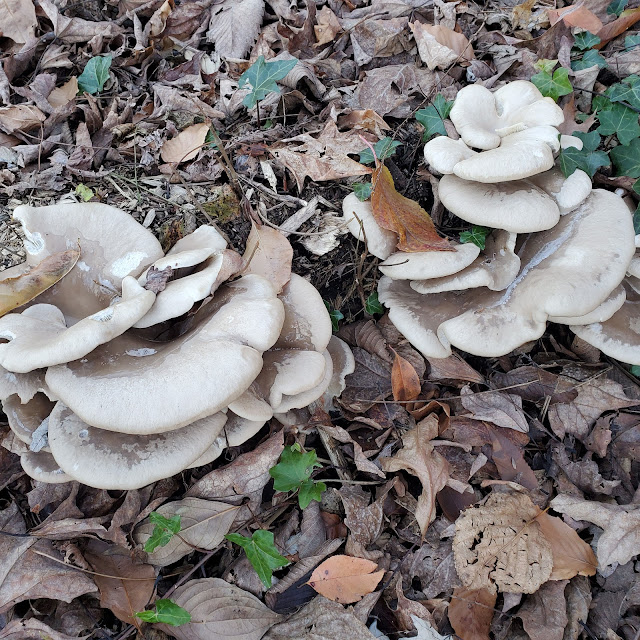
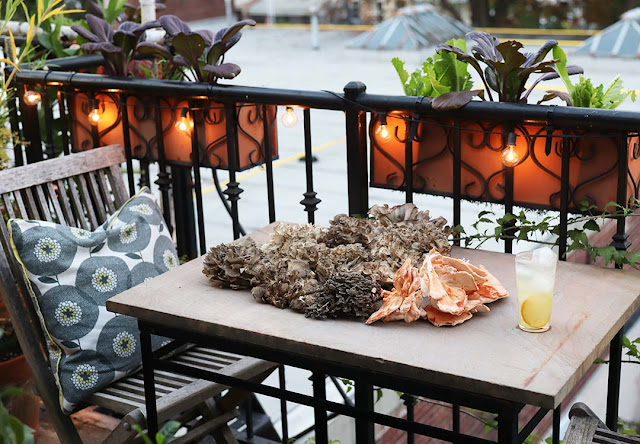
It was a remarkably good month for mushrooms. October always means hen of the woods (Grifola frondosa, and often referred to as maitake, the Japanese name for them), and it reached a point where I would just have to ignore them and walk past. I had enough. They are one of the easiest edible mushrooms to identify and a lot of fun to spot, fruiting at the base of hardwoods like oak (especially) and beech, and even cherry and sycamore. The specimens above (the brown frilly ones) were quite young and very tender - they can grow huge. We ate some freshly cooked, but most of them were frozen (after cooking) for later deployment in mushroom rolls, mushrooms pies, tarts, and probably some mushroom treats I haven't yet thought of. 

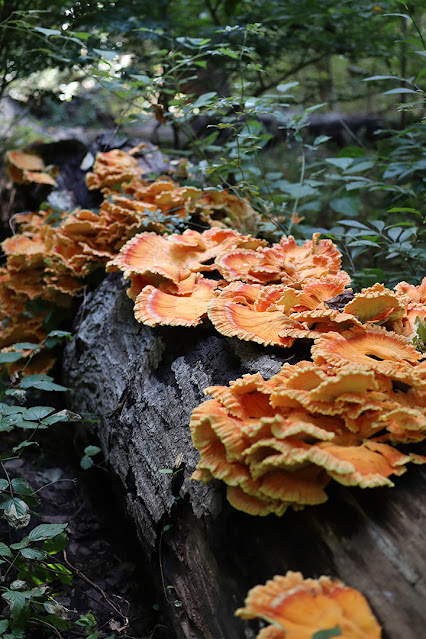
The other easy edible mushroom is right beside the hens. And it's a...chicken! Bright orange chicken of the woods (Laetiporous sulfureus) is exciting to find because it can be prolific (see previous post for an example). It has much, much less mushroom-flavor than hen of the woods, and can be quite dry, unless it is very young. But it is a very useful filler, and I think we ate this one in a dish of delicious dirty rice.

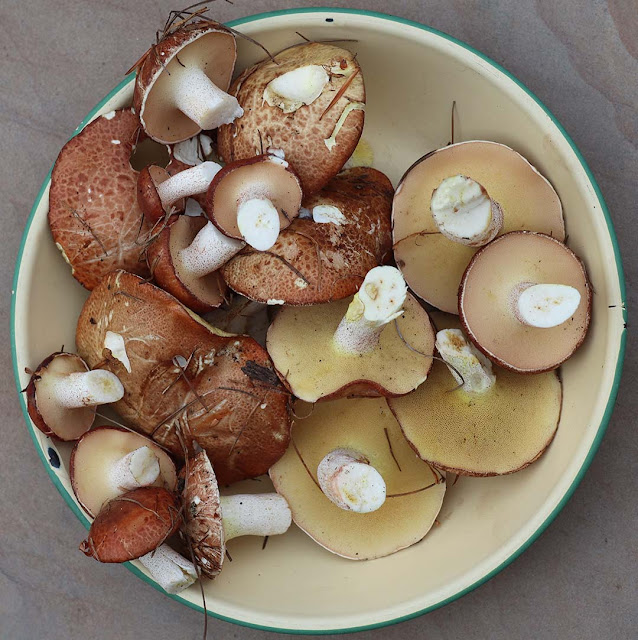
And boletes, as the capped mushrooms with spongy tubes - instead of gills - are known collectively. I was pleased to find a trove after teaching an edible plants class at the New York Botanic Garden. I generally peel off the sponge and then slice the caps very thinly. These were sauteéd to top toast.


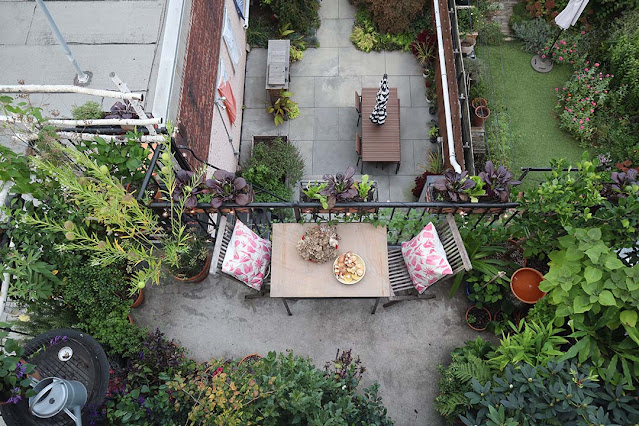
Late October was lush on the little terrace, with the prickly ash already beginning to turn yellow, the  sesame leaf (Perilla) almost four feet tall (beside the birdbath), cold-loving brassicas already in the windowboxes, the myoga ginger making is aromatic little edible buds, the citrus trees catching their last outdoor breaths before temperatures dipped too low, and the balloon milkweed filled with its late-season, prickly balloons.  

The gardens downstairs are now brown and empty. On the frozen terrace the milkweed has been cut back, the sesame leaf plants are dead sticks. The citrus trees are basking in southern sunlight (but indoors), and the myoga has just woken too early from a two-month dormancy, under my drawing-desk (I shouldn't have watered it).

_________________

My Books

Monday, January 17, 2022

The wild and the tamed and the diverting

From the photo files, where I am making progress, in terms of sorting, some tidbits:

Last October, in a shoreline forest on Long Island, we found a very wonderful chicken of the woods log. We took home plenty and some of it is still stashed (after cooking) in the freezer for picnics to come. The mushroom works very well in portable hand pies.


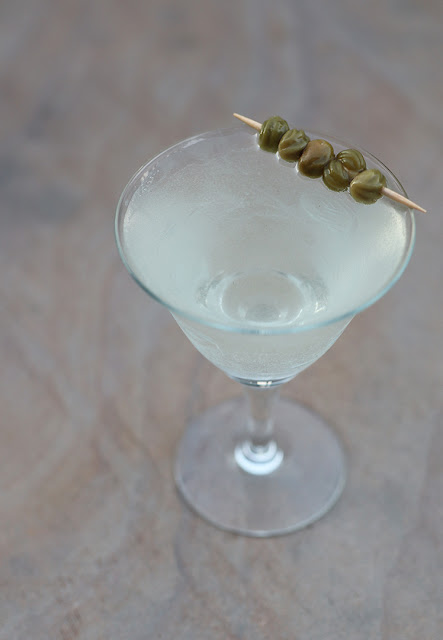
These nasturtium capers were from green seeds I collected in my mom's Cape Town garden in February 2020. I lacto-fermented them with 2% of their weight in salt for about 20 days, then pickled them in a vinegar-brine. Here, they were nibbled on the October 2021 terrace, atop a petite Martini. They are rather good. (And I brought back a new batch, a couple of weeks ago; nasturtiums grow like weeds in that Mediterranean climate.)


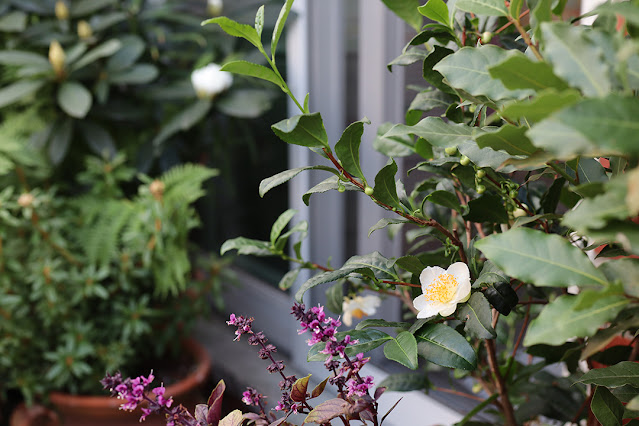
Last year I bought two tea plants. I clicked a mousepad, and a few days later they were at the door. They are Camellia sinensis, and they bloom in autumn. Their buds began to open in October and the small, anemone-like flowers are lovely, lasting about two days. The little shrubs kept blooming right into winter. On the cold branches in January there are still buds, and the leaves look dark and healthy. I collected many new green shoots which I dried, and at some point - soon - I must grind them to make my very own green tea, or matcha powder. I have no idea if I like green tea. I shall find out. 

The plant in the background, lower left, is another sort of tea if you like common names: labrador tea, a species of Rhododendron. It should bloom in April, if all is well. 

And you never know. All may be well. And if it isn't, we'll make another plan.
____________________

I'm also here, @66squarefeet

Monday, March 15, 2021

Not-quite-spring snacks


For a recent forage walk on a colder-than-forecast afternoon I made some canapés to accompany small glasses of chilled PandemicVermouth, infused and blended in April 2020. 

On the right are buttery salmon and field garlic (Allium vineale) tarts, with a savory custard filling. To serve them I added more slivers of salmon and extra, snipped field garlic. In the rear? Fir sugar shortbread cookies. Bottom left are toasted rounds of field garlic cheese bread. 


I topped those toasted rounds with garlic mustard (Alliaria petiolata) pesto and pickled chanterelles, from an epic mushroom hunt in the woods upstate two summers ago. The chanterelles - incredibly - still have that magical apricot aroma that traveled back with us that day.


And there were eggs, not quite deviled. Cooked in boiling water for eight minutes before being peeled and covered in miso, overnight (chilled). The miso flavors them but also draws out some moisture, so the texture becomes firmer. Onto their yolks I dripped some powerful, bright green ramp leaf oil, Aleppo pepper, and the peppery leaves of bittercress (Cardamine hirsuta), a maligned but exquisitely pretty edible green in the Brassica family - like tiny watercress. 

Socially distanced walks and picnics are a challenge but everyone is well-trained, by now, and very considerate. (At least, the people who sign up, are!) There will be more, and it feels good to be creating wild food treats, again.

________

Tuesday, November 3, 2020

Blewit feast

In the last wet weeks I have been lucky to find huge fairy rings of blewit mushrooms. Their wide circles in the grass are quite perfect. 

These beautiful and edible mushrooms are violet when young and slowly turn cream as they widen and grow. 


Many of their caps are cinched by a root of grass. 

They have come up in response to weeks of foggy nights and days, and a lot of rain. They are very good to eat.

My basket overflows fast.

After spore printing every mushroom overnight (their spore pints are a very pale creamy-pink), I cook. 


And the first thing to make is mushrooms-on-toast. Good bread, good butter, salt.


So that even when the world is falling apart, lunch seems certain.

________________

Saturday, October 10, 2020

October in New York

Seaside Solidago sempervirens, on a quiet afternoon with dunes and waves and birds.

This solidago (a.k.a. goldenrod) is late to bloom, and even here at the beach, honey bees found it.

Nearby were autumn olive trees (very invasive Elaeagnus umbellata), heavy with fruit. I love eating them straight up. They are reminiscent of red currants, slightly sweeter, but more tannic.

And October is always hen month: hen of the woods, maitake (Japanese for "dancing mushroom"- because of the happy dance it inspires). Grifola frondosa is a wonderful mushroom for beginners to find, because it is so distinctive. And if you find a nice fresh one, it can weigh upwards of five pounds, easily, so there is ample opportunity to experiment in the kitchen. Some of my standard ways to deploy it include red wine soup (lots of sautéed mushroom, onion, some good bacon, a little flour, lots of red wine, bay leaves), and mushroom shepherd's pie. I think this one may become sausageless rolls, as in mushroom rolls.


These mushrooms grow on living trees, which are they slowly but surely killing. I chanced upon this one on a tree that gave me hens almost ten years ago. 

So mark the spot - they will appear again.

______________

Forage, Harvest, Feast - A Wild-Inspired Cuisine

Tuesday, August 18, 2020

Lockdown lunch


Once a week I cook something that the Frenchman and I can share, sitting at the kitchen counter (which is where I write) in the middle of our work days.

And for as long as he has to work from home, we call it lockdown. How the seasons have changed. Pre-spring is late summer. And here we are.

I seem fated to discover the best mushrooms only when I have left the house in sweats and running shoes, bound for exercise only - a nearby hill in Prospect Park, where I run up, and down, up and down. Basketless, bagless, knifeless, as a forager I am unarmed. It's happened twice in the last eight days. (Last week it was chanterelles, incredibly. In Brooklyn!). 


Yesterday's discovery was a beautiful chicken of the woods, growing on a street oak, and still at the first, elusive and moist nubbin stage, before its chubby curves have fanned out into impressively huge but dry shelves. On my way back from the hill, I scooped it up and carried it home.

Today it became part of the topping for our weekly lunch: steamed eggs. Just eggs and cream (although sometimes milk, and sometimes hot water, depending on the texture I want), poured into bowls and steamed for 7 minutes. Very smooth, and purposefully bland. The seasoning today was all in the topping. Some of the mushroom, slowly caramelized in the juices of an overripe heirloom tomato, a dash of strong, dark tamari, and a final slivering of a soy-pickled shiso leaf from the terrace. 

Eaten in two minutes. 

_____________


Monday, July 22, 2019

Stuffed Tomatoes with Chanterelles and Black Currants


The Frenchman and I have enjoyed some very good chanterelle hunting, this hot summer. The glee of filling all your boxes and bags with the golden mushrooms is thrilling. It really is like a treasure hunt. And you can't help gloating about the fact that they are selling for $44.99 a pound at Union Market in Brooklyn.


After a happy hunt you are faced with the task of sorting and cleaning, and deciding how to eat them. There are worse dilemmas. I had a lot of fun devising new recipes for them. I cook instinctively, taking notes as I work. If we like what I make, the recipe is made again and again as I test it. The stuffed tomato recipe below is a keeper (I am addicted to stuffed summer tomatoes and could make a different version every night of the week).


Apart from the mushrooms we ate fresh, I pickled many, and quick-cooked and froze a stash, for later.

Chanterelles are more scented than they are flavorful. Fresh and raw their aroma is a lot like cooked apricots. But I like their texture, very much: it is substantial and meaty.


Stuffed Tomatoes with Chanterelles and Black Currants:

Makes 8 medium tomatoes

Here, aromatic chanterelles are complimented by tart and complex black currants.

This method also works very well with very young and tender chicken of the woods. If you do not have wild mushrooms, substitute chopped shiitakes or button mushrooms. Completely different flavor and texture, but not bad at all. And for a lower carb or keto version, omit the rice and bump up the walnuts.

Eat hot, at room temperature, or cold in the middle of the night.

8 oz chanterelles
8 medium tomatoes
2 tablespoons butter
1/4 cup basmati rice
4 oz bacon, chopped
6 large scallions finely sliced (1.5 packed cups)
1/4 cup black currants (optional - substitute fresh sour cherries, or 2 tablespoons black currant jam)
1/4 cup (.8 oz) walnuts, chopped very finely
¼ cup finely chopped dill
2 sprigs thyme
1/2 cup red wine
3 tablespoons olive oil
2 teaspoons Aleppo pepper

To clean the mushrooms: trim off any dry or bruised pieces. If they are dirty, soak for 20 minutes in a large, salted bowl of water. Drain and dry the mushrooms (or repeat the wash if there was a lot of debris in the water). Cut larger mushrooms into halves or quarters.

Cut the tops or bottoms off the tomatoes and scoop out their insides, using a spoon. Discard any hard core at the stem end. Reserve the cut-off lids and ½
cup of the flesh and juice (save the rest for gazpacho, tomato sauce, or Bloody Mary’s). Chop any large pieces finely. Arrange the hollow tomatoes in a skillet or baking dish and salt their naked insides.

In a small pot melt the butter over medium heat and toast the basmati in it for a couple of minutes. Add ¼ cup of water. Bring to a boil, lower to a faint simmer and cook for 5 minutes (it will not be fully cooked). Meanwhile, in a skillet, cook the bacon pieces over medium heat until the fat runs. Add half the the scallions and stir. Increase the heat to medium high and add the chanterelles. Cook for 5 minutes, stirring. Add the reserved tomato pulp and juice, currants (or sour cherries), nuts, rice, half the dill, and the thyme, and stir well. Add half the wine. Taste, and season with salt.

Stuff this mixture into the tomatoes and drizzle the olive oil over and between them. Top the tomatoes with the reserved tomato lids. Distribute the rest of the scallions and any leftover filling between the tomatoes. Sprinkle lightly with salt. Transfer to the hot oven and bake for 1¼ hours or until the tomatoes are beginning to caramelize and the bottom of the pan is syrupy. Halfway through cooking, add the rest of wine, and add splashes of water if the pan juices begin to stick.

Before serving, sprinkle with the Aleppo pepper.


Sunday, March 31, 2019

From the woods


Why do I forage? It's an unanswerable question. But I am as curious now about wild things as I was when I was a very small girl. Walking in the woods, or anywhere else, really, is an adventure. A never-ending Easter egg hunt. On a hill in a city park I might suddenly find wood ear mushrooms where two weeks before there was just a big, dry log. Species of Auricularia, wood ears (also called cloud ear fungus) are prized in Asian cuisines and sold dried by the bagful. Their texture is tender, like soft velvet covered with a thin film of cool, human skin. Yes, very strange.


While they are usually used dried and reconstituted, I find their fresh, cooked texture to be very appealing.


The early spring things that accompany them: field garlic, baby ground elder (invasive bishop's weed), lesser celandine (I dislike the leaves' slightly acrid flavor but use them for garnishes), and some horseradish-hot garlic mustard roots.


And then comes the recipe creation. This one-pot chicken, field garlic and cream stew with rustic potatoes was mouthwateringly good. The mushrooms became sponges, their soft black collars plumping up like oysters to absorb the sauce. They combine that oyster slipperiness with a crunch.


Field garlic (the invasive Allium vineale) is like an assertive chive, and I have been using the leaves a lot over the last week-plus. The soup above, veiled by a melting dollop of whipped cream is lamb, red wine and field garlic; the pesto on the cracker is garlic mustard. Both were leftovers from a forage-picnic in Inwood. I have not cooked with cream for a long time but I bought some for that picnic's chocolate spicebush roulade and had to use up the rest. I had forgotten how good it is.


And the faithful field garlic and cheese bread. It's one of the first snacks I ever made for my forage walks, and I think it is delicious. It is a baking powder bread so needs to be eaten within a day of baking to be best, but it does make outstanding toast. The recipe is in Forage Harvest Feast, and works just as well with normal chives or even thinly snipped scallion greens.

The next walk is on April 6th in Central Park's North Woods. What will the picnic be? Come and see...

_____________

Saturday, October 24, 2015

Who's your honey?


I knew I had spotted something interesting in the upstate woods, but I also knew that it would be a few days - and perhaps never - before I tasted these perfect little mushrooms.


They were young, and in pristine condition. I collected most of them by slicing the stalks, but kept this entire cluster for identification purpose. All parts of a mushroom are needed for an accurate ID.


Above: In mushroom identification, recording and observing the caps as well the gills is important. So is knowing that there is a veil, or partial veil attaching cap to stalk.

Accurate identification involves a series of important steps, and every detail counts. And you always make a spore print. Each is like a finger print for a species.

People who dismiss eating wild mushrooms as dangerous tend to think that it is a case of Russian Roulette. Maybe the next one will get you. But there is a protocol to follow, and if observed minutely, you will lead a long and well-fed life.

** I guess I have to say it: if you have never collected mushrooms before, don't start with the gilled ones. Aim for pored mushrooms. They are easier. People who cut corners can get into serious trouble with gills. **


Once I had done my reading at home, submitted my photos to several mushroom groups, made my spore print (WHITE - if it is a rusty colour you may have collected a deadly Galerina, or a big laughing gym, Gymnopilus junonius, which will make you sick) and consulted with members of the New York Mycological Society, I was ready: I had a species of Armillaria - all are edible, and are collectively known as honey mushrooms. The species itself was probably gallica, based on the bulbous stem, but several species are apparently so hard to tell apart that it requires microscopic analysis.

So that took 24 hours.

I cooked and ate six tiny ones, on the off chance that I had an allergic reaction (it can happen with mushrooms). I didn't.


36 hours after collecting them, I dived in. 

Mushrooms on toast. These honey mushrooms are firm and a little nutty, and do not lose moisture in the way that store-bought button mushrooms (Agaricus) do.


Mushrooms with crisp pancetta, a poached egg and mugwort-infused butter.


And the rest - along with regular button mushrooms - on a tart, with a dandelion base. 


I used the olive oil pastry recipe in my book (page 111) and adapted that lambs quarter tart recipe to use dandelions. The mushrooms I sauteed  each in their own pan, till cooked, topped the cooked greens with the cooked mushrooms, and poured over the cream and egg yolk mixture from that recipe.

The Frenchman hummed.

____________________