Sunday, January 17, 2016

Matjiesfontein - may we go back?


There are several South African Matjiesfonteins, if you start Googling. This is the one that belongs to Papkuilsfontein guesthouse and farm, near Nieuwoudtville.


We slept here for two nights in September, which is South Africa's spring. 

 Photo: the Frenchman

Matjiesfontein's wide white walls enclosed the sort of space I could live in, forever. Or, you know, till I die. Whichever comes first. But this was borrowed time - for most of the year, Mariette and Willem van Wyk, the owners of Papkuilsfontein, live here. Willem restored the homestead's structure and moving parts, and Mariette brought it to life, inside.

Thick walls, deep windowsills, cold, solid floors (with heating pads under the rugs - a brilliant invention), books - good ones, a rosemary hedge humming with bees, and birds: brilliant bishop birds visiting the nearby spring, a resident coot, paddling in the deep puddle we had to cross in the car to get to the house, a malachite sunbird, a pair of swallows rebuilding their mud nest in the eaves of the nearby rondawel.


(Read more story about the house itself - which dates back to the seventeenth century - in my story for Gardenista).

We were happy. Very happy.


During the day, we drove through fields of flowers on the farm Papkuilsfontein, some kilometers further up a dirt road. After good rains, the flowers appear in this region - known as the Hantam - like snow in technicolour. The window is narrow - the weeks from mid August to early September are prime flower time.


It was towards the middle of the second week of September and already the show was past its best - so said people of the region.

I had no complaints. Would you?

One woman did. I was buying some home-baked and -bottled goodies at Lekkerbek, a wooden shack on the the main drag through town one day, when an Englishwoman's voice  complained to the owner, "I am just so TIRED of yellow flowers! It's all you have! Where are the blue flowers?"

I cringed. Flower tourists.


I mean, yes, there was a lot of yellow.


Is that a bad thing? Above Bulbinella latifolia, en masse.


Nemesia cheiranthus


Cotula.


The air here smelled like honey.


A shrubby species of Hermannia, near our house.


A very aromatic false buchu - Diosma acmaephylla. Yes, I cooked with it, two nights later (in a completely different landscape). Needles so sharp they drew blood.


In the land of geophytes, a glorious gladiolus, above. In our trip, we had driven as far north as Kamieskroon, 500km from Cape Town, and then towards the coast, where succulents and daisies rule. Now, south of there, 350km from Cape Town, but suddenly high on this escarpment, we were in the most bulb-rich spot on earth.

On. Earth. 

I'm telling you: put this on your To Do list.

Because for anyone paying attention, there is plenty of blue, too!


Felicia australis, above.

But somehow color is immaterial, yielding to form, diversity, and mindblowing variety.


The blue above is flax.


Lapeirousia...


A field of Ixia rapunculoides, right in town, outside the church. "Tired of yellow." Pfff. Her eyes were closed.


A ghostly Moraea, above.


Above - a thorny shrub I have not identified.


Garden-friendly internationally - Anchusa capensis in its homeland.


And Lachenalias growing lushly in a damp patch on the road out of town.


Another Lachenalia, growing on the very dry edge of the Oorlogskloof ('war canyon'), below:


We found many solitary flowers while we hiked in the dry Renosterveld on the edge of this canyon, a sudden and stunning feature in the landscape, and one that had drawn me to Papkuilsfontein in the first place. 


Another Moraea, above. While I have piles of excellent regional books, time has been short and so not all ID's are offered, yet. 


An orchid above, Holothrix aspera - growing from crumbling rock. Each flower smaller than a pinkie-nail.


A species of Crassula in its own lichen garden. Lichen is an indicator of clean air.


Vygies.


The pools below are what you see just above the slim waterfall, above.


Here, Mariette told me, the water never dries up completely, not even in the very hot summers. These pools are the kuils of Papkuilsfontein.


Waterblommeties were in bloom, and looking at them made me hungry for the Cape bredie that they flavor.

Change of subject: 


Is this leopard poo, about 12 inches long? Because I suddenly grew eyes in the back of head and began staring at the rocks very carefully.

Ok, fine; back to flowers.


Towards town, we drove on the deeply rutted back roads (each telling silent stories about stuck cars in the rainy season). And beside standing rainwater, we found these beautiful Wurmbea stricta, above.


And in the nearby Hantam National Botanical Garden - once Neil MacGregor's beloved farm, Glen Lyon, which I visited in 2006 with my mom - once-seen, never forgotten Sparaxis elegans, above - like an Art Deco hallucination.


Along with Moraeas like flocks of butterflies.


And evidence of porcupine activity. Their digging is considered an important part of the local geophyte cycle of life. We saw one, one night, sailing ahead of us in the carlights,  his black and white needles erect and swaying, pausing often to dig and eat and grunt, turning his back and bristling when Vincent got out of the car to take his picture.


There are other seasons, of course. Green winter, while it is raining (and hopefully it is raining). April, when, a few weeks after the first autumn rain, the Brunsvigia bloom: giant pink candelabras. Very hard to pin down, but if you hit it, you are very lucky. Summer, when it will be very peaceful, and the nights will glitter beneath the Milky Way.

Matjiesfontein itself is only available in spring, but there are three beautiful, aloof stone cottages on Papkuilsfontein (they were fully booked while we were there) where you can self cater, or order dinner to be delivered to your stoop. They looked wonderful.

It is a special part of the world.

Go. 

Tuesday, January 12, 2016

The small things


There is a shop on Wolfe Street in Cape Town that I love: L'Orangerie. The last time I was there I spied a vintage rhino watercolour print, applied to a placemat. There was an elephant, a hippopotamus. I wanted them. But I needed six. A sales assistant found three more animals for me at another branch, nearby. But by the time we had had all our other gifts wrapped a phone call came in saying that a woman in the other shop had snapped up all MY animals. Gr!

But 18 hours later, Jess, the sales assistant, called to say that she secured more animals from the person who makes the beautiful mats, and the Frenchman went to pick them up for me on the day we left town. Now I have the springbokkies above, a sable antelope and a kudu, too. I love them.

The proudly displayed shampoo is the haul I just brought back from Whole Foods. I can't find it anywhere else in the hood, so I stocked up. Giovanni. It's nice.

Glass, one of six given to me many years ago by my friend Bevan. In it? Cider.

Coaster, silver and glass  - from a local junk shop.

There endeth the post about Objects as Pleasure.

Friday, January 8, 2016

Where to stay near Cape Town


In frozen-solid January (in New York) it is good to think about faraway places. 

What are my favourite things? Food, flowers, foraging, fruit, a Frenchman.

Shake that all up and you get an idyllic 18 hour stopover.

In September, at the end of our wildflower trip up South Africa's West Coast, we cruised back towards Cape Town by way of Babylonstoren, less than an hour from the city. While I have visited on day-trips many times - for lunch, for garden stories - I had never spent the night, before, and we were thrilled to be Babylonstoren's guests for our last stage on the road. 


The transition from the preceeding two days in a remote and very basic semi-desert cottage without electricity to intense luxury in the winelands was an experience that left us both with the best sort of whiplash. It was rough, but we handled it.


The kitchen gardens at Babylonstoren typically combine indigenous South African plants like spekboom ("bacon tree") - Portulacaria afra, bottom right, and succulent waterblommetjies (Aponogeton distachyos, in the pools), with deeply familiar western plants like southern French lavender.


In spring the lettuces were popping.


And the orchards were blossoming. While the central kitchen gardens inside whitewashed walls are planted with plenty of espaliered quince, plum, nectarine, citrus, and more, the larger farm beyond contains big orchards, and while we were there every citrus tree was in bloom, with a perfume that I last smelled on the Mediterranean in southern Turkey. It was like being in a scent-movie.


And when the day visitors left, the overnight guests had the run of the place. 


The grounds are large, and beautiful and we walked, and walked. The clivia show had just begun.

There was no one else to be seen...


(...but some chickens.)


Leaving our cottage was hard enough. Within half an hour of arriving, and our early exploration of the estate-bottled and chilled Viognier waiting for us, a waiter was at the door with smoked trout canapes. Our feet were up, the fire was roaring, and we smiled.

The old Cape Dutch buildings have been renovated to within a glossy inch of their lives, with polished floors, heated towel rails, huge baths, scented posies of herbs, thick towel and robes, silky linen, and baskets of freshly picked fruit.


And a fully equipped - and very sexy - kitchen, with the farm's tea, olive oil and wine on tap. And that roaring fire (with pine cones!). 

New York could go to hell, for all we cared.


Books. An exquisite collection of books.


We were invited to pick what we wanted, where we wanted, but I still felt like a child raiding the neighbor's fruit trees.


The lemons went back to Cape Town with us, as gifts.


Breakfast in the conservatory yielded my favorite fruit, good coffee, farm eggs and invitations to enjoy spa treatments, mountain bike rides and wine tastings.

But we were Cape Town-bound. If we could have stayed I think I would have buried myself in a book and walked in the garden some more, perhaps picking salad for a self catered supper near the fire.

So we shopped for a bit, quickly.


And bagged some more oranges.


We drove away with the windows rolled down, sniffing the last of the citrus blossom.

If you have the time and the opportunity, and you are in the cold North, head south (the exchange rate is very much on your side, right now, you will get very good value for money). Spend a few nights at Babylonstoren. This is the kind of hospitality that needs to sink into your bones. There is so much to do and see on the farm, and in the immediate vicinity that you owe yourself the luxury of coming home to that cottage, in those gardens, every night. 

There endeth my lesson. 


Thursday, January 7, 2016

Ice bath


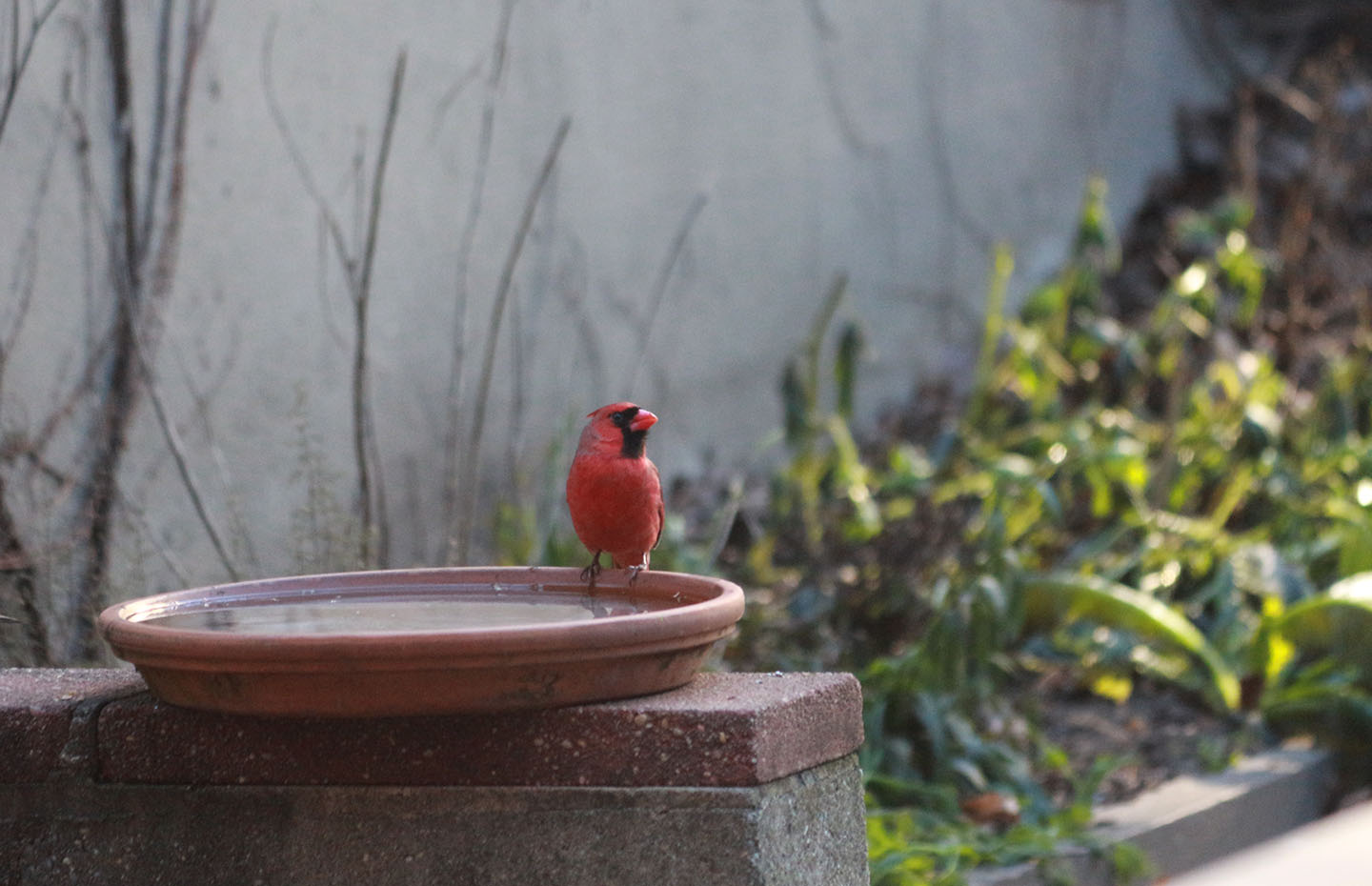
Problem. Frozen birdbath every day.

The birds come and look, and fly away again.


So I go out with hot water and pour it in, and it smokes as it melts the ice.

Then the birds come back and drink, and bathe.


After half an hour it begins to freeze again, so the squirrel drinks from a hole.


Then I pour on some more hot water.


And so it goes.


Are those sunflowers seeds, over there?

Wednesday, January 6, 2016

A walk as winter arrives


On Sunday, we walked to Red Hook as the first cold air of winter blew in.

These beautiful lambs quarters were growing in a tree pit on a quayside street where litter rolled in the icy breeze.  They are the result of the very mild start to winter, with record highs recorded, but also of the late rain we received in late November and December. Last summer, when downpours should have been tropical, was very dry, and shrubs and perennials in gardens and woods drooped. Then came the rain, and we had a small, strange spring in autumn, and then in winter.


Queen Anne's lace, or wild carrot. In January.


We found a friendly street cat, who was not a crook, and who rolled and rolled in greeting. He had food and shelter. He must be colder, now - yesterday it dropped to 15'F/-8'C and the wind was bitter.


The Queen Mary was in town. 


We had planned to picnic on a pier over the water, above, but the wind blew us right back, shivering, and we inched closer to Fairway's bulk and the windbreak it offered.


From our concrete perch we watched the traffic.


And wolfed our brioche and crisp bacon sandwiches, fishing vegetables from their vinaigrette with our fingers.


And then we walked home, fast. Passing this cherry tree in bloom on Van Brunt Street. Looking at the flowers closely I think it is Prunus subhirtella, which tends to bloom in autumn and spring, so it's not as satisfyingly freaky as it looks.

It froze hard in the last two nights. The soil in the garden looks like chronically unmoisturized skin - humped and pale and rough, and the lush arugula, mustard and fava beans are gorgeous no more. The birdbath is frozen and in the morning I pour boiling water into - the birds come at once, as it steams, and so do the squirrels.

So winter is here, at last.

Despite that cherry tree.


Saturday, January 2, 2016

Winter's strawberries


The Alpine strawberries. In winter. I doubt they will ripen, but this is a sign of the winter we are not having.

It did turn colder on January 1st, and on our Frigid Forage in Central Park snowflakes fell just as we stopped for our picnic, on a hilly spot. The hot mushroom soup seemed welcome. We toasted the new foraging year with hard apple cider and spicebush cordial cocktails - tentatively named Hair of the Alpaca, by a foraging friend who is familiar with my wish for a pet alpaca to carry my snackpack.

The next forage walk I will lead will really be in the teeth of winter: 20 February, for the Brooklyn Bridge Park Conservancy. Tickets are just $5 as the walk is underwritten by the Conservancy. Info here:
                                                     
                                                     _____________________________