
Outdoors. Why does it all taste better under an open sky?
Open sky. Not as open as it once was. But we can pretend. The chimney swifts hunting their in-flight dinners above us convince us everything might be as it should be.
______________
Open sky. Not as open as it once was. But we can pretend. The chimney swifts hunting their in-flight dinners above us convince us everything might be as it should be.
______________


This New Year's Eve we treated ourselves to Champagne and a supper of smoked salmon on toast, with asparagus and a fennel slaw, followed by squashed, roasted potatoes topped with crème frâiche and salmon roe. The little jars of roe were $13. The next roe up, American sturgeon, was $80. After that Osetra sparkled at $180.
Salmon it was. And very delicious.


And now, in light snow, and sub-freezing temperatures, we walk to see the fireworks at Grand Army Plaza. Squirrels, raccoons, possums, birds, cats, and dogs, cover your ears. Poor things. When will we ever learn?
See you on the other side.


When local greenmarkets spill over with produce it's hard not to be vegetarian. Corn is ritually peeled of its outer husks, the tender silk removed (it's very good to eat in a coconut milk soup), and then the inner husks folded back carefully over the kernels so that they are not burned by the fire that cooks them.
We ate this corn with basil butter (heaps of basil whizzed in a food processor with as much or as little butter as you like), and an anchovy butter. So...not quite vegetarian. A quick cabbage slaw, and broccolini dressed with ramp leaf salt and a Palestinian olive oil made by Al'Ard.
Late bees still buzzed the hyssop and African basil while we ate.


It wobbles, it jiggles, it's straight out of the beginning of the middle of the last century. It's wonderful. It's tuna mousse. Wrong, somehow. But wonderful. And inhalable. I revive the recipe every year when heat threatens and I won't cook indoors. We are in for a possibly unprecedented week.
We - the Frenchman and I - used to eat it on our rooftop in Cobble Hill, accompanied by Don Estorbo (de la Bodega Dominicana - a bodega cat before bodega cats were cool), with a wide view over New York Harbor. In those days we had a single, room airconditioner, whose roaring was no match for the baking heat. The rooftop was our evening escape.
Tuna...is overfished. Try and find pole-caught tuna: American Tuna, Wild Planet, or Whole Foods 365 brand are better choices. Walk past the Starkist. You are better than Starkist.
The beauty of this decadent, 60's-suggestive mousse is that it goes with all the crunchy, healthy things: celery stalks, crisp cucumber spears, carrot sticks, endive leaves, snap peas (halved lengthwise), long breakfast radishes or round, stout ones, quartered.
Tuna Mixture:
For the tuna mixture: Combine the ingredients and whizz in a food processor till smooth. No food processor? Chop the capers and cornichons finely, then mash everything with a fork in a mixing bowl bowl.
Wobble mixture: In a small bowl, combine the gelatin and the extremely hot water and stir until the gelatin has dissolved.
Add the gelatin mixture to the tuna mixture and whizz/mash again.
Taste. Assess the salt, pepper and lemon juice situation. Adjust.
Transfer the tuna mousse mixture into a small bowl or mold. Chill for at least 2 hours. To unmold, slide a knife dipped in hot water around its edges, cover with the serving plate, and shake until it plops out.
It wobbles. See?
Of course, you can also eat it with a good baguette, or dark brown Scandi bread. Or crackers. Or a spoon. Or on your own, with no one else watching.

Here's a bonus picture of Storbie, aka Estorbo loco, aka The Don.
Gone, never forgotten. Eeep.

Cool, grey, misty mid-June days and evenings have sent us back indoors for supper.
Tonight's was a salmon oven-roast that we've fallen in love with and repeated many times. I first started cooking it in Maine, where we had access to superb - if farmed - Gulf of Maine salmon, and it has translated well to Brooklyn (with salmon farmed in the Faroe Islands; eating fish is...tricky, to say the least).
The recipe is based on this one: spicy slow-roasted salmon, from The New York Times. I riff a lot with the spices, and often use berbere (the fragrant East African spice blend). And tonight's version included three tender, sliceable heads of spring garlic.


So where and how did I convert? This country. Living with a food-loving Mexican for four years may have had something to do with it. New York City, and it's plethora of Southeast Asian eateries. And simply being on the continent in proximity to so many forms of fresh and dried chiles had significant powers of persuasion.
I like heat, now. A lot. But there's heat and there's heat. For my recent experiments making shatta, a gently fermented and staple chile condiment eaten in Palestine (and other Eastern Mediterranean countries), I learned that long red cayenne peppers make a fantastic shatta—sweetly hot and mellow. But that compact Scotch bonnet peppers (I know, what was I thinking?) blew the house down.


My shatta recipe is up on Gardenista.
________________

Seeing red. Well, deep orange? Amber? A rufous hue? This is the perfect stage, not in a renewed presidency, not in the world, but in the short, truncated life of a tulip. Full blown.
Supper began with snacks of olives that I salt-cured, given to me by the friend who came over last night to eat them. She grew them, just a few blocks west of us. Then, a couple of salads, drenched in a bright dressing of Thai lime juice (from the happier of our two trees) with fish sauce and some sugar: crisp endive, thin rounds of watermelon radish, a shaved heart of mustard, and tiny, vinegar-soused cucumbers. And another of peeled and naked pomelo sections, topped with fried shallots. After that, the duck legs, simmered forever in shoyu with many bay leaves (our tree, yay), on a starchy foundation of lacy lotus roots. With a side plate of chilled spinach stems, with shoyu and ginger and crisp sesame seeds. Followed by durian ice cream, just-churned, and cherimoya granita.
Life in the big, evil city, where dozens of cultures collide daily and (mostly) get along.
Cherimoyas (custard apples) are in season for another couple of months, in California. I highly recommend treating yourself to a box, if you live within shipping reach of Rincon Tropics (a small business with a real, live human owner) whose fruit is wonderful and whose shredded paper packaging makes unpacking it a treasure hunt.
My granita recipe is at Gardenista.
That's all I've got. But we're all going to have to do better than gape, as each new violence unfolds. It is beyond anyone's experience, but catch up we must. If you don't already belong to the American Civil Liberties Union, there has never been a more insistent need to join.
___________________

Wait, what, summer?
Tidying up photographs, cleaning one of the two memory sticks I use in my Canon, I find myself drawn into meals eaten, seasons lived, flowers in bloom. This was June 2021. Yup - I have a lot of tidying to do. The terrace, and what is clearly a warm weather supper. The Frenchman's T-shirted arm pouring cold Sauvignon blanc. Salad - a deconstructed salade Niçoise. Grated carrot? I know. I take liberties (it was soused in lemon juice, with some chile flakes added - try it).


Leaves are drifting down. The grass and sidewalks underfoot are a-crunch, crunch crunch. And the most generous of mushrooms is in season, loaded with flavor.

One of my favorite autumn recipes is up on Gardenista - a maitake and farro pilaff. It's really delicious.
_______________
November Walks and Forage-Picnics




Evening time. After leading a friendly pack of 15 people on a plant walk on the 4th of July - none of us feeling celebratory - and feeding them a tasting picnic (what's a tasting picnic? A picnic where you have a taste of everything, of course), I came home, washed up, and thought about supper. I like thinking about supper. The Frenchman rolled some paper balls for me (we use paper shopping bags as fire lighters; never, ever the smelly liquid) and carried out the charcoal (hardwood, not briquettes), and I lit the fire.
Then I picked some flowers for the table.


And the Oscar goes to: the liatris. Plus, nobody got slapped. These plants (they grow from corms) slept quietly all through winter in galvanized bucket (with drainage holes punched into the base), and are now around three feet tall. I lost several lily bulbs to the old freeze-thaw cycle, but the liatris seem immune. Bees love them.

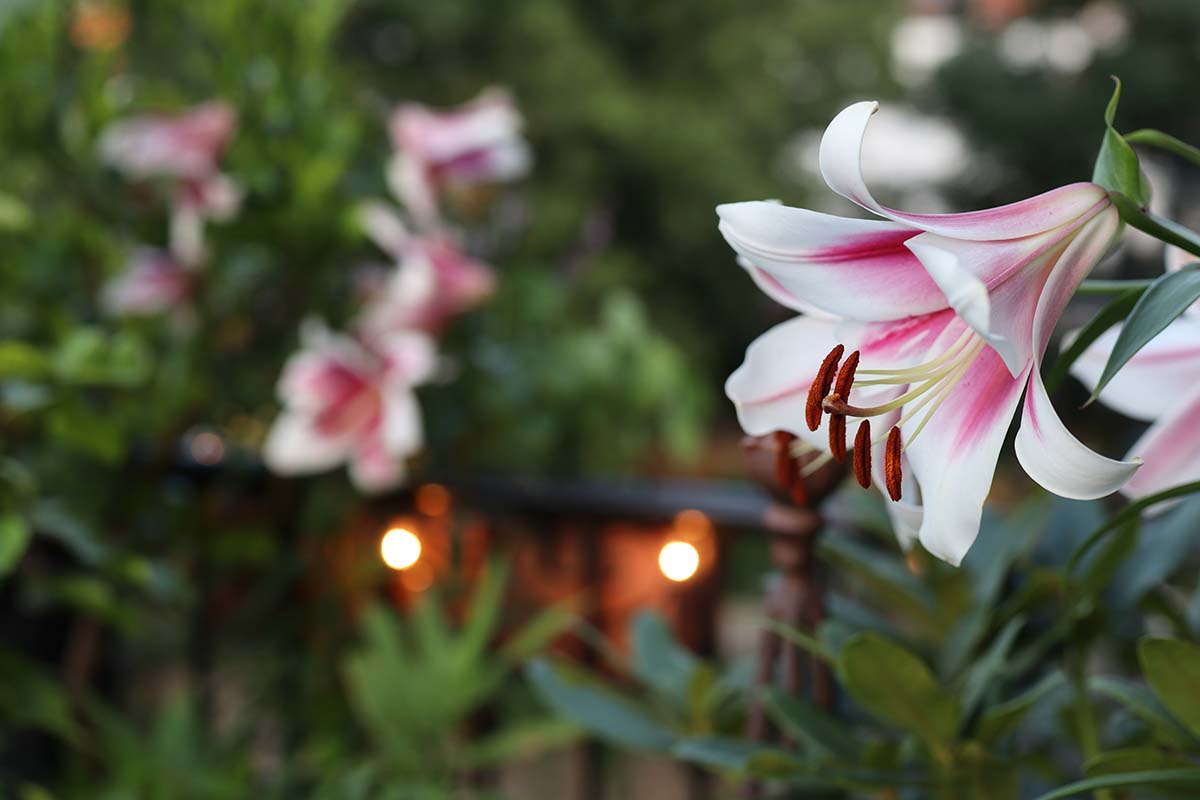
While fireworks crackled on the street and local rockets burst nearby, and giant dragonflies patrolled the sky, occasionally zooming past at ear level, the first 'Silk Road' lily opened, unafraid of the bright competition. As the evening darkened the lily's perfume grew stronger. By the time the thunderworks of the Macy's display had started, way north on the East River, out of sight but not sound, the terrace was drenched in scent.
_____________

For me, much of the appeal of traveling - even a small distance - is to meet the plants that grow in the other place. (I can't imagine what it is like not to see plants, and perhaps people who don't, or can't, lead more focused lives?) And if some of those plants are edible, it is an intense pleasure to use them in the kitchen. It's an immersion in place and season. (Also, I just like to eat.)
So in coastal Maine bayberry (Morella pensylvanica) has featured frequently. Last night's dinner was a shepherd's pie, made partly to use up leftover meaty pieces that I'd braaied when a friend came over for supper (hi, Friend!), and partly to amuse the Frenchman, who adores the rustic dish. This time I added a lot of young bayberry leaves, still at that tender, chewable stage. And topped the ragú with stamped potatoes (because our cottage has no masher or potato ricer, so stamp, stamp, stamp).

Fir and spruce tips are still new and soft up here (as opposed to down there in New York) and so there is a batch of very fragrant fir salt drying on the wide table in the wide room with the endless, wide windows. Air-drying keeps the flavor better than oven-drying.


The longer infusions (in vodka) were forest-heavy: fir, spruce, hemlock (Tsuga, not Conium), as well as bayberry and a syrup of baby spruce cones (the pink glass). Into the wine they go, according to taste, and now it is bottled. Downeast Vermouth.

And yes, I bought eggs, too.
_____________
Find me on Instagram

Saturday supper. In cold weather we eat at the kitchen counter. So, all winter. And last night it was covered substantially in the loot we had gathered in a giddy half-day of shopping at the Union Square greenmarket and Eataly (downtown). Inbetween food-buying stops we walked up and down the Arctic length of the winter High Line. The sky was blue, the sun shone, and we felt like visitors in our own city.

My guiltiest pleasure was a potful of New Zealand cockles. I love them. Just some garlic, finely chopped in butter, an overly-generous dash (meaning about one-third of a cup) of dry vermouth, cooked till boiling, and then the shellfish, steamed until open.
After those we moved on to a smoked trout pâté (made by whipping flaked trout with cream cheese and Meyer lemon juice), unapologetic, oil-cured anchovies, smoked oysters (part of our early pandemic stash), green Italian olives marinated for an hour with blood orange zest in good olive oil, nine-minute eggs topped with bottarga, cucumbers washed in tulip poplar honey (a summer find at the greenmarket) and white wine vinegar and...a couple of rich slices of wild smoked salmon, each.
The radishes were crunched as palate cleansers.

There is the out-of-focus Frenchman with an in-focus potful of cockles. With last week's tulips, our much-delayed bottle of New Year's Eve Champagne, and hot sourdough toast under the red napkin.
It is snowing, now.
And January has come to an end. We thought it never would.
_______________
