Wednesday, April 30, 2025
Feral Goddess Dressing
Tuesday, February 8, 2022
Of abundance
Time capsule. Brooklyn chestnut blossom on our windowsill in May, 2021.
Have you ever tasted chestnut honey? It is dark, and slightly bitter, and smells of springtime in a small German town, then only recently released from the East, where Goethe built his theatre, and where I sang, disguised in heavy make-up, false eyelashes, and bespoke costumes. That was long ago.
But the smell of chestnut honey (more than the blossoms, strangely) whips me instantly to the park in the town where the trees in bloom soared like green cathedrals.
From the forage kitchen, too, last May. How different the season, and how encouraging. A bowl of pokeweed shoots, waiting to be blanched (the pokeweed chapter of Forage, Harvest, Feast explains this in detail, along with lots of recipes, including one for Kentucky Egg Rolls - you'll just have to read it). Pine cone jam and green fir cones, to the right beside the laptop. Some of the cones were pickled some are still buried in miso and must be tested. And who else tapes over the camera on their computer when not in use? I know I'm not slone.
The books on the counter? Let's see: Koji Alchemy, by Rich Shih and Jeremy Umansky, The Complete Bocuse by Paul Bocuse, America - The CookBook, by Gabrielle Langholtz (I contributed the wild recipes), and Larousse Gastronomique, a grand and dated but wonderful reference. Half the stack was for reference and half was for a video meeting (I perch my laptop on them). In the days when culinary residencies were beckoning, only to be tanked by COVID.
In the background there is a damp paper towel draped to dry over the Frenchman's Nespresso machine. Paper towels are one of weaknesses. But I recycle them.
May is a a busy time. Recipes. Notes to be taken. Constant exploration.
Tuesday confessions complete.
_______________
Monday, January 17, 2022
The wild and the tamed and the diverting
From the photo files, where I am making progress, in terms of sorting, some tidbits:
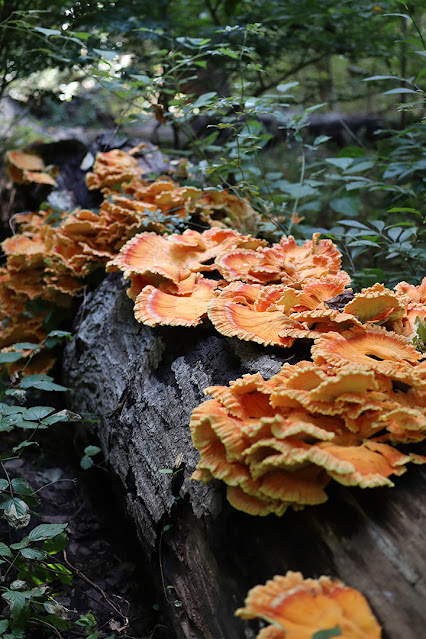
Last October, in a shoreline forest on Long Island, we found a very wonderful chicken of the woods log. We took home plenty and some of it is still stashed (after cooking) in the freezer for picnics to come. The mushroom works very well in portable hand pies.
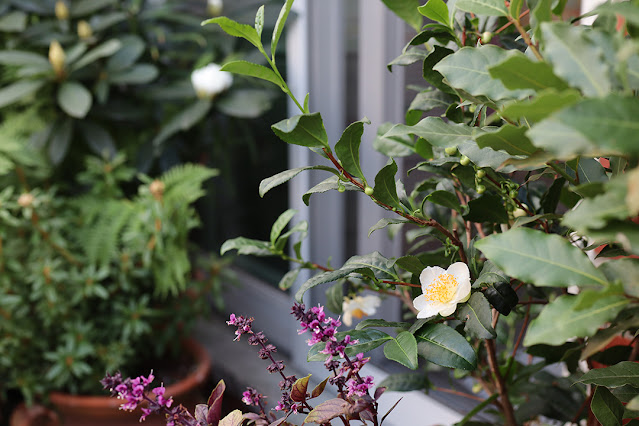
Last year I bought two tea plants. I clicked a mousepad, and a few days later they were at the door. They are Camellia sinensis, and they bloom in autumn. Their buds began to open in October and the small, anemone-like flowers are lovely, lasting about two days. The little shrubs kept blooming right into winter. On the cold branches in January there are still buds, and the leaves look dark and healthy. I collected many new green shoots which I dried, and at some point - soon - I must grind them to make my very own green tea, or matcha powder. I have no idea if I like green tea. I shall find out.
Tuesday, October 5, 2021
Black nightshade vs deadly nightshade
"But isn't it deadly?"
Noooooo. Deadly nightshade is another plant. And it looks different.
Edible black nightshade fruit occurs in clusters (above). And you almost always see clusters of ripe as well as green fruit on the plant at the same time. The fruits have a matt appearance - no shine. And here is the real tell: the calyces of black nightshade (the green bits like lapels or a collar between stem and fruit) are smaller than the fruit.
The green, unripe fruit of black nightshade are considered toxic, so avoid those (the same way you would avoid a green potato). As Ben-Erik van Wyk writes in his encyclopedic Food Plants of the World, "Care should be taken to only pick ripe berries, because the unripe (green) fruits may contain toxic levels of alkaloids (6 - 8 berries may kill a child)."
Incidentally, deadly nightshade is not very widespread in the US - it occurs mostly on the West Coast, but that will inevitably change (since first publishing this post it has crept to the East Coast).
Sunday, April 11, 2021
An early, edible spring
Early spring on the stone table.
Field garlic, some dandelion rosettes, dandelion flowers (their petals destined for tartlets for a forage picnic); ground ivy (Glechoma hedera) in the tiny dish at the back - it is quite minty in flavor and is very beautiful in lawns; no idea why people spray it.
And early violets, henbit (Lamium amplexicaule), and chickweed. I'm working more with chickweeds this season: Their fresh flavor is like cornsilk.
The little blue vase of yellow flowers holds coltsfoot - Tussilago farfara, a sub-alpine perennial from Europe and Asia that is now quite at home on this continent, where it invades disturbed ground and roadsides.
_______
Sunday, March 28, 2021
Spring, in increments
Walking on a well traveled woodland path in Prospect Park I stopped abruptly. Diminutive bloodroot (Sanguinaria canadensis), the most exquisite little spring ephemeral, has emerged. The afternoon was overcast and the flowers were closed and well-wrapped in their leaf cloaks. I wished them well, so close to dog paws and people feet.
They have many companions - the gazillion germinating seedlings of last year's biennial garlic mustard (Alliaria petiolata) flowers.
The damp leaf litter of winter is also green with garlic mustard that will bloom this May. Looking at the plants, I planned a forage walk around the cunning invaders from Europe. They are edible, after all, and rather delicious. If you like garlic. And mustard.
The spicebush (Lindera benzoin) is beginning to bloom.
And so are these. But what are they? Elm?
On sunny slopes henbit (Lamium amplexicaule) is beginning to get overexcited.
And in damper, shadier areas, purple dead nettle (Lamium purpureum) is flowering. I'm wondering how, or if, it hybridises, because these leaves look a little different.
The magnolias have just woken up. Their petals taste like minted ginger.
Monday, March 15, 2021
Not-quite-spring snacks
For a recent forage walk on a colder-than-forecast afternoon I made some canapés to accompany small glasses of chilled PandemicVermouth, infused and blended in April 2020.
On the right are buttery salmon and field garlic (Allium vineale) tarts, with a savory custard filling. To serve them I added more slivers of salmon and extra, snipped field garlic. In the rear? Fir sugar shortbread cookies. Bottom left are toasted rounds of field garlic cheese bread.
Wednesday, October 28, 2020
Kahili ginger - botanical mugger in disguise
Late fireworks on the terrace. This beautiful flowering ginger-cousin is a species of Hedychium, and was a very kind and unexpected gift earlier this year from a garden design client, who knew how excited I was to hear that his ginger relative had actually bloomed.
When the giant plant was delivered to our door in early September, beautifully wrapped in burlap, I hefted it up and out to the terrace and then did some reading.
Don't judge a plant by its spectacular cover. Hedychiums, native to Asia, are known collectively as flowering gingers. They are apparently popular in the nursery trade. (I had no idea.) Bought and planted by loving plant owners the gingers have escaped, and this has led their becoming some of the most invasive plants on the planet. In mild parts of the world where they are not native they take over. Even in Cape Town I have seen a similar ginger clogging a stream near my mother's house. In Hawaii Kahili ginger - as this species (H. gardenerianum) is known, there - has a price on its head. In Florida it is running rampant.
In New York's cold winter climate it doesn't stand much chance of becoming a thug, of course. If left out doors it would succumb. But in Hawaii my friend Sunny Savage is devising ways of dealing with the habitat-altering invasive creatively: by eating it. (You can download her Savage Kitchen app to learn more.)
We will talk more about native and invasive edible plants this Saturday, October 31st, at the New York Botanical Garden; and there are now some tickets available! Click on the date links to book. My second fall class was shifted from Thursday because of predicted torrential rain, and not every student could make the rain date. (Apologies if you are one of them.)
__________
Sunday, September 20, 2020
Breezy Point - Backroads and Beyond
Conservation should be at the forefront of any administration's funding. Instead, it is a distant afterthought.
Saturday, July 18, 2020
Summer's wildness
Some high summer forages, in season when the air turns sticky:
Spicebush (Lindera benzoin) - fragrant like orange peel and a little like fresh black pepper (in aroma, not taste). The leaves, twigs and fruit are all useful and flavorful and I deploy them in different ways (see that chapter in Forage, Harvest, Feast). Thus is a wonderful eastern North American native shrub-slash-small-tree for you to grow at home, too.
Wineberries (Rubus phoenicolasius) - an invasive wild raspberry originally from Asia and imported to serve as a rootstock for domestic cultivars. Easily identified in any season by its very furry and prickly canes.
Below the fruit, native wild mountain mint (Pycnanthemum tenuifolium) and an escaped wild pineapple mint. The mountain mint is a wonderful perennial for a sunny garden and pollinators love it. The leaves are intensely, well...pepperminty.
And to the right, the misunderstood and underappreciated native American burnweed. Erechtites hieraciifolius. It is very pungent, slightly bitter, and I love it. The chapter on it in Forage, Harvest, Feast explains much more, but I equate it with cilantro, in terms of love-it or hate-it. This is the time of year when I make a charred chicken stew (the chicken is first fire-seared), a wild riff on a Kenyan classic, that also features spicebush, sumac, coconut milk, and peanut butter! It's incredible. My mouth is watering as I type (it's on page 23 of the book).
Forage on.
Friday, May 1, 2020
April's end
In a tearing, rain-flurried wind I went for a walk in nearby Green-Wood Cemetery on the last day of April. They have opened all their side gates - usually firmly locked - to allow people easier access to the calming space of hills and green hollows. Led by George Washington, civilian troops suffered a major loss here against the English in the Revolutionary War. He retreated to Manhattan.
We haven't seen Manhattan in months.
The side gate nearest us is just a couple of blocks away and this has given me an unprecedented appreciation of the park-like grounds. I knew them well, but now I see changes in micro-seasonal increments. And it has been a long, cool spring.
And these peonies were so fragrant I could smell them right through my mask.
I have a new and improved mask: My friend Kirstin kindly gifted us two that she had sewn expertly. We have been trading. Her husband David gave us a very generous tip about morels. We searched and found them. Or, the Frenchman did. So many that we split them with David. He fetched them and we got masks in return. All at a suitable, face-covered remove from one another. He is the first friend I have seen in six weeks.
And at lawnlevel ground ivy (Glechoma hedera) is gorgeous. It is usually unwanted but I wish people would recognize its beauty and stop spraying it. It makes lawns lovely. It's the ultimate steppable groundcover.
And you can eat it, too. Crush the leaves and add them to drinks and green herb sauces: they are intensely minty. or make ice cubes filled with the flowers.
Tuesday, March 24, 2020
Edible Weeds - Garlic Mustard and Sauce Alone
Here we are in our second week of COVID-19 lockdown. The only reason we go out is to exercise. Or forage! (Read essential state guidelines regarding safe and reponsible living here.)
For anyone longing to get out of the house for a solitary, socially distanced treasure-hunt, garlic mustard (Alliaria petiolata) is one of the earliest edible spring edibles to appear on still-brown forest floors and along their sunlit edges. These delicious greens are very tempting: the leafy vegetable tastes like a very mild broccoli rabe after blanching, and is peppery and garlicky when raw. It costs nothing, is versatile in the kitchen, and collecting it immerses us in nature at a time when the changing season seems like the only normal thing in our lives.
So what is this edible weed? Garlic mustard is highly invasive in the States -place it at the top of your invasivore spring menu. It is prolific where it grows wild - so your conscience can remain clear when uprooting it. It is a biennial plant, meaning it lives for two years. What we see in spring are its two forms: the leafy, second-year rosettes that germinated from seeds last spring, and a mass of newly-emerged seedlings (dispersed last summer), like a green carpet growing on the still-brown forest floor. Here in the Northeast, both forms appear around early March.
When the weather is still frosty at night the leaves on the rosettes are small, dark blue-green, and quite tough. But as the days lengthen garlic mustard becomes fatter and taller and the emerging leaves become bright emerald and tender.
Under the ground is a hidden treat, if you are willing to scrub and trim it at home: the contorted fat roots are as hot as horse radish (see Forage, Harvest, Feast - A Wild-Inspired Cuisine for that relish).
By mid-spring garlic mustard is bushy and lush. Its tender flower stalks in April are perhaps the best part of all, juicy and snappable when young, and resembling broccoli florets in miniature.
The flowers are of course edible, too. Pretty, peppery treats.
Those flowers are a hidden menace, Stateside, because they are the precursor to the plants setting seeds. Thousands and thousands of seed. Once dispersed they lie in wait for a year to emerge as that edible mat of microgreens – wonderful for foragers but terrible for biodiversity. This invasive plant is a thug that crowds out native flora. Harvesting this edible weed is an act of environmental kindness. Collect and preserve poundsful at a time with impunity.
One of the most evocative English common names given to garlic mustard is sauce alone. While I have made and eaten dozens of dishes featuring this plant (it hogs its own chapter in Forage, Harvest, Feast), I had never really thought about that. Until now. Perhaps COVID-19 made me re-focus on the basics – we need simple things. And we feel we must provide for ourselves.
So this vibrant bowlful is my idea of what ravenous hedgerow mice would cook for their spring dinner. If mice cooked. I think they’d like it with a cheesy sauce, so I have included that in the method, too.
The basic, cooked greens (above) are good enough to eat as a delicious side, a topping for pizzas, or filling for savory tarts and phyllo. The substantial Spring Green Purée that follows is a perfect bed for eggs. Or swirled into dashi or a miso broth. Or a stew of chickpeas or beans (you have those, right!?). Make it the basis of a minestrone with farro or pasta and canned tomatoes.
Sauce Alone uses just 1 cup of that purée. The rest I cool then freeze in a ziplock bag, pressed flat - very stackable and space-saving in the freezer (what, you don't have pine pollen in your freezer? Go out and get some! Ripening now).
At the cheese-sauce stage, top it with poached eggs, or add it to mashed potatoes and cauliflower for comforting bowlfuls.
For my allium elements (leeks, field garlic) – substitute any onion you have around: onion-onions, shallot, wild garlic, chives, ramp leaves, or scallions.
Sauce Alone - Serves 4
Spring Green Purée
3 tablespoons butter (or oil if you go vegan for the basic purée)
Leaves from 2 large leeks (about 4 cups), well washed and roughly chopped
2 ¼ lbs* garlic mustard leaves and stalks (about 10 – 12 plants), washed
¼ cup finely snipped field garlic
Salt
*The cooked yield should be 10 oz, squeezed dry
Basic Cheese Sauce
This is a thick sauce, for a runnier version add another ¼ cup milk.
2 tablespoons butter
2 tablespoons flour
1 cup milk
2/3 cup grated cheddar (or whatever)
Salt
Pepper
For the Purée: In a pot warm the 3 tablespoons of butter or oil over medium-low heat. Add the chopped leek tops. Cover, and cook gently until the leeks are very soft – about 15 minutes (stir occasionally).
While the leeks are cooking, bring a large pot of water to a boil over high heat. Add the garlic mustard. Cover, and when the water boils again cook uncovered for 2 minutes, pushing the green mass down every now and then. Drain the boiling water and refresh the greens in a bowl of cold water. Squeeze it as dry as possible. Then, using your fingers, tease the compressed greens apart to loosen the mass.
Increase the leek pot's heat to medium and add the field garlic and blanched garlic mustard. Stir well and season to taste with salt. Cook for a couple of minutes.
Transfer the cooked greens to a food processor and whizz until very smooth. This (above) is now the thick, hearty purée base for a hundred digressions.
For the Cheese Sauce: Melt the butter in a saucepan over medium heat. Stir in the flour until thoroughly blended. Allow this roux to bubble - without browning - for a minute. Slowly drizzle in the milk, stirring very well as the mixture suddenly seizes up and thickens. Once all the milk is incorporated cook the milky mixture, stirring, until it thickens evenly. Add the cheese and stir until it has melted. Taste, and season with salt and pepper. Now stir in 1.5 cups of the reserved Green Purée. Warm through.