Showing posts with label Hikes. Show all posts

Wednesday, October 5, 2022

North

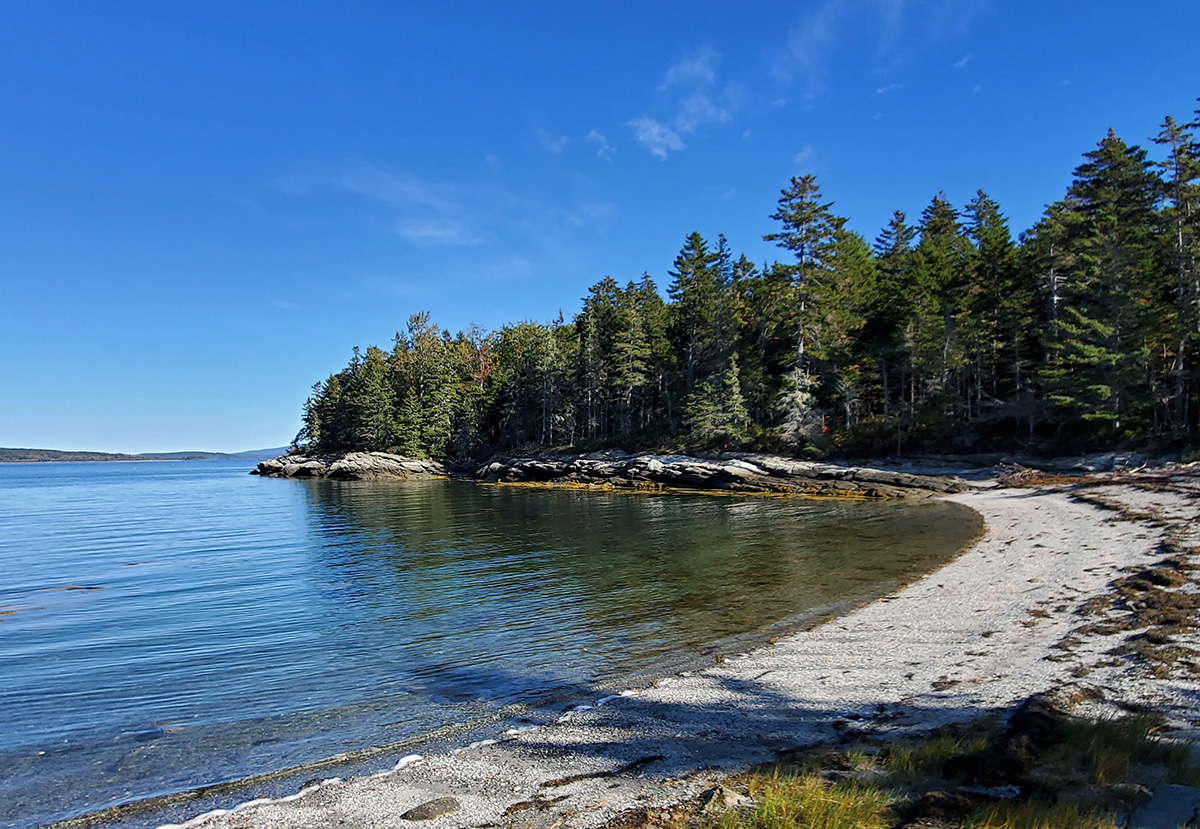
We arrived for a short break in Maine just in time for blue weather and sunshine.

The woods crowding right down to the water still awe me. 

Sitting beside the clear water, hearing the small sounds as the tide moves massively and delicately in and out, is beyond price. A seal surfaces, breathing. An animal swims across the smooth inlet - at first we think it is an otter. But when it walks onto the island nearby it is clearly marten-like. It is a mink. And not in coat-form. Just doing its private mink-things, where it belongs. Later, in the woods, we see two porcupines in a maple tree, talking to one another

I don't know how to value these experiences. Watching the Frenchman, who has been working seven days a week for a long time, is like watching fresh life being pushed straight into his veins.

European sea rocket (Cakile maritima) grows on these pebbled shorelines. In New York we have the native America species, C. edentula. Both have horeseradish-strong leaves and young pods.

Under the trees, on springy soil rich with layers of fir and hemlock needles, we walk along small trails and pause often to look. At ferns, at bark, at mushrooms, at red squirrels.

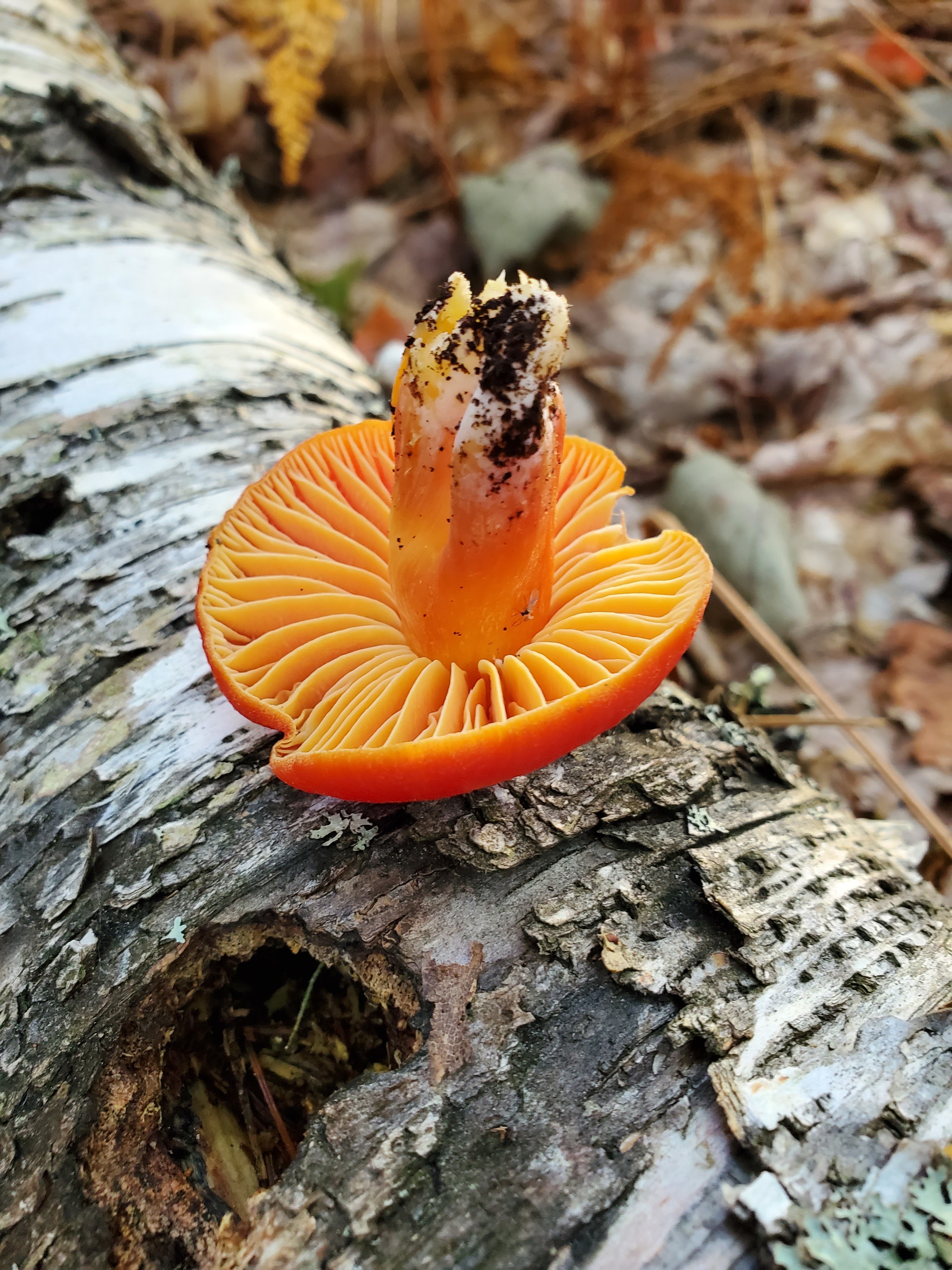
Honey mushrooms, is my first thought. But the essential (if you're thinking about dinner or want accurate identification) spore print I take is tan. Honeys have white spores. They turn out to be a species of Pholiota, also edible. The other possibility is a species of Gallerina, which is exceptionally toxic. Mushrooming is always humbling. We didn't eat them.

And a vivid Hygrocybe. 


More mushroom challenges. I still don't know what these are. They grow flush with the deep quilts of moss that cover the duff under needled evergreens. Their caps are solid, dense, and dimpled downwards, so that each is concave at its center. I collected a flock to make spore prints (white) but still have a clutch of possibilities and no real idea.  Possibly a species of Lactarius (milky cap), although the solid texture suggests Tricholoma. I know: Talking to myself. 

But it's all so interesting.

____________________

@66squarefeet

Saturday, January 8, 2022

Up, and down again


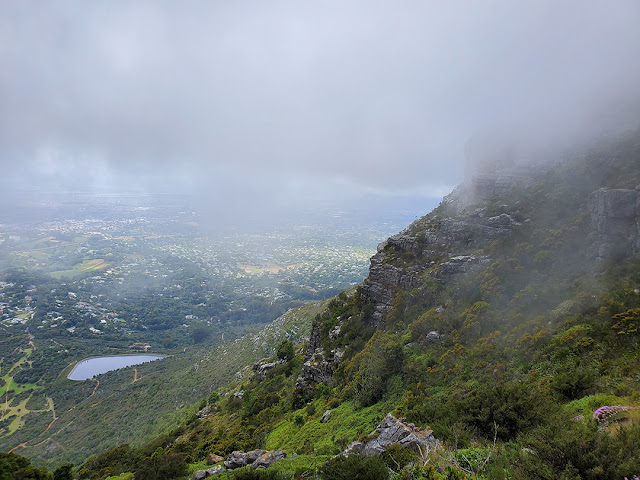
A recent hike up Table Mountain with three friends was like a tonic. We met at 8am, and then began to walk. 

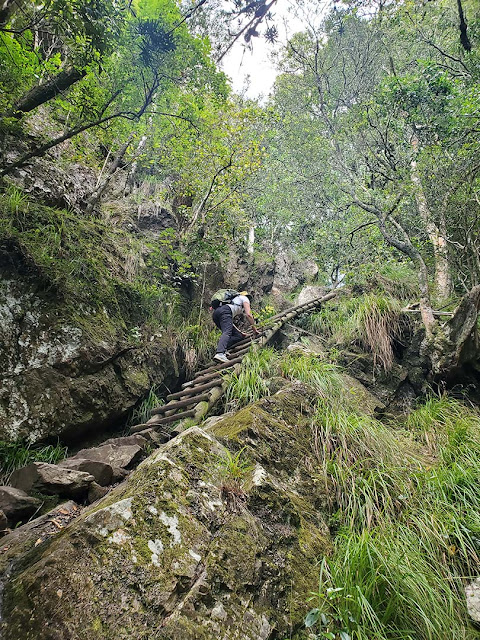
There are dozens of ways to climb up, and we chose Skeleton Gorge, on the cool western flank of the mountain, where you endure (endless) log and rock steps before climbing up (much more amusing) ladders and then scramble up boulders in the steep bed of a stream.


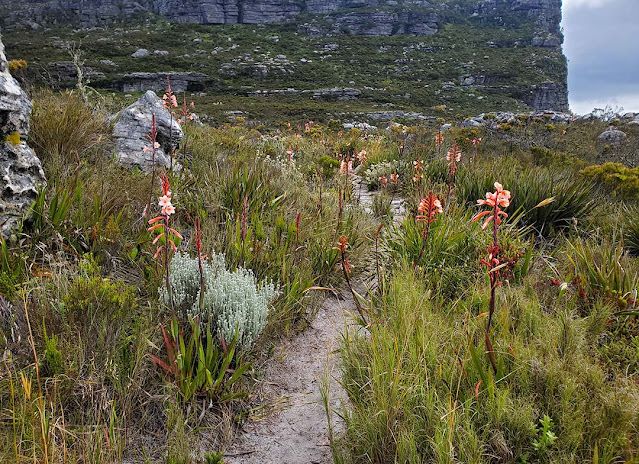
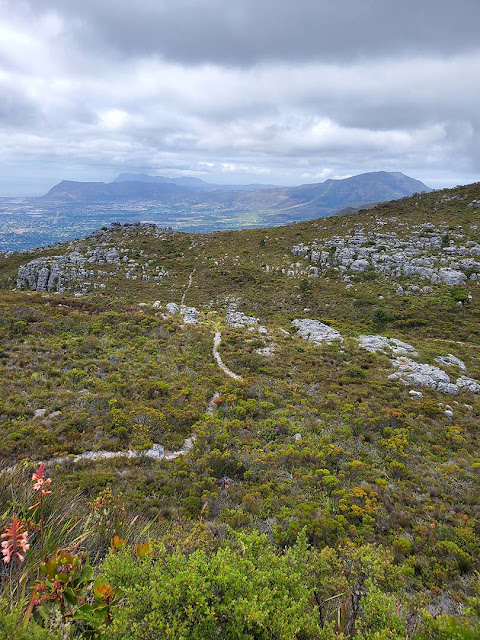
I love this route because it flattens for a spell, along the Smuts Track, above, and then allows you to choose to swing west along the Aqueduct, where disas, an endemic orchid, flower in summer. Watsonias dot the fynbos. Grassbirds and sugarbirds and sunbirds sing.


That's the Smuts Track in retrospect.

Photo: Marian Oliver

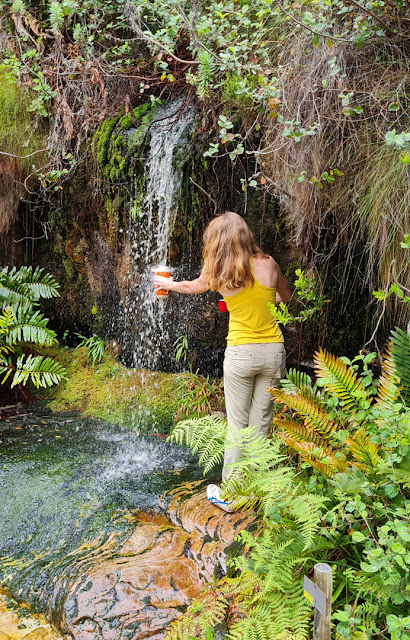
And the waterfall that never stops pouring pure, tea-colored mountain water. A good place to stop for a drink. 


Beautiful little drip disas (Disa longicornu) grow in the wet moss on the rock walls.


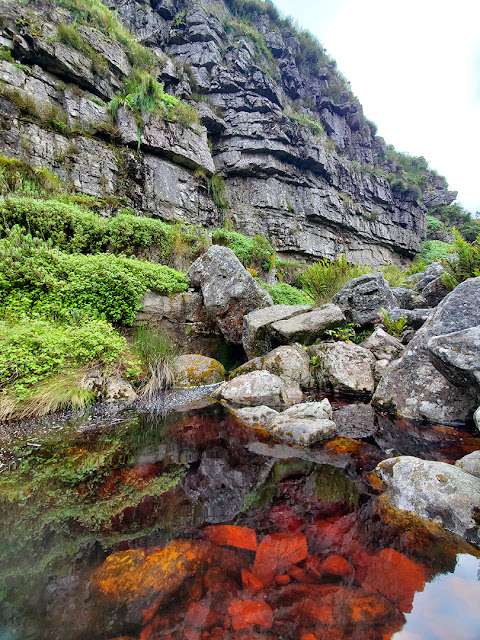
And after a downhill track you are in the kloof of the Disa River. We dipped, skinnily. It was freezing and wonderful.


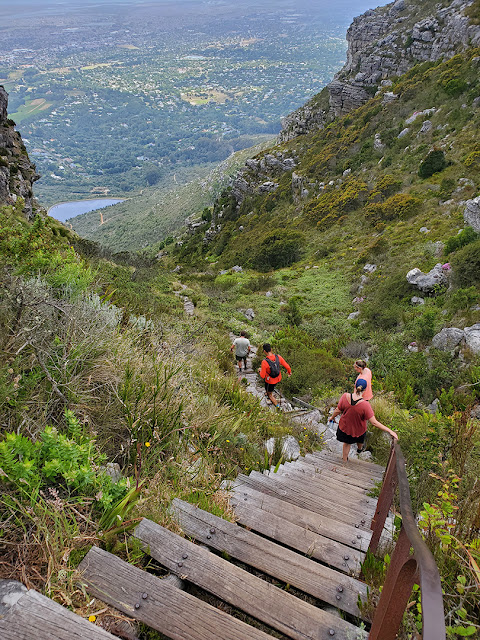
And eventually it was down again, to the waiting world. This group of Belgian trail runners trotted past us at the top of Nursery Ravine. 


Clouds rose as we descended and the lower slopes were cloaked in a misty rain as we ended our walk in the early afternoon.

Next stop, Brooklyn.

__________

Find me on Instagram @66squarefeet

Monday, May 31, 2021

Cottage in the mist

Within a week of leaving this cottage in Maine last September I had booked another week, for this spring. We had no idea what the travel situation would be, whether we'd be vaccinated, or what the world would look like. But we knew we wanted to come back.

We have walked in wet woods and found glorious wildflowers. I have never seen lady's slipper orchids in their natural habitat, before. 

And bluebead lilies covering the mossy forest floor.

I had been spotting carpets of bunchberries from the car as we drove north, and on our first hike they kept us company all the way. The tiniest of dogwoods.


The cottage has a natural hedge separating it from the dramatically rising and falling tide. In it grow bayberry, blueberry and native black cherry. The bayberry is at that deliciously tender stage where it quickly perfumes a drink. 

So that is what it did. 

 
__________

Tuesday, February 23, 2021

Tropical winter

Tropical fruit basket

I've been traveling. In the last couple of snowy months, I have visited the tropics. Twice. To get there, I traverse Siberia. Sort of.

At the end of a two mile hike straight across Prospect Park, I reach Grenada. On my way there my basket is empty. Heading back, boots squeaking in the freeze underfoot, it is brimming with fruit from the Caribbean. I need huskies.

Canistel fruit

It began in December, with a thoughtful gift of grenadillas and an unfamiliar canistel (Pouteria campechiana - above) from my friend Hannah Goldberg. She bought them at Labay Market, a West Indian grocery store in Brooklyn's Prospect-Lefferts neighborhood, on the east side of Prospect Park. Hannah is a regular, often in search of good things for her catering company Tanabel Table.

So I had to go. After a quick look at Google Maps walking made the most sense, because snowdrift parking is not much fun in this city. And a four mile hike is decent exercise (cardio-with-a-reward).

Snow in the park

I went this way.

Snow in the woods

And down there.

Roselle or hibiscus

And landed up here.

The corner store is lined with bins that spill produce flown in from the Dominican Republic and Grenada. And so I met sour, fresh roselle for the first time. It has numerous common names and may be best known simply as hibiscus; it is not the flower, but the calyx of a hibiscus species that actually resembles okra, in terms of its blooms. Its botanical name doesn't mess about: Hibiscus sabdariffa var. sabdariffa race ruber. I made a fermented syrup from them and they candied as they fermented. 

Green coconuts

Not plantains, or bananas. But you can have as many green coconuts as you like chopped open for you on the sidewalk.

The owner, McDonald Romain (who goes by Big Mac) presides inside behind a slipping facemask and a clear-ish MacGyvered COVID screen between his cash register and his customers. He takes his time to chat with each person as they pay, over the thumping sounds of loud Christian music (his Facebook page explains that he is "covered in the blood from head to toe"). And he grills me about what I plan to do with his produce, giving instruction, when necessary.

Once you squeeze past the counter (it's not a large store, and I am double-masked indoors, these days) you reach a jumbled motherlode of seasonally changing fruits and vegetables that are rare-to-non-existent in supermarkets: squat bananas, unripe, fat plantain, grenadillas, mamey apple, breadfruit, soursop, real Key limes, sour and sweet fresh tamarind, and, most recently, black sapote. In an open refrigerator are bags of frozen, peeled sugar cane, and elegant bundles of fresh taro leaves. Shelves are lined with West Indian delicacies and staples like canned callaloo, sacks of brown sugar, bags of mace. On ice at the back is a collection of whole, fresh fish. There is a kitchen too, but I have not seen it in action.

Tropical fruit

And so I come home with loot. It is urban foraging at its happiest.

platter of tropical fruit

The black sapote (a.k.a. chocolate pudding fruit) is the large green, round one, above. Amazingly, to me, it is closely related to persimmons: It is Diosypros nigra; Asian persimmons are Diospyros kaki, and the little native American persimmons are D. virginiana

Big Mac suggested I would soon be back for the chocolate pudding fruit, but its thick creaminess and bland sweetness didn't thrill me. Possibly it was picked too early, someone suggested (when I posted it to Instagram) - it has many passionate supporters.

Kitchen scene in winter

But I will be back for the taro. I prepared the large leaves first in a Jamaican curry, and then in a non-traditional Hawaiian lau lau - packages of pork belly wrapped in the leaves and steamed slowly (taro must be cooked for a long time to destroy the calcium oxalate crystals that otherwise irritate your tongue and mouth; this is not a green to blanch and eat vividly green). 

The leaves have a delicious and distinctive flavor, and a silky, melting texture, once cooked. My lau lau also featured fresh ginger, because Labay's is the nicest I have ever eaten, it cooks till tender and chewable, as well as good Japanese soy (Ohsawa nama shoyu, from Gold Mine Natural Food Company). 

Spring will come. But this is not a bad way to spend winter.

_________

Find me daily @66squarefeet on Instagram

Thursday, February 20, 2020

Hiking in Cape Town: Silvermine


Gladiolus, somewhere between G. undulatus and G. monticola. 

[This post was first published on March 29th, 2009. After Googling a hike-time for Silvermine I landed up on my own blog. This post. Funny. Everything seen and documented ten years ago is true now, so I re-posted it.]

"The entire Cape Floristic Region averages 94 species per 1000 square km, making it much more diverse than any other part of the world. California and Southwestern Australia, two other Mediterranean regions, have respective average diversities of 14 and just under 12 species per 1,000 square km...Within the Cape Floristic Region, fynbos alone may contain between 150 and 170 species per 1,000 square km, an astonishing two or three times that measured for tropical rainforests..."

John Manning, Field Guide to Fynbos, 2007

Vince and I, two corgis and one black lab, set off from the eastern section of Silvermine, easily defined as lying on the eastern side of Ou Kaapse Weg, one afternoon after lunch at home. There are several possible routes one can follow from the car park, but we wanted a shortish walk of about three hours, and headed off towards the Amphitheatre*. I was relying on memory and an old map from Jose Berman's out-of-roint hiking book (circa 1976), but we should have had the up-to-date Slingsby's Silvermine Map.

* Confusingly, there are two Amphitheatres at Silvermine: One above Boyes Drive on the Kalk Bay (eastern) side, and the Amphitheatre Path around the reservoir (western side).

Slingsby's are excellent maps and I would encourage visitors to the Cape to purchase several (Table Mountain, Hout Bay, Cape Point) , and then use them. Very few tourists consider hiking proper (i.e. with backpacks, proper shoes and a MAP) when they come to the Cape Peninsula, and this omission deprives them of an unforgettably rich lifetime experience.

Table Mountain might look flat (or in our accent, flet) from the front, but it contains mountains within the mountain. The Table Mountain National Park itself extends right to the tip of the Cape Peninsula, with hundreds of hiking trails crisscrossing it, with plants and views unique to each.


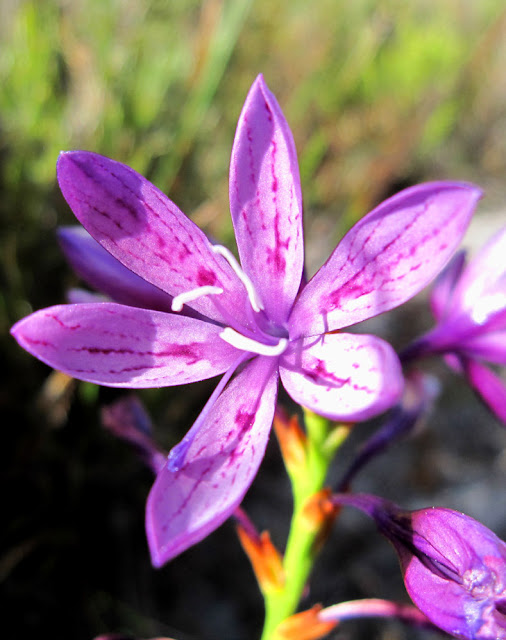
Ah, Romulea, But you are not in Mr Manning's book. Growing almost flat on the sandy soil leading steeply up to the Amphitheatre, and as dense as gentians. Known as African bluebells.


For better ID'ing I have ordered Wild Flowers of Table Mountain, from England. Amazon had never heard of it. However Amazon did have Cape Peninsula: No. 3: South African Wild Flower Guide" by M.M. Kidd. A whopping $55. But I still have credit on my Christmas gift card. Thanks, Boss. Sold. So hopefully I will be saying "I think..." a little less often when it comes to plant names.


Pelargonium cucullatum, and the first and easiest I ever learned to recognize, as a twelve-year-old newly moved to the Cape from the grasslands of the Free State.


On a hill overlooking Ou Kaapse Weg, this Protea speciosa grew right next to the path.


I have seen these pelargoniums two years in a row now, in relative abundance beside these paths, growing out of dry sand banks, with leaves frizzled to nothing. I think they are P. pinnatum. What I love about these walks is that you see one flower for a few metres, and then another, and then more of the second, and so on, so that always there are localized pockets of something new. And this was a midsummer hike, not exactly the most floriferous time of year.

"At every step a different plant appeared; and it is not an exaggerated description, if it should be compared to a botanic garden...so great was the variety everywhere to be met with."

William Burchell, journal entry for the last week of November 1810.


Flax - Heliophila, no idea which species. And blooming late...it seemed to be a late year in general.


Thereianthus, and again not sure which one - the last time I walked here I saw them showing only their tantalizing drying stalks. With petals they are lovely!


This stunning, shrubby erica, dripping with waxy white and green blooms, grew on the path down into the Amphitheatre, just after False Bay had come into view. Sunbirds darted about, drinking their nectar. No luck ID'ing, as it does not seem to match the white ericas in my book.


Poor, short-legged corgis. I had told them the walk would be gentle. I had completely forgotten a steep, boulder-climbing section. Not having a collapsable water dish, we poured their water into one of the honeycombed sandstone boulders on the way. Here is Ted, slurping it up.

They said a lot in Welsh, and from the tone none of it apparently noy especially flattering to my person.


Lobelia, of course. L. coronopifolia.


Lachnaea grandiflora - mountain carnation, or bergangelier. They can also be pink. 


Polygala - butterfly bush.


Protea nitida, I think. For some reason I never paid much attention in the past to the proteas, most famous of the fynbos flowers. This one grew low down on a shrub about 8 feet high.


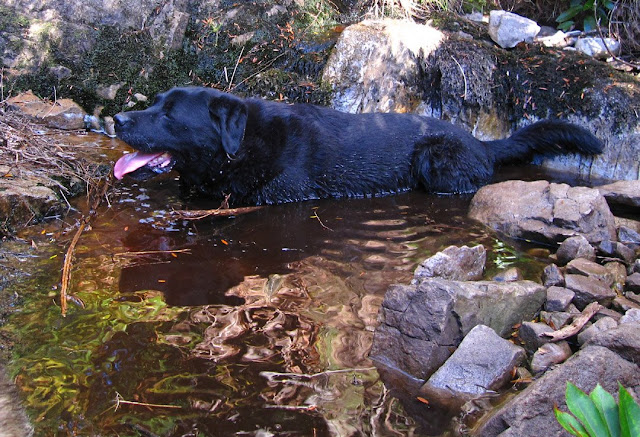
Back on the home stretch, Ben flopped into the pool above the waterfall.


And in the thicker, grassy vegetation behind the pool I found several more of these gladioli. The colouring looks like G. monticola but the form and habitat resembles more G. undulatus. Help.


Coming full circle. And home (10-minute drive) before dark. Obviating the necessity for a posse led by my father, which is what I found in the driveway the last time I returned, with Marijke, well after sunset, from this circuit.

Some hiking tips for visitors (and the first one I need to um, obey too. I hate hats):

1. Wear a hat or sunscreen. Our sun will burn a hole in you.
2. Take a sweater and a light waterpoof jacket no matter what the weather looks like. Up there is not like down here.
3. Take water and a snack
4. Tell someone exactly where you are going. Write it down.
5. Do not hike alone.

Mountain rescue: 021-937-0300 (updated February 2020)
More Mountain Rescue info


______________________

February 2020: What happens in ten years? 

My father (23 November 2018), and Ben (9 March 2012) and Teddy (22 January 2020), are no more. 

I no longer have a boss to give me Christmas gift cards, and am my own. I also have far less time for ID'ing South African flowers. 

The Frenchman's generous vacations have shrunk as the flexible start-up he worked for become a publicly traded corporation. This year he spent six days in Cape Town, rather than weeks. He still works his tail off and I never forget it.

In ten years we moved three times, I made three gardens (aside from those designed for others, of course), and wrote two books. In November of that year I went for my first official forage walk, and now I lead my own.

Some things don't change. My hiking companion is still the love of life. And that life is good.

_______________


Wednesday, December 26, 2018

Hike it out


I uploaded these pictures weeks ago and never hit Publish. Family events have swamped other impulses. But this was a lovely walk, and allowed me to reconnect with my niece, whom I have not spent time with for a very long...time.  It also gave us both a really good workout. The first hour-and-a half is steadily, steeply, strenuously uphill (upmountain - why is that not a word?).

If you know what that moth is, please say. My South African insect book is sitting uselessly in Brooklyn. The moth is on scabiosa, a South African native that is now common in the international nursery trade.


Remarkably few Capetonians (certain biologist-friends excepted!) seem enthused about walking on the beautiful mountain smack in the middle of the city. It still surprises me. It is famously/notoriously accessible and reveals a world of botanical integrity that is kind of mind blowing. Luckily The Niece is intrepid, and she and I slogged our way up Skeleton Gorge, stopping often to pant, before reaching the top. Approached from this angle it is not, as many visitors think, flat.


Ella is not an ugly girl. Here with Watsonia tabularis.


Real plant ladies. These are the kind of people who first introduced me to the plants on the mountain. Long pants, hats, backpacks, walking sticks, sandwiches and flasks of tea.  The eldest in their party must have been in his early 80's. They were walking with a young guide, possibly to act as muscle in case they needed it. Like us, they were in search of an ethereally beautiful local orchid, the drip disa, Disa longicornu. It flowers in December only in the cleanest of seeping or dripping water.


We found the disas in their usual spot. They are enchanting. 


The botanical ladies also showed me this tiny orchid, about four inches high, growing from the same rock face. Holothrix. I think the species is villosa.


Fifteen minutes later I returned the favour and showed them this exquisite little disa, hidden in a mossy wall. They told me it was Disa vaginata (what if women had described and named more plants?). The flowers less than half an inch across.


The Frenchman and I always make a ritual stop as this little waterfall. I filled my water bottle, and The Niece splashed.


Fast forward past a breakfast break, a long hike down deep gorges past pools flowing with fynbos water the colour of Coca Cola, two reservoirs, and a landscape of twittering orange-breasted sunbirds (if only I had my telephoto with me), and we had come full circle, arriving at the top of our route down: Nursery Ravine. Recent fire had provoked this flowering of Bobartia indica.


It is a relentless series of steps and if you have sore knees, forget about it. I'm not sure Ella has forgiven me. But there is always the gentle jeep track if you need a slower descent.


You can't repress the inner forager. Bracken fiddleheads in abundance invited harvesting. Blanch them in boiling water before eating, and they are delicious (in Forage Harvest Feast they are one of the two fiddleheads I recommend eating).

Long hike, and two days later I was really stiff, but it was wonderful to reconnect with what matters; in most ways (with exceptions, of course) 2018 has been a year to forget rather than remember. I have lost parts of myself along the way, and I have changed. I don't like the change, and I will be working to find the lost bits and perhaps some new ones, too. The only truism I know remains intact: life may be unfair, people do not have to be. We can all choose to act with integrity. I am beyond lucky to be married to a person who has had as tough a year, more so, in some ways, but who has managed to be a solid support - and lifebuoy - throughout. Time for me to return the favour.

In other news, if you usually find me via Facebook, I will be deleting my Facebook accounts at the end of the year, but will still be on Instagram. The latter may be owned by the former but - for now, at least - the privacy and data concerns are far more controllable on Instagram, and I just prefer it as a way to communicate. I will keep posting here too, but as time allows.

And I will be posting a new, late winter walk schedule, soon. On February 28th there is also a wild-inspired cooking class and cocktail-supper lined up for Brooklyn's beautiful Cook Space. I will add these links as soon as they are live.

...

Dear 2019: Be nice.