Showing posts with label Road Trip. Show all posts

Wednesday, October 5, 2022

North

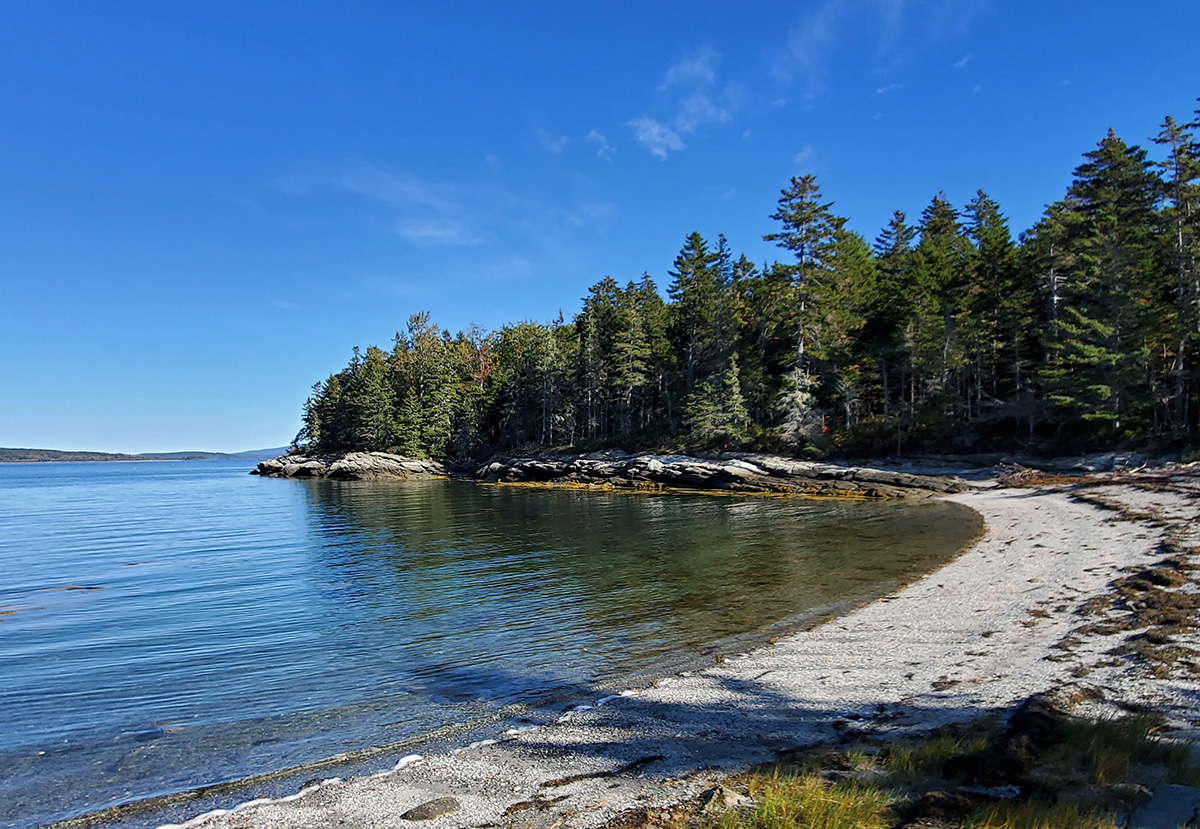
We arrived for a short break in Maine just in time for blue weather and sunshine.

The woods crowding right down to the water still awe me. 

Sitting beside the clear water, hearing the small sounds as the tide moves massively and delicately in and out, is beyond price. A seal surfaces, breathing. An animal swims across the smooth inlet - at first we think it is an otter. But when it walks onto the island nearby it is clearly marten-like. It is a mink. And not in coat-form. Just doing its private mink-things, where it belongs. Later, in the woods, we see two porcupines in a maple tree, talking to one another

I don't know how to value these experiences. Watching the Frenchman, who has been working seven days a week for a long time, is like watching fresh life being pushed straight into his veins.

European sea rocket (Cakile maritima) grows on these pebbled shorelines. In New York we have the native America species, C. edentula. Both have horeseradish-strong leaves and young pods.

Under the trees, on springy soil rich with layers of fir and hemlock needles, we walk along small trails and pause often to look. At ferns, at bark, at mushrooms, at red squirrels.

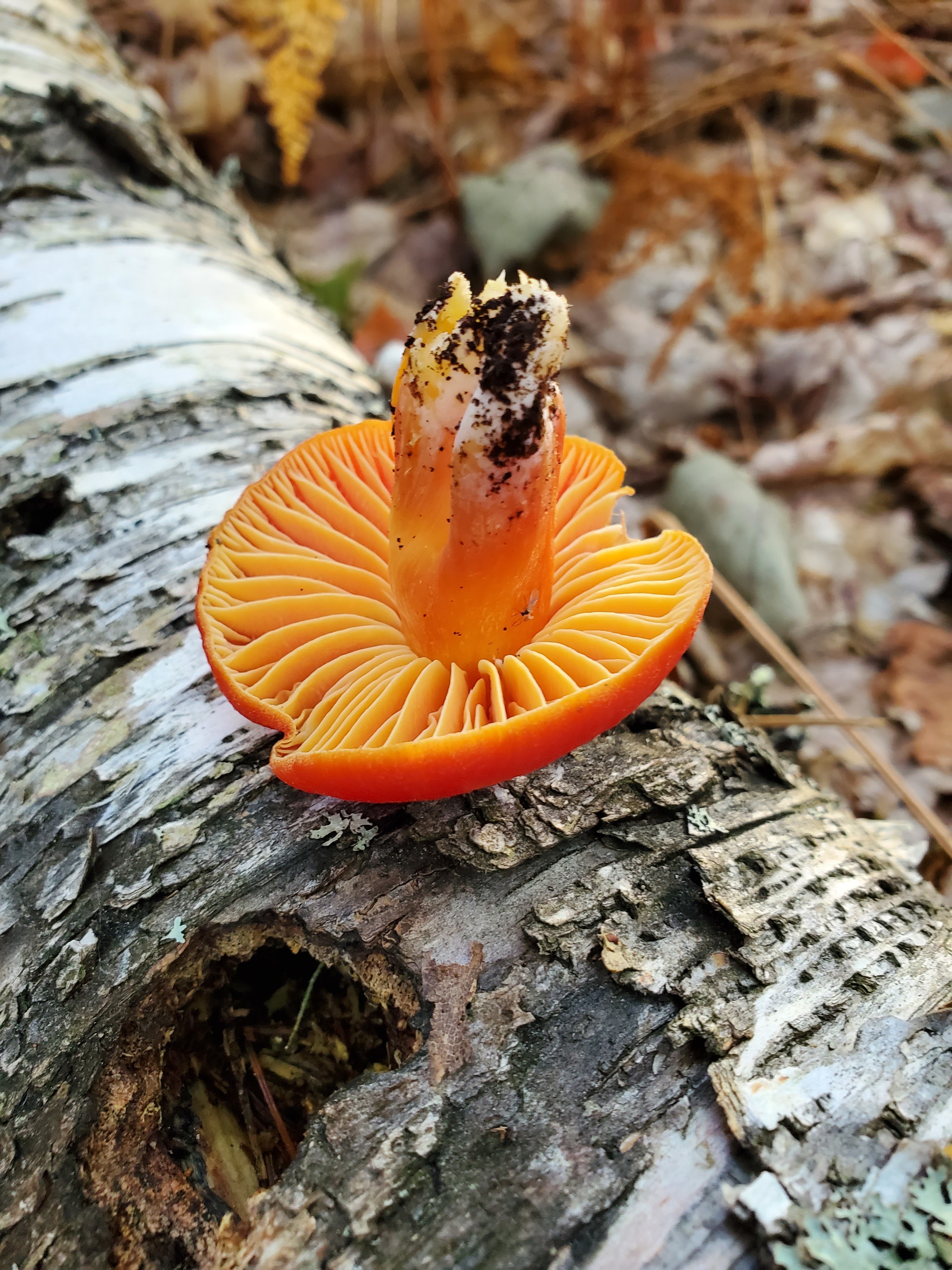
Honey mushrooms, is my first thought. But the essential (if you're thinking about dinner or want accurate identification) spore print I take is tan. Honeys have white spores. They turn out to be a species of Pholiota, also edible. The other possibility is a species of Gallerina, which is exceptionally toxic. Mushrooming is always humbling. We didn't eat them.

And a vivid Hygrocybe. 


More mushroom challenges. I still don't know what these are. They grow flush with the deep quilts of moss that cover the duff under needled evergreens. Their caps are solid, dense, and dimpled downwards, so that each is concave at its center. I collected a flock to make spore prints (white) but still have a clutch of possibilities and no real idea.  Possibly a species of Lactarius (milky cap), although the solid texture suggests Tricholoma. I know: Talking to myself. 

But it's all so interesting.

____________________

@66squarefeet

Monday, February 18, 2019

Jersey Shore


In search of snowy owls, we left Brooklyn over the Verrazano Narrows Bridge and headed south to the notorious Jersey Shore, synonymous for me with the reality TV show, hence zero appeal; but the Frenchman had visited in January, and had just missed what the locals referred to as the bird. So in the brave spirit of adventure, I voted we return.

In just under a two-hour drive we reached the beautiful barrier island that contains Island Beach State Park, first passing through miles of strangely pristine and deserted beach houses - perhaps pristine because many of them will have been rebuilt after been wacked by Hurricane Sandy in 2012.


In the park a sign said: Do Not Feed Fox. Fox! One fox? Many foxes? I had never seen a fox.

And then juniper berries greeted this happy forager (I bet foxes eat juniper berries). They belong to Juniperus virginiana, whose confusing common name is eastern red cedar (there is a whole chapter dedicated to unpacking that in Forage, Harvest, Feast - and lots of recipes: think Juniper Strawberry Ice Cream).


And in the dunes I saw smilax fruit in wild tangles. The spring shoots of smilax are delectable.


The beaches here seem limitless, marred only by the presence of occasional cars, which are obscene in this beauty. We walked to find the owl a photographer had told us about and spent a long time watching it. It sat. We watched. Sometimes it scratched its feathers.


I can't imagine what summer looks like, here - inundated - but on a cold and sunny winter day the desolation was perfect.


We stopped at various spots to access the endless beach on paths through the dunes.


And on one the Frenchman suddenly hissed, FOX! I froze.


Of course my own telephoto was uselessly in the car. Thank goodness he had his (see his post here). See the reddish dot on the sand towards the middle of the screen? Sleeping fox! We watched the fox for a very long time, trotting to and fro, settling to nap again. I fell in love.

Photo by Vincent Mounier

That fur. That nose. Those whiskers. The ears!


And of course we picnicked. Pickled cabbage and beets (pickles belong in winter, somehow), a treat-sandwich of sourdough and chevre and pea shoots.


That morning I had made a soup with a mushroom and bacon base, with tomato paste and smoked paprika, sloshes of red wine and good broth. It was still steaming hot from the Thermos and we sat on the sand sipping it, insulated in many layers, watching the crashing waves.


And then it was back to Brooklyn, our route this time taking us through the industryscape one expects of Jersey, belching smoke, filled with super highways seven lanes wide in one direction.


In the failing light, it had a futuristic appeal.


Over the Goethals Bridge into Staten Island.


And back home across the Verrazano. Heads still filled with owls and foxes, empty dunes and cold, clean beaches.

_______________

Saturday, November 18, 2017

The Road


As we drove north on the N10 from Addo to Mokala, Eastern Cape to Northern Cape, rain came down. In terms of biomes we were leaving coastal thicket for grassland and thornveld, with the Great Karoo inbetween, and all three needed rain. In early October, in this part of the country, we were on the cusp of the summer rainfall season. 


The N10 is a beautiful road that cuts almost precisely north.


For Vince and me, this is the time and space we would like to preserve. Driving, alone, an endless view, a Thermos of espresso at our feet, promise ahead.


I had back issues (too much heavy lifting + genes) so every couple of hours we stopped so that I could walk, jump around and stretch. This allowed us to smell the rain bursting in pockets on the horizon.


We drove through an area of what I call aloes, but I don't actually know what these succulents are. Flowers like cotyledons. As far as the eye could see. The fields were red. So was the mud. My driving shoes were my bright pink Rothy's, bad for slick mud walking, but I can now attest to their washability. Brand as new. [Identified as Aloe striata by my cousin, Kate Webster, who lives in the Eastern Cape]


We made a much anticipated stop (always a dangerous thing). Years ago, traveling in the opposite direction from the Mountain Zebra National Park we had chanced upon the Daggaboer Farmstall and had ventured in, finding warmth, welcome, and some delicious, very fresh roosterkoek (yeasted rolls that are cooked over the hot coals of a fire) being baked in the warm place. I had been thinking about the roosterkoek for days. After our early start it was time for breakfast.


The mysterious succulent grew at the door and I planned to ask what it was.


Inside, black nightshade jam - a South African thing at farmstalls. But the place was very cold, both in temperature and in atmosphere. The door to the warm kitchen shut and everything stank of cigarette smoke. We wandered around the shelves. Three women were working there, an owner in an office, where the smoke was thickest, and a mother and daughter, moving about. No one even glanced up at us. No other customers. In the middle of nowhere. In friendly South Africa.

I greeted the daughter, who was unable to crack a smile in return. I asked if they still had roosterkoek, and she shoved a menu at me. I asked whether it had rained, yet, a dry country question. She replied nonsensically that fillings cost extra. My heart hardened in disappointment. This is not how you run a business. Things had changed.

We bought things. Fancy wool slippers, from allegedly local sheep, for Tipsi, back home. Droëwors for the road. Preserved green figs. We waited for our roosterkoek to come from the kitchen.


The only warm thing in the frigid place was this little cat, who wanted to come with us.


Back in Mogashagasha we poured the last of the coffee and ate our roosterkoek as we drove. Mine was stuffed with grated biltong, the Frenchman's with cheese. We swapped halfway. They were not the fresh roosterkoek of memory and possibly microwaved. But enough to fill partially the hole that memory had made.

We opened the koeksisters (traditional braided deep fried and syrup soaked pastries) that we bought a few miles further into our drive. Dry as little bones. I looked at their sell by date. Two weeks past.

If we ever pass that way again, we will drive on.


It was a long day's drive, about eight hours, with our stops.


The weather played with us all the way.


We drove into that black storm, through sheets of water and lighting bolts being thrown down at the Karoo plains around us. I closed my eyes, glad the Frenchie was driving. Lightning makes me jump.


At the tail end of the dry season up here every view was still brittle and brown, with white highlights. The last time we had driven through this part of the country, in the middle of summer, it had been green. There is never much rain, here, but when there is the veld responds, fast.


Near every roadside cellphone tower I indulged in roaming data (free with our cellphone plan) and enjoyed my Instagram feed before it blinked out into the vast disconnect, again.


We both like roads, because we both like driving. And roads to me are a sign, too, of a country's health. They are tax money at work, they are civic engagement, they are an expression of a functioning governing body. This beautiful N10 filled me with optimism.

As we entered each town, this optimism was replaced by despair. For non South Africans, a small, dark backstory: During apartheid black and brown South Africans were not allowed to own homes or property within white towns and cities. The Group Areas Act forbade it. And so on the edge of every ostensibly white town grew its mirror image, a brown town, minus the trimmings of a comfortable life - and referred to simply as a "location." Where does she live? She lives in the location.

Apartheid ended formally in 1994, with the South Africa's first free election. But because the infrastructure existed, and because people lived where they lived, and because there was really no material change in most people's lives, these two side-by-side towns continued to coexist, even as the so called locations were recognized, given names, and appeared on maps. They remain historically brown or black, and their size often dwarfs the size of the old official town. While each mirror town has its upwardly mobile or comfortable section, the towns on the edge are usually disproportionately impoverished. From houses with many rooms they shrink to basic, boxy "Mandela Houses"- a promise by the government to provide housing, partly delivered - to scanty corrugated iron and plastic shacks with no running water or electricity or sewage.

Why the poverty? Simple. There is not enough employment. There are too few jobs and opportunities, and education for most South Africans still lags very, very far behind its ideal. And so as we entered every municipal area from the open countryside we were met first with the smell of woodsmoke, as many informal dwellings rely only on fire or spirit stoves for cooking, then by restless seas of plastic bags blowing in the wind, and then by the view of people living their lives. Many toilets are outdoors, and informal settlements share outdoor communal taps to supply water for all their needs. It was cold. And we would drive through and slowly past the outside town and into the inside town, with its dead streets on a weekday, its burglar bars and walls and few businesses (the exodus from the platteland to the big city is ongoing, even as there is a small, wealthy immigration to some dorps by monied city dwellers who relish a country life and possess an enterprising spirit). The contrast was like a wall, every time, and the questions it raised are close to insurmountable. How do you solve this?

This is the legacy of apartheid. One of many. But it is the thing that tips scales.


Within spitting distance of Mokala we became clogged in one of the infamous Stop-Go's, roadworks that close a lane of road, requiring one stream of traffic to stop while the opposite stream goes. A large section of the N12, onto which we had recently turned to head northeast, was being repaired - jobs, engineering efficiency, smooth road, optimism - but it took us a long time to clear. So somewhere just beyond our sixth hour my camera readiness deserted me.

Then we turned off onto a subsidiary road, following my plotted course (I disagreed with Google maps) and onto a relatively short section of dirt road, with some of the most violent corrugations we have experienced (sorry, Google). So we slowed to a decent crawl. But as we rattled and rolled the landscape changed dramatically, and I began to think that my cousin Andrea's suggestion to visit Mokala might have been a very good one: The tired Frenchman at the wheel had pricked up his ears and had begun to smile.

Monday, November 13, 2017

Addo - place of elephants


The Frenchman and I headed towards Addo Elephant Park after leaving Storms River. I had never visited - the park is very close to Port Elizabeth and I was worried that it might be overrun with people. Friends had warned me that because of the dense nature of the coastal thicket vegetation, we might not see many animals. But within an hour of entering near the south end we were surprised by the wide vista above. There is a little knot of elephants to the right, near the curve of the road. We drove right through that section of the park, south to north, meandering at the required 40km/hour, to reach the main camp and reception where we were required to check in.

After a disinterested welcome - if you can call it that - at reception (unusual for a SAN Park), we got back into the Landcruiser and headed for our camp, Nyathi. I had chosen it based purely on its relative remoteness on the maps I had studied and the fact that it seemed to have a good view from the cottages, and our fingers were crossed. What would it be like?


First, we had to leave the main park area, through an electrified fence and gate that was unlocked for us, across a railway crossing, across a national road, through a new gate, another electrified fence, and into the next section, Nyathi. We saw a male lion almost at once, lazing behind a tree, upside down, indolent cat fashion, and then this herd of peaceful elephants browsing. We felt happy with our choice of stomping ground for the next few days.


This was the view from the curving wooden balcony of our luxurious rondawel - hills and thicket and every day a slow, large herd, 60 - 80 strong, of elephants moving back and forth, eating, rumbling, communicating with each other in a way we could not understand. Every night and morning a chorus of unfamiliar birds, with the exception of the haunting fiery necked night jar, not just one, but four, calling from every corner of twilight. It was shiveringly beautiful. Never the sound of a human.

I took remarkably few pictures, here. I think we were still in some translocation shock, the remoteness, all of a sudden, the desire to absorb this kind of silence.


These sweet, unfraid little swallows lived in a neat mud nest above the front door.


From the balconies, which curved along the tips of the trees below us, I could do some fascinated botanizing. The vine above was strongly scented and we saw sunbirds feasting on the flowers. It reminds me of the greenbrier family Smilacaceae.


And its host, the supporting tree, excited and surprised me even more. Like seeing a friend in a very unexpected place. A dead ringer for prickly ash (Zanthoxylum americanum) but in South Africa! The East Asian prickly ash species is Z. piperatum - otherwise known as Sichuan, as in peppercorn. Why not an African species? My impatience had nothing to do but to cool its heels. No Googling for us: thanks to our desire to be Alone we were well beyond cell range, had no data, and no Internet. But I nibbled and tasted and had no doubt. How exciting. My submission to iSpot once we were back in Cape Town has met with no response. Could it be the species capense? Prickly ash fruit and leaves zing with citrus and pepper, and that curious tingling sensation that makes Sichuan so well known. The trees belong to the large and fragrant Rutaceae family, like the aromatic fynbos herbs I love, as well as well known citrus fruits like lemons and oranges.


We took daily drives, with a Thermos of coffee and a trove of rusks, and made friends along the way. And every afternoon we came  home to our rondawel, lit a fire and ate dinner to the sound of those night birds.

As lovely as Nyathi was - and I recommend it highly - Addo in general suffers from what I assume must be poor leadership. Nowhere was there a genuinely friendly person* to direct or welcome us, and after an entrance boom was dropped on our car's roof at a gate the indifference and lack of professionalism could not have been louder. We were deeply unimpressed. I have still not heard back from the person who should have contacted us and frankly apologized for the damage. So that left an abiding impression which flavors the whole experience.

* An exception - a very helpful mechanic at the main camp lent Vince some tools to tighten the connections of the batteries in the Landcruiser, which had rattled loose on very bumpy roads. He should be front and center in the welcoming committee.

But if you do not require a smile when checking in, are wary of falling booms, rely on yourselves for catering, stay away from the tourist mecca of the main camp, and book a spot at that beautiful, quiet spot in the hills, you will be happy.

You might even forget to take pictures.

Thursday, October 19, 2017

Storm's River - place of waves


After seven long hours on the road from Cape Town to Storm's River, it was a relief to reach our roomy wooden chalet perched at the highest spot above the crashing waves of the spectacular Tsitsikamma National Park. We had been checked into the park by a very efficient and friendly SAN Parks staff employee, who dealt with a long line of tired and impatient Dutch and German guests (we were the only South Africans at that time) as we all poured in from various corners of South Africa, stiff from driving, hungry for showers, clean beds and the views we knew were around the corner.

Below the chalets were the campers and their tents, right on the shoreline (where we had stayed, before), with a very high tide sending waves roaring over the rocks. In the blue valleys between the waves we spotted pods of dolphins, who stayed and played in the huge breakers for hours, with more elusive whales blowing in the background.


The Frenchman was in heaven. Seeing him unfettered and trigger happy made me smile.


All around the campsite fires were lit, with embers sparking as people began their supper preparations. We lit our braai on the incongruous set up - an iron grid and ash box attached directly to the wooden railing of our high wooden balcony, and rather wobbly. It would take only one very heavy person to lean against it and go whoops right over the side - I cannot imagine this in America, but in South Africa perhaps the need to braai wins. It is like an inalienable right. (There was a second braai on the private patio below, reached by steps.) What did we cook? Chops, I recall, and boerewors, with a salad of cucumber and tomatoes. Red wine. Basic, happy food.

It was cold, and we sat outside well wrapped, later sliding between crisp white sheets beneath layers of comforters and blankets, falling into a sound sleep to the boom of the surf.


Early the next morning our blue view brought a lump to my throat. I know these creamy seas. I swam in this water and these waves every childhood summer until I was an elderly teenager. Not right here, but a few dozen miles further west, at Plettenberg Bay. A strong swimmer, I lived in this sea. Hearing and smelling and seeing the powerful surf - quite different from Cape Town's colder water - brought back physical memories and longings I can barely articulate.


In the morning on a short walk (we had to check out by 10am and drive on to Addo) I spotted pokeweed, a species I had never seen. My friend Don offers Phytolacca octandra for identification. Even though it was still spring, and the night had been very cold, the plant was at the maturity stage I would expect in late summer, Stateside (from Phytolacca americana). I'd love to see its earliest shoots and test how succulent (or not) they might be.


We had time for a walk across the little beach and onto a long and sinuous boardwalk that snaked towards the river mouth in the forest before heading back to pack the car again.

But Storm's River has been discovered and can be a busy spot - very beautiful, but now too trafficked for my taste. I noticed with some amusement (because I loathe racism), a rising xenophobia and antagonism in myself as European and Asian visitors brushed past us without greeting, talking loudly, behaving like tourists anywhere, oblivious of the birds in the canopy, the possible Cape clawless otters on the rocks below.  Most South Africans will look you in the eye and greet you, just a smile or a nod, or an actual hello - I find it charming, and I felt cross and resentful that Foreigners had not adopted this etiquette.

I needed to get further away from people.

Fortunately, we were headed in the right direction.