Showing posts with label Plant walks. Show all posts

Wednesday, October 5, 2022

North

We arrived for a short break in Maine just in time for blue weather and sunshine.
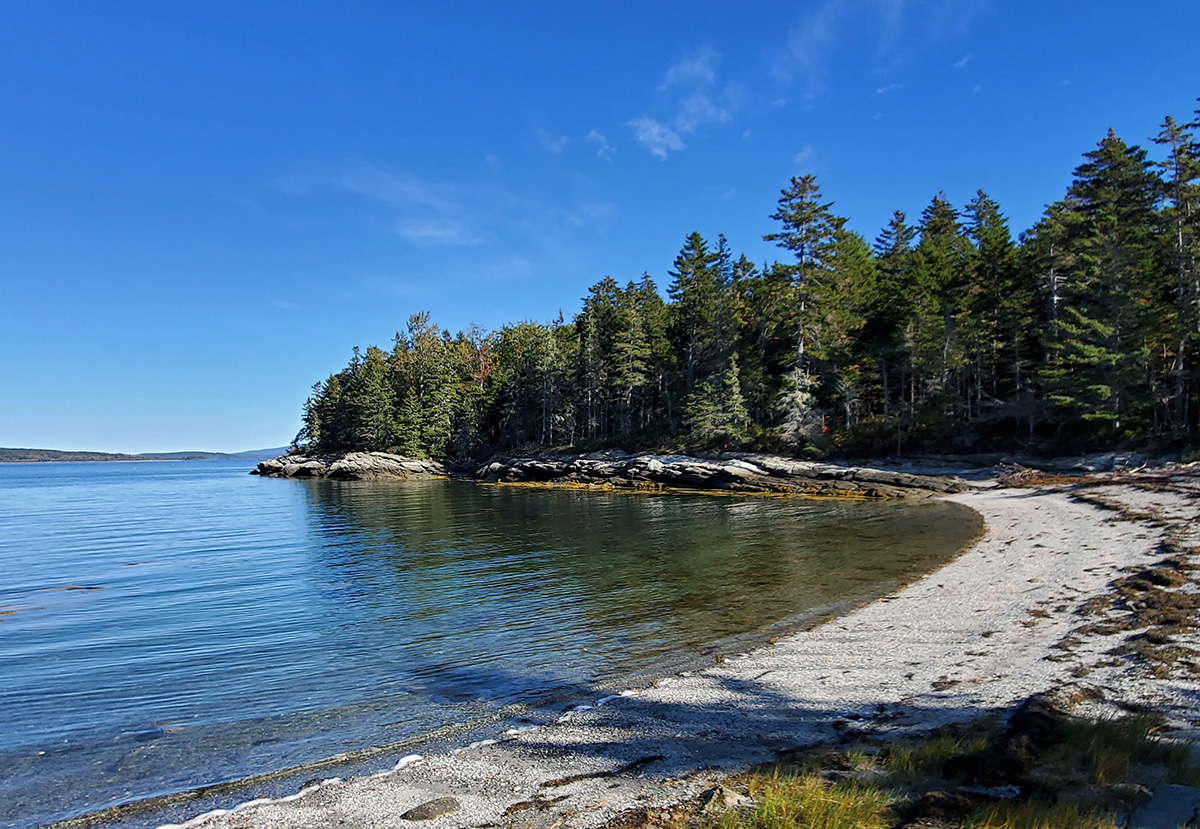
The woods crowding right down to the water still awe me. 

Sitting beside the clear water, hearing the small sounds as the tide moves massively and delicately in and out, is beyond price. A seal surfaces, breathing. An animal swims across the smooth inlet - at first we think it is an otter. But when it walks onto the island nearby it is clearly marten-like. It is a mink. And not in coat-form. Just doing its private mink-things, where it belongs. Later, in the woods, we see two porcupines in a maple tree, talking to one another

I don't know how to value these experiences. Watching the Frenchman, who has been working seven days a week for a long time, is like watching fresh life being pushed straight into his veins.

European sea rocket (Cakile maritima) grows on these pebbled shorelines. In New York we have the native America species, C. edentula. Both have horeseradish-strong leaves and young pods.

Under the trees, on springy soil rich with layers of fir and hemlock needles, we walk along small trails and pause often to look. At ferns, at bark, at mushrooms, at red squirrels.

Honey mushrooms, is my first thought. But the essential (if you're thinking about dinner or want accurate identification) spore print I take is tan. Honeys have white spores. They turn out to be a species of Pholiota, also edible. The other possibility is a species of Gallerina, which is exceptionally toxic. Mushrooming is always humbling. We didn't eat them.
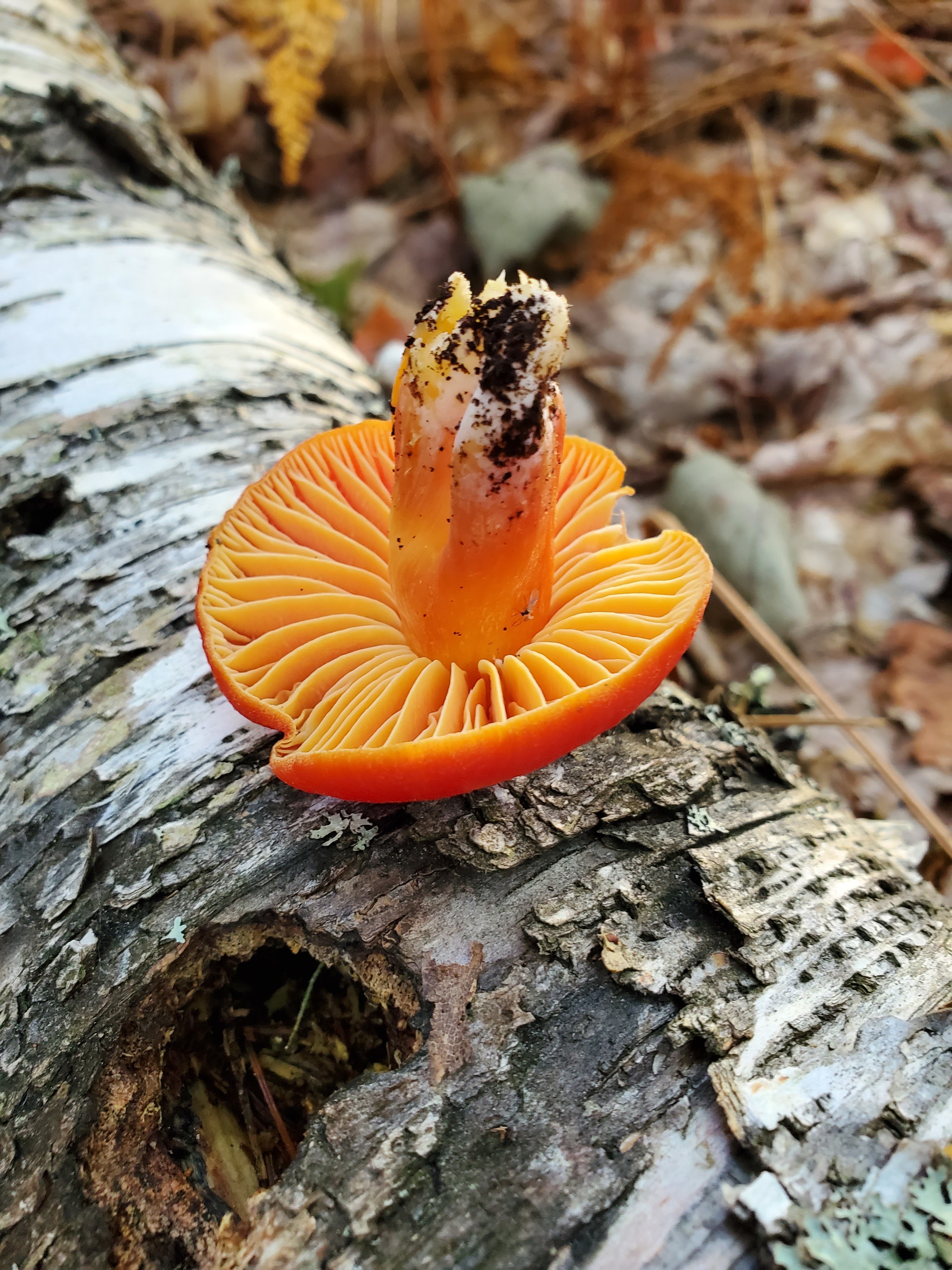
And a vivid Hygrocybe. 


More mushroom challenges. I still don't know what these are. They grow flush with the deep quilts of moss that cover the duff under needled evergreens. Their caps are solid, dense, and dimpled downwards, so that each is concave at its center. I collected a flock to make spore prints (white) but still have a clutch of possibilities and no real idea.  Possibly a species of Lactarius (milky cap), although the solid texture suggests Tricholoma. I know: Talking to myself. 

But it's all so interesting.

____________________

@66squarefeet

Wednesday, September 28, 2022

Picnic fare for fall

In Brooklyn we are breezing into fall. It seems sudden, but how can it be? Days pass, nights cool, mornings feel fragile. The September blue has settled over the city, and in park woodlands white snakeroot flowers are in full, white fluff. 

My plant walks and forage picnics are more frequent. Carrying a 20 - 25lb backpack when the weather is 70 degrees is remarkably more more pleasant than when it's 90 and humid. 

The buns above are made with a luxurious, cream-and-milk-based dough, and are stuffed with a beach plum paste, made by cooking down the pulp of the small, native fruit (it is intense - sweet with just the right amount of sour).


And the tiniest of Seckel pears have arrived at market, perfectly-sized to fit into the stainless steel picnic containers. I poached them in a juniper (eastern red cedar - Juniperus virginiana) and Meyer lemon syrup.

______________

Find me on Instagram
@66squarefeet

Tuesday, October 5, 2021

Black nightshade vs deadly nightshade


Black nightshade

[Published annually, since 2016, with occasional updates.]

Late, late summer, and the black nightshade is ripe, on cue. I tasted these and they had a good, sweetly earthy flavor. It can vary. Some are quite bland.

"But isn't it deadly?"

Noooooo. Deadly nightshade is another plant. And it looks different. 

The problem with common names versus botanical - that is, scientific - names is that occasionally you run into real confusion. So people hear "nightshade" and freak out. But the same people happily wolf potatoes and tomatoes and peppers and eggplant. All nightshades. Also, the Web is rife, riddled, with misinformation about the two plants. Read carefully.

Our black nightshade friend, pictured above and below, is Solanum nigrum - or, possibly one of several different species belonging to the Solanum nigrum complex. There is eastern black nightshade (S. emulans), and there is S. americanum; there are subspecies. But all ripe black nightshades are edible. 

Deadly nightshade is Atropa belladonna. It looks very different. 

A fear of and prejudice against black nightshade as a food persists where people are not familiar with how plants in general, or with how they are classified. Most people suffer from plant blindness. And that's to be expected. Fortunately, it's curable.

Both black and deadly nightshades belong to the tricky family Solanaceae. As mentioned, other edible members of the nightshade family include potatoes, tomatoes, eggplant and chiles. (When they first encountered them, Europeans were afraid of tomatoes. Green potatoes are toxic. But we don't tremble when we walk down the fresh produce aisle. Death and deliciousness are in the details.) 

In South Africa I grew up snacking on black nightshade, and there, and in other parts of the world, the cooked greens are eaten, too. Black nightshade is edible, and not to be feared.

Read on to learn to identify edible black nightshade versus toxic deadly nightshade. Luckily, the differences are quite obvious, once you start paying attention. 

Edible black nightshade

Edible black nightshade fruit occurs in clusters (above). And you almost always see clusters of ripe as well as green fruit on the plant at the same time. The fruits have a matt appearance - no shine. And here is the real tell: the calyces of black nightshade (the green bits like lapels or a collar between stem and fruit) are smaller than the fruit

Black nightshade flowers

Black nightshade has tiny, star-like white flowers with prominent yellow anthers. Sometimes the petals are furled back. Not always.

Black nightshade

The ripe black fruits of black nightshade range in flavor from insipid to delicious (like a sweetish tomato with dark undertones). 

The green, unripe fruit of black nightshade are considered toxic, so avoid those (the same way you would avoid a green potato). As Ben-Erik van Wyk writes in his encyclopedic Food Plants of the World, "Care should be taken to only pick ripe berries, because the unripe (green) fruits may contain toxic levels of alkaloids (6 - 8 berries may kill a child)."

Note that uses he word "may" twice. 

He goes on to write that "the dark purple to black berries are delicious to eat raw and make excellent jams. The juicy pulp may be used for pie fillings, jellies, and drinks. Young leaves are commonly used as pot-herb in rural parts of Africa and Asia." 

Black nightshade jam at the Daggaboer Farmstall in South Africa

My aunt calls black nightshade fruit soepsoepertjies (an Afrikaans word) and used to make jam from them, before her fingers became too sore. She is 93. Nightshade jam is sold at regional farmstalls in South Africa. 

Black nightshade with its tomato cousins, peaches, and burrata

I like more savory applications. A fermented black nightshade ketchup lasts indefinitely in the fridge, and I deploy the raw fruits in luscious salads.

Tomato and mugwort confit with sheep cheese, lambs quarter and black nightshade

And as beautiful garnishes for seasonal tartlets I carry on forage picnics.
 
In the US, garden huckleberry is the user-friendly and exceedingly confusing common name given to a black nightshade variety (Solanum nigrum var. melanocerasum) that is cultivated as a garden crop. Huckleberries belong to the genus Vaccinium, like blueberries, and this name is all about marketing, rather than botanical accuracy. Its fruits are somewhat larger than the feral versions of black nightshade. You can buy it online at Baker Creek and elsewhere. I was introduced to it by the lovely folks at Tyrant Farms, who sent me a package years ago.

But even seed sources muddy the identification Internet waters by saying inane things like, "Caution should be advised not to confuse the fruits with those of nighshade [sic] (a very close relative), as nightshade fruits are highly poisonous."

Um... It is a nightshade. They're all nightshades. 

Deadly nightshade. Photo: Stefancek

Let's move on:

What about deadly nightshade identification? Atropa belladonna fruit is borne singly, never in clusters. Deadly nightshade fruit is glossy. 

The green calyces of deadly nightshade are very prominent, more Elizabethan ruffle than collar, extending beyond the fruit.  

Deadly nightshade flower by Bojana Matic

The flowers of deadly nightshade are tubular and bell-shaped, and range from purple to lilac, with green. They are distinctly ornamental, versus the hard-to-spot tiny white flowers of black nightshade.

Incidentally, deadly nightshade is not very widespread in the US - it occurs mostly on the West Coast, but that will inevitably change (since first publishing this post it has crept to the East Coast). 

__________

Thursday, March 18, 2021

Drink the season


Cocktail with sugar rim

I was tinkering recently with drink ideas for a walk. The advantage of smaller groups (10 people rather than 15) during viral times is that I can tote drinks more easily. Liquids are heavy!

This was a test that never made it to a forage walk, as everyone was happy to be served a seasonal vermouth - but sometimes someone doesn't drink and then I either include a no-alcohol variation, or make them all non-alcoholic. This rather delicious forage-inspired mocktail called on one of my fruitier vinegars, from last spring: wisteria blossoms! Spiked with spicebush, and cut with plain, cold water. Perfumed, tart, sweet, and very refreshing.

The catkins surrounding it belong to Turkish hazel (Corylus colurna). This year has been my first of noticing the fascinating flowers of hazel, and I was playing with their pollen. The catkins are male, and the tiny female flowers are separate, and a deep burgundy.

___________

Forage, Harvest, Feast

Monday, March 15, 2021

Not-quite-spring snacks


For a recent forage walk on a colder-than-forecast afternoon I made some canapés to accompany small glasses of chilled PandemicVermouth, infused and blended in April 2020. 

On the right are buttery salmon and field garlic (Allium vineale) tarts, with a savory custard filling. To serve them I added more slivers of salmon and extra, snipped field garlic. In the rear? Fir sugar shortbread cookies. Bottom left are toasted rounds of field garlic cheese bread. 


I topped those toasted rounds with garlic mustard (Alliaria petiolata) pesto and pickled chanterelles, from an epic mushroom hunt in the woods upstate two summers ago. The chanterelles - incredibly - still have that magical apricot aroma that traveled back with us that day.


And there were eggs, not quite deviled. Cooked in boiling water for eight minutes before being peeled and covered in miso, overnight (chilled). The miso flavors them but also draws out some moisture, so the texture becomes firmer. Onto their yolks I dripped some powerful, bright green ramp leaf oil, Aleppo pepper, and the peppery leaves of bittercress (Cardamine hirsuta), a maligned but exquisitely pretty edible green in the Brassica family - like tiny watercress. 

Socially distanced walks and picnics are a challenge but everyone is well-trained, by now, and very considerate. (At least, the people who sign up, are!) There will be more, and it feels good to be creating wild food treats, again.

________

Monday, March 8, 2021

The journey to a sandwich

Snowbell flowers

In mid-May of 2019 I met a tree crowded with bees and panicles of fragrant flowers. Each bloom looked a lot like those of Styrax japonica (snowbell), but I had never seen them arranged like this, or smelled that intoxicating perfume. It was Styrax obassia, fragrant snowbell.  

Styrax flowers

I like to catch scents and flavors. And so after as much research as possible, I collected some of the flowers and decided to preserve them in the form of vinegar, fermented from scratch. Just flowers, water, sugar, and time. 

Styrax vinegar testing pH

After the first fizzing happened, and the flowers were strained out, I left the sweet, fragrant liquid in loosely covered jars to invite the lactobacter to do their work. They did, in a remarkably short time. The sweet ferment turned into a deeply fruity and complex vinegar in just four weeks. I bottled it.

Snowbell vinegar shrub

It is one of the best vinegars I have ever made, good enough to sip, which I did. Here it is in September 2020, with a dash of baby pine cone syrup, a lemon slice, and chilled sparkling water. Because of their depth of flavor (good) vinegars are ideal and healthy mixers if you don't want to drink alcohol.

Carrots in vinegar

Fast forward to last Saturday, as I prepared a forage picnic for 10 walkers. Carrots quick-pickled in the last of the fragrant snowbell vinegar. Destined for Wonder rolls - slices of crustless Wonder bread spread with chickweed and field garlic mayonnaise, and stuffed with the carrots, black radish and garlic chive flowers (I could write a treatise on my reason for making these with That Bread but we don't have time right now).

Forage picnic in containers

There they are, top left. Clockwise from there, watercress tartlets, black currant and juniper hand pies, and quails' eggs with a ramp leaf salt for dipping.

So if you'd like a sandwich in 2023, you'd better plan ahead. 

The next walk is What's that Bud? This Wednesday, with drinks and canapés, on a pretty-weather day in Prospect Park.

Book Here.

____________________

Monday, March 1, 2021

Plant Walk at Historic Green-Wood

Spring catkins by Marie Viljoen                                                                                                        

See the Trees Walk

Green-Wood Cemetery

7 March 2021, 12pm - 2.30pm

$60

The snow has melted! Join me this Sunday in the beautiful arboretum that is historic Green-Wood Cemetery in Brooklyn. On our late winter walk our focus will be on trees and buds, and we will identify some of the many edible parts that trees offer in this and other seasons. It's fair to say we will see some interesting edible weeds underfoot, too, like chickweed and ground ivy, just getting ready for spring. We will also learn to identify plants in disguise, like the winter skeletons of pokeweed, mugwort, and tara-no-me (I'll explain!). 

The weather will be in the mid-40's but chilly. We will sip a non-alcoholic hot toddy where fresh fir, gingery magnolia and honeysuckle cordial will warm you. 

Masks are mandatory and $5 per ticket will be donated to Green-Wood. Our meeting point will be at the Prospect Park West entrance. More details will be emailed upon sign up.

Fully Booked

Sunday, September 27, 2020

Beautiful Fall Forage Classes at the NYBG

October is around the corner, and that means autumn, for real. 

In an unreal year.

I visited the New York Botanical Garden recently because I will be teaching there again in a few weeks: Two outdoor classes, on October 15th and October 29th. [Update: these classes are fully booked but there is one in WINTER! January 21st] The classes are really walks, and we will be visiting the Native Garden (above) and the Thain Family Forest. And probably meandering  a bit more if the mood strikes us. 

Come and learn to identify edible plants in their fall clothes, and understand how they fit into the bigger ecological picture. We will breathe in the good, fresh air of the mainland (hey, I live on an island; the Bronx is exciting to a Brooklynite!). 

Masks are mandatory - so our fresh air will be filtered - and attendance is limited for social distancing reasons. So book, soon.


I spotted a sweet hummer in the jewelweed patch. Planting annual Impatiens capensisis is a sure-fire way to attract and support the vulnerable little birds on their way south in early fall. Jewelweed self seeds very readily (and its seeds are edible!) so once you have it, it will be there forever. It likes dappled shade and a lot of moisture. Low-lying areas that don't drain well are perfect. But I have grown it successfully in pots and planters, too.


Still boggy, here is pickerel weed. Its young leaves, buds, flowers, and seeds are good to eat.


No, don't eat the pitcher plants. But it's fun to see carnivorous plants flourishing.


These are ostrich ferns. In spring their fiddleheads are delicious. Plant one and in a couple of years you will have a dozen. Perfect for a deep shade spot.


Golden rods (Solidago species) are often blamed for seasonal allergies, but they are innocent: their pollen is too fat to affect our sinuses. In fact, showy flowers whose job it is to attract pollinators are usually never allergen-culprits. Rather, it is the inconspicuous flower of wind-pollinated plants (like ragweed, and I suspect, mugwort) that is an irritant, because it is so fine and light, designed to be dispersed by the puff of a breeze. 

And yes, some golden rods are delicious...


The extreme climate of the Northeast is also home to a native prickly pear, Opuntia humifusa. Muggy summers and freezing winters do not rattle it.
 

Fragrant Pycnanthemum species love full sun and pollinators love them. Their leaves, flowers and seeds make refreshing drinks.


Imposter! Not native. But very closely related to our indigenous prickly ash (which can be used in the same way). This is Chinese pepper, or Sichuan, Zanthoxylum simulans: citric, cooling, numbing, unique.

Yes, the elusive pawpaw (Asimina triloba) lives at the NYBG. The fruit ripens under its green umbrella-ed leaves in mid to late September. This still-underplanted tree deserves a spot in every garden. This year I enjoyed wonderful pawpaws picked from a tree in Brooklyn's Park Slope.

And the delicious - or terribly stinky, like-sweaty-socks-that-a-cat-peed-on? - cranberry viburnum. The smell is in the details. How to tell the difference between the native and European species? We will learn! 

Use the links below to book.

October 15th

October 29th

____________

Wild Foods Cookbook

Tuesday, January 14, 2020

Daylight Savings Walk - Jamaica Bay

Snow geese at Jamaica Bay. Photo: Vincent Mounier

The Good, the Bad, and the Berry 
Jamaica Bay Wildlife Refuge
8 March 2020
12pm - 2.30pm
Tickets: $52

Today the clocks are set an hour forward. Come and celebrate the end of dark afternoons with a brisk plant identification walk followed by a picnic featuring the flavors we have seen.

Jamaica Bay Wildlife Refuge is where New York's contradictions of populated skyline and free range nature meet in a fascinating intersection of estuary, wetland, beach, field uplands and woods.


Late winter and early spring show us undressed shrubs where tempting drupes and berries persist. Some of them are delicious.


Some of them are not. What are they? Friend, or foe? 


Learn to tell the difference between native and Asian bittersweet.


Edible and poisonous fruits. Which is which?


The refuge has a wild and exposed western side. Waterfowl like snow geese like to overwinter here, and if we are lucky we will spot them.


A viewing platform allows access to the wetland's edge.


The quieter eastern side of the refuge is where woodland and swamp meet. 


On our walk we will meet a range of Northeastern native shoreline plants, like pine and juniper, and in our post-walk hot toddy we will taste them.


Fragrant male eastern red cedars will be bursting with pollen.


And spring's luscious shoots will be disguised in winter's skeleton forms. 


This is the time to identify common edible plants for future forages.


Our wild-inspired picnic will feature a hot and fragrant toddy as well snacks checking the invasivore and native flavor boxes. (Yes, in a wild food world, such boxes exist.)

Despite the date, March can be the snowiest month in the city, so be ready with boots, mittens, and ear warmers, in case.

The Jamaica Bay Wildlife Refuge is reached by car (lots of parking), bus, or by the A train (to broad Channel - a 15 minute walk away). Thanks to the National Parks Service (and our tax dollars) there is a very civilized bathroom on site.