Monday, March 16, 2015

The earliest flowers


As promised the High Line witch hazels have frilled into bloom. The Siberian Express has moved on. Hurry, if you'd like to see them. I can't think of an earlier flower. 


Soon, as the botanical second hand ticks around the March clock, the viburnums will begin, starting with the early hybrid I first met in Cobble Hill, and the hellebores, and winter aconites; crocuses of course (see them en masse at the BBG  - it's one of my favourite pictures in my book). Winter honeysuckle (Lonicera fragrantissima - highly invasive) might already be sending its sweet lemony perfume into Central Park, and Prospect Park and onto Christie Street, on the Lower East Side. Ornamental quince (Chanomeles sopp), and then the predictable and beautiful daffodils.


On indigenous forest floors Dutchman's breeches (Dicentra cucullaria) will appear beneath spicebush blossom - Lindera benzoin (try Inwood Hill Park). Later, into April, there will be carpets of trout lilies (Erythronium americanum) and cutleaf toothwort - Cardamine concatenata (Pelham Bay Park and Central Park). And that's just a teaser.

 Feasts to come, for flower hunters...

(Visit the link below if you'd like to join the hunt with me.)

___________________________________


Saturday, March 14, 2015

Last meals


A bagel and smoked salmon brunch before I fly south to Cape Town.

___________________________________


Friday, March 13, 2015

Planting before the last frost date


I've been tidying a winter's worth of debris from the terrace. As the snow retreats I advance, swooshing leaves and ice-heaved soil from the boards with a watering can, going indoors to fill it for each new swoosh. The water outside is shut off, so no hose, yet.

This wild kitty toed his way carefully along the top of the chainlink down below as I worked.


Above - the pruning book is my bible and is homework for a writing assignment in Cape Town, which will take me - happily - back to Babylonstoren.

My seed choices are modest for spring. The fava beans have soaked overnight and today I plant them. They are a March ritual. They'll have to come up and do their thing while I am in Cape Town. The Frenchman will send progress reports. If all goes well it will mean salads when I am back, then flowers, then beans. The cilantro late last year stood up to several freezings and snow before expiring, so it really, really prefers cool weather.

The pots on the terrace have almost all thawed and the standing water has drained. In some pots, digging speculatively, I found a dark heart of ice, fitting in my palm.

I fed the blueberries Holly Tone, and fed the roses some stinky Jobes granules.

And the doves have come back, along with some friendly house finches. Nobody froze, after all.

___________________________________

Wednesday, March 11, 2015

Forbidden


Guilty pleasures.

The smoked tuna from Zabar's. Must be eaten in the company of a martini or cold vodka. Also, on a birthday.

Sorry, tunas. We hardly ever eat you.

Eating any kind of fish has become very tricky if you give a hoot about sustainability. Farm-raised is not necessarily a good thing. You're better off eating a grass fed lamb chop.


Tuesday, March 10, 2015

Bring on the empty snorkels!*


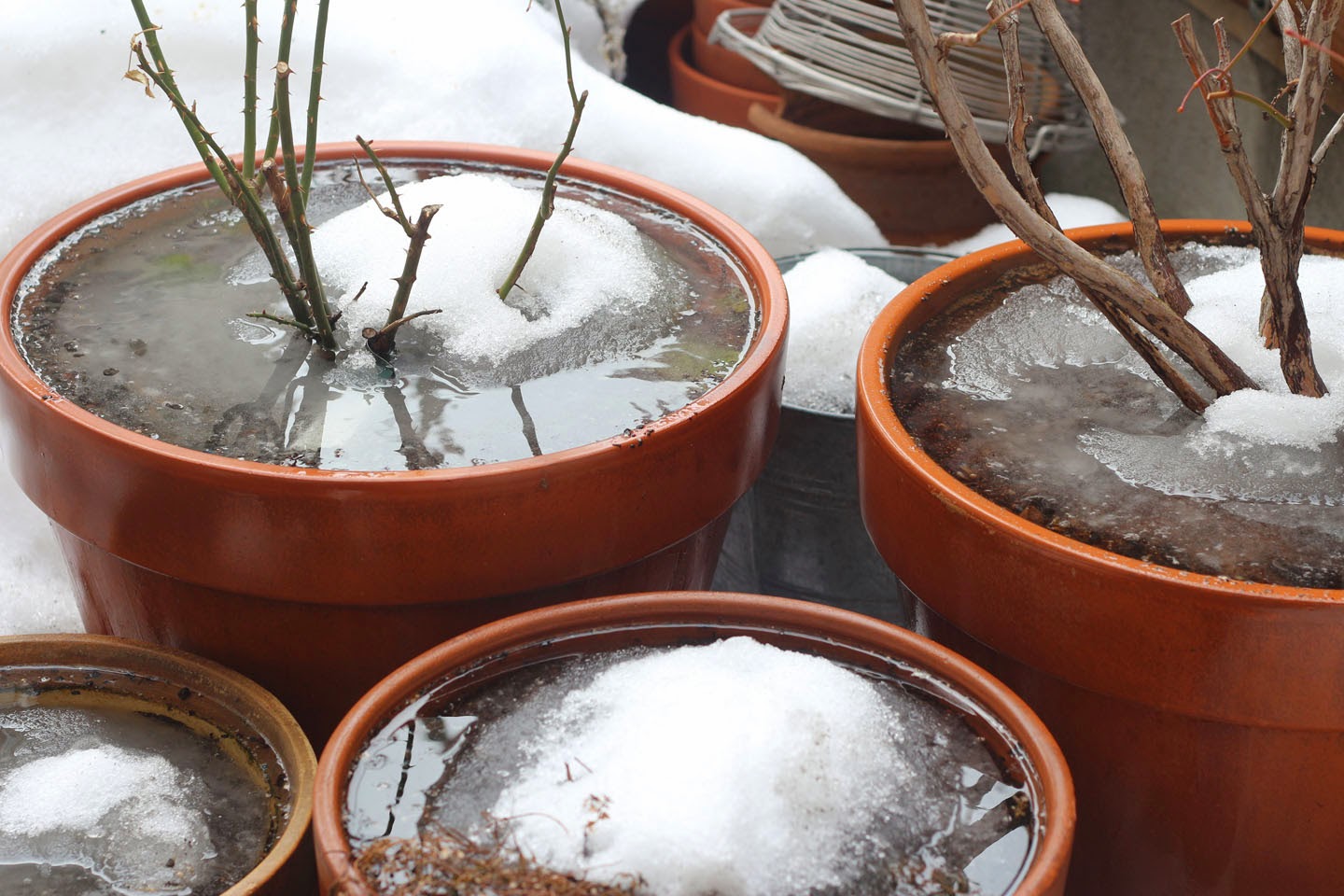
This sight does not thrill me. At all. Standing water is the death of non-aquatic plants (if you're wondering why hydroponically grown plants don't drown, it's because their water is oxygenated).

The good thing, perhaps, is that this water is not draining because the rest of pot is still frozen solid. So the plants' roots are not yet suffocating. They're frozen. Still, I stand the pots on their sides and tip the water out.

Our thaw has been rapid and dramatic, starting on Sunday, with the time change, and with full day and night temperatures above freezing. Earlier last week it snowed a good 4". And I have seen March blizzards, before. Anything is possible. But next week is also predicted to be warm, so these snow pictures may be the last of our record-cold season.


The blueberry above - one of three - is not so bad if it's swimming, as the plants have evolved as bog dwellers. But the roses? Raspberries? And the poor boxwoods?  I think the cold may have done the beautiful boxwoods in. Their leaves make that sinister (to a gardener) rustle that is papery and lifeless, and they are pale and curled. They were a wonderful gift from Virginians Paul and Sonya, last summer. A lifetime away.


This was March 5th, just five days ago. It's a lot messier now.


I am very glad that I lifted all the lily bulbs - the first time ever. They would have rotted.


If they continue to store well - above - they will be planted in mid April. The Lily Garden's Judith Freeman sent me some good storage advice late last year: "...pack them in peat moss, wood shavings, vermiculite, etc. in plastic bags with either just-a-bit-loose tops (like staples but not tightly sealed) or a few pencil-point holds if you use ziplock bags.  (Packing in peat for early-dug bulbs is too damp, but it's fine for now [November], since they have all died down and they aren't too fussy.  You can put them in the fridge or a place that's cold enough (below low 40's) but won't freeze hard. A note of caution--exposure to light can cause them to sprout too early, so don't pop them a vegetable crisper and then pull it out every day...or just put them all in a black bag or something like that."

I used peat, individual baggies, and left them open, in the crisper drawer, with a paper bag over the top to shut out any chinks of light. So far there is a little mould one large Silk Road bulb, but I cleaned that off. Hopefully they will stay healthy.

This is a good time to order lily bulbs, by the way. Order ye lilies, while ye may.

* And David Niven's second memoir is not a bad read, if you're looking for uncomplicated escapism. And who isn't (says the woman sloughing her way through Moby Dick. And yes, I mean sloughing - it's a good book for scrapig off the layers you want to get rid of)?


___________________________________


Sunday, March 8, 2015

All bets are off


You can never tell, with March. Right now, there are mounds of snow on our Harlem terrace. In parks, gardens and on streets flowers are a month behind schedule, but they will catch up within weeks, as they did last May when everything bloomed at once.

March is when it begins. Tick, tick, tick.

And I will miss it.

Family matters call me to Cape Town, and soon I will plunge from the end of winter to the end of summer in a day's flight. Seasonal whiplash.


These are pictures from previous Marches. The city unwrapping itself from the heavy layers of winter.


I will be back in April, when spring has got a grip.


This week, temperatures will be above freezing. On Sunday - when our time changed and turned sane again - I walked with just two sweaters and without a coat. I felt thin.


It would be nice, in this thawing weather, to visit a wintery beach:

"We still like empty shorelines. On Vincent’s birthday, with high cirrus striping the washed sky, we take the subway to the end of the line and then board a bus bound for the Far Rockaways, part of the string of barrier islands that shelters New York from the Atlantic Ocean. Baguette and saucisson are packed, cameras are locked and loaded. Here, beyond the dunes, there is no spring profusion. The beach is austere; the only interruptions to its surface are the shells and smooth stones left by the retreating tide. Mussels cluster around exposed wooden pilings.

"Except for a man on a bicycle who inspects shells, and two girls who walk as we do, armed with cameras and curiosity and wrapped in sweaters and coats and woolen hats, we are alone. We spread our kikoi on the sand and eat our picnic and sip our cool red wine, finding respite from the cement and streets and traffic in this wide open silence, the collapsing waves, the wheeling seabirds. The sea is silver and blue, the seashore vegetation wind-bitten, gray, and reclusive. We ride back into Brooklyn with salt in our hair."

From 66 Square Feet - A Delicious Life.


___________________________________

Saturday, March 7, 2015

The message in the flames


The Constantiaberg, Silvermine, Muizenberg and Clovelly burning. Photo: John Henderson

There are many kinds of stories emerging from the Cape Town fire that began on March 1st on the fynbos-covered mountain above Muizenberg, and which was still burning in places, six days after it started.

Stories about good will and selfless actions, about the phenomenon of social media playing a vital role in civilian-based disaster relief and organization. About firefighters refusing to give up. About who fights the fires and how little some of them are paid, about helicopter pilots* water-bombing around the clock. About missing cats, rescued squirrels and a sudden abundance of snakes. About fear, and loss. And about fynbos.

Many Capetonians view this fire as a catastrophe - the utter destruction of a loved environment: The Mountain in the middle of the city. And much has been lost. But to people who understand the fynbos biome, this fire is something else.

I asked my friend Don if I may reproduce here what I read first on his Facebook page. Don Kirkwood is an ecologist who lives in Noordhoek with Rosie Stanway, a botanist. They were in the thick of the fire.

                                         Monkey Valley, Noordhoek. Photo: Marilyn Coldrey

Their part of the mountain - really a series of mountains stretching from the city centre down to the pointed tail of the peninsula - is now black and covered in ash. Don's perspective of the fire is that of a resident who experienced it first hand, but also of someone who understands this fire, at this time, within the context of the space where he lives.

Context is be the genius key to circumstance. He writes:

"We love this mountain but it seems that at times like this we forget that fynbos is not just flammable: it is entirely dependent on fire for existence.

"And it needs a particular fire regime to retain all of the species that make it so special. Not only must it burn at least once every 10 to 30 years or so, but it needs to burn at the right time of year. That time is now. The end of summer, when it's hot and dry and windy and absolutely terrifying.

Cape Point burning. Photo: Theo Lane

"Fynbos plants can be tough as hell, but their reproduction is tenuous in the extreme. Many plants are serotinous - the proteas hold their entire future, their seed bank, in cones and flower heads on the plant. These are released only after fire. Burn too frequently and the plants won't be old enough to even have seed. Burn too seldom, and the plants get too old to make seed - the next generation rots and withers before it can be set free to grow. Burn too early in summer and rodents and bugs will eat everything before the winter growing season. Burn into winter and seedlings can't establish before the summer drought, never mind the cold, patchy burns that are no good for healthy fynbos.

    Proteas on Silvermine. Photo: Duncan Robson, The Network

"February and March, when the veld is achingly dry, brittle tinder. This is the right time for fynbos to burn. Hot and clean. Hot enough even to stimulate germination of the kreupelhout seeds buried deep in symbiotic ant burrows.

"And hot enough to make thatch roofs burst into flame 100m from the fire front. I'm so sorry for those that have lost property. I really hope no one has been hurt. But I'm happy that some really old, desperate-for-fire fynbos got a proper burn.

"Let us be reminded that the human consequences of these "devastating fires" are a result of our short memories and disregard for how and where we place our houses in relation to a naturally fire-prone habitat.

       Protea seeds being released. Photo: Duncan Robson, The Network

"This is exacerbated by legislation and management policies aimed to protect us by reducing fire risk in the short and medium term (by putting out even natural ignition events, and especially by doing limited areas of control burns, and only at at safer, cooler times), ultimately leading to a buildup of massive, unmanageable flammable biomass loads in certain areas.

                                                Firefighters at work. Photo: Gabriela Sissons

"I really hope that this reminder of the power of nature doesn't result in a further backlash against natural fire, but results in us thinking more carefully about how to live with it, and be prepared for those inevitable times when it runs far beyond what any firefighting resource could contain."

* On March 8th one of the Working For Fire pilots, Willem "Bees" Marais, died after a forced landing at Cape Point. Condolences to his family.

___________________________________