Friday, April 26, 2013

Cherry blossom at the BBG


The main, Kanzan cherry, event is not happening yet, at the Brooklyn Botanic Garden. They are in bud.

But I think their blooming coincide pretty perfectly with the scheduled cherry blossom festival - Sakura Matsuri - this weekend. That timing is a coup for the garden, as the festival is planned eons in advance and must sometimes go ahead well before or after peak bloom, which varies from year to year, and cannot be timed perfectly.

Personally, I prefer the cherries without all the people, but if you're into Entertainment with a capital E, go. It's quite something. If only to see the characters who dress up in the guise of their favourite Anime characters for a competition which is taken very seriously.

I may return next week, or try and time a visit for when the petals have all  fallen, making a pink carpet.


This week the earlier cultivars are in bloom, and are very pretty.


I was really there to look at the kitchen in the new and very impressive visitors' center. I am weighing whether to do a cooking class there in the fall. It has been presented as an option, and I have wanted to do a sort of forager's table, or farmer's market table, for quite a long time. I could even cook a menu from my book. It will be an enormous amount of prep work, and, knowing me, I will be fretting about it weeks in advance. I obsess. So I need to think about it. Fast and hard.


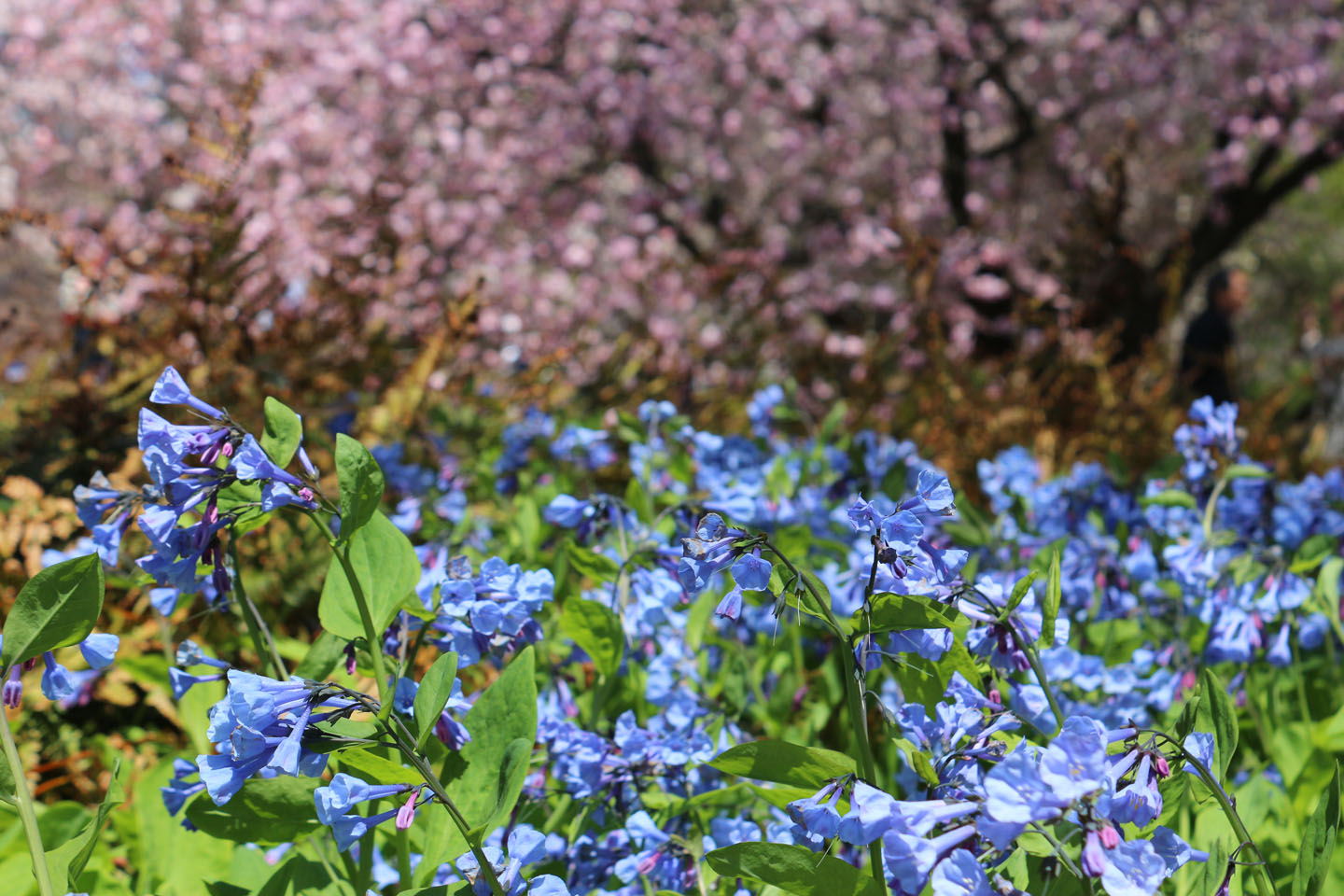
Here, native Mertensia virginica - Virginia bluebells - hold their own in the company of the imported, media-friendly crowd of cherries.


 It's a beautiful garden. I know it well. But it does not fail to impress.

Thursday, April 25, 2013

The Catskills on an empty spring day


I realized something, today. Sometimes I don't post about the best things.


I was sorting images on my computer, and storing them in their various orderly folders, when I saw the Catskills folder (in: New York, 2013, April).

I never wrote about the Catskills. All two hours of them.

One of the reasons was that the day we spent in the mountains was the day of the Boston bombing. So writing about our idyllic getaway didn't feel right.

Another reason was that those few hours felt perfect.


There was another perfect time, near Stanford, in South Africa; hours spent paddling near sunset on a mirror-smooth lagoon past flocks of flamingoes, gliding in silence,  gorgeous waterbirds in the reeds right beside us, mountains all around. I have never written about that. It was years ago. It was too intimate, too beautiful. Too impossible. The effort required to catch it in words too daunting. And also the knowledge - fear? - that my photographs cannot possibly convey the feeling or beauty of the moment.


It was a long drive. To the Catskills. We'd picked up sandwiches at the Overlook Farm Market, mimicking our October 2009 route, when we drove with my mom to see fall foliage. It was chilly. Both times. We bought a gas station beer, to go with the sandwiches. And then we drove some more. At last we were in the mountains, and spring was nowhere near. We had left the flowers behind us in the city, and now even the small towns' forsythia bushes were still tightly furled in bud

But then we stopped in a narrow valley when I started to see all these little yellow flowers flashing by, and couldn't stand it anymore...

They are coltsfoot (Tussilago farfara), but I did not know that, then. Then, they were freaky, magical, pushing up out of heavy, papier mache-like leaf litter and dried mud, their tender, fragile stalks heaving it all up without effort, no leaves, all stalk and flower. In this valley the chill left the air. And the coltsfoot was everywhere, on southfacing slopes in the sun. It is not native, as I thought, then, but a European import. Edible, ironically, and famous and controversial, medicinally. How could I have eaten these?


Beside this rushing, clean stream I saw plants I did not know - very striking. 


A member of a Facebook botanical group sent me in the direction of Veratrum, or false hellebore, and indeed: Veratrum viride. I last saw the species was on the slopes of Mt Baker, Washington, at about four feet tall, and at serious elevation. That was another perfect moment. Hiking in fields of flowers, like my best dreams.


There were trout lilies nearby, not quite open yet. Spring was delayed up here. 


I found, and picked winter cress (Barbarea verna - yellow rocket, land cress), a European weed.


From the slope to our right many streams ran. There was still snow on the shady side of the road. 


I explored while Vince took pictures of a beautiful waterfall. I found wake robin, not quite open yet (Trillium, but I don't know what species). Then I remembered Bears and started to make more noise.


Tiny yellow violets in the leaf humus on a very steep, southern slope. Deep happiness. Plus pollinator.


This is where I found the violets. 


We found our remembered creek, from that cold, brilliant October.

Perhaps that's it. The reluctance to write. Creek. One of the best words in the English language. So American. Storied. Touching on dreams. Crick. I wanted a cabin. I wanted to move in. Nowhere seemed better than where we were.


The water was fast and cold. We put our gas station beer in a small stream that ran to meet the creek. 


I followed Vince's pointing hand to a patch of green on the slope ahead.

Holy moly. A mountainful of ramps.


My first ramp sighting. Ever.


I pulled about six. Much harder to unearth than  field garlic. Even if I had had the proper digging implement ( I had a nice stick) I'm not sure I could have taken more. There were thousands. Which is why this post has no GPS coordinates attached.  I felt like I'd walked into a bank vault and been shown all the money. So I pocketed five dollars. And remembered what all that money looked like. I washed them in a stream. We took them home for a very special dinner.

Perfect.


Our gas station beer was cold. 


Our picnic was very basic. We'd had no plans, for once. We'd just wanted, needed, to get out of Dodge. 


I'd like to see it again. Now that green has entered the trees.

Wednesday, April 24, 2013

Brooklyn Bridge Park - native blossoms


Yesterday, late afternoon, in flat white light, I took a stroll down to Pier 6, five minutes from home, on the other side of the moaning and humming BQE. Shorthand for the Brooklyn Queens Expressway, about eight lanes of serious if submerged (it's in a trench at this point) traffic. 

I intended to be out for fifteen minutes, but was still wandering, an hour later, on one of the most lovely of my spring walks through this city. The air was chilly, but every serviceberry tree was in bloom, near the water. Perhaps thirty-five of them. I should count.  They are Amelanchier species - small trees and shrubs native to the Northeast, and producers of delicious red and purple fruit in June (their pie recipe will be in my book!). 

I think this will be a bumper year for the serviceberries. And I will be 8,000 miles away. Somebody, eat them for me!


I feel privileged to have seen, in person, over the last few years, the transformation of the barren, concrete docklands along the water here in Brooklyn, into one of the best parks I know. I distinctly remember standing on the Brooklyn Bridge, looking down at the wharfs, and thinking, what a waste.

Brooklyn Bridge Park is right beside the East River, and New York Harbor. Hard to beat Lady Liberty, the orange ferries, cormorants sunning their wings, and the looming presence downtown Manhattan right across the water. The park is visionary, and is a big and wonderful Up Yours to the highwayed legacy Robert Moses, the man who cut New Yorkers off from the water.


Yesterday I found something new. I never think I will, but every year I notice a new botanical thing. This time it was sassafras flowers, which I have either never seen, or never registered. I knew they had to be sassafras because I remembered how many of the trees are planted here, at Pier 1, from leafy summers and falls, past. Their powdered leaves are used as thickener in gumbo, or any stew (their roots, famously, made sarsparilla). The viscous effect of the leaves does not appeal to me much, but they are beautiful to look at.


That's them - the chartreuse flowers. The white behind - serviceberries.


And it's easy to note how this native spring is so much more muted than the imported one, on the street (that's the second half my walk, post coming later): Daffodils and tulips and magnolias have been shouting, and this woodland creeps in, behind them.


Tuesday, April 23, 2013

Flowers in the house


Somehow, the house went without flowers, last week. So this week I felt I was entitled to two bunches.

The flower sellers outside Key Food had all sorts, but very little spring: asters (fall), Barbeton daisies (summer), chrysanthemums (fall), orchids (...?) , lilies (summer), Inca lilies (summer), day-in-day-out roses (summer), baby's breath (summer), calla lilies (summer), tuber roses (summer)...

There were spring stocks. But I knew I'd be feeding lunch today to Amy, who will stay here for some weeks while we travel in South Africa, and not everyone likes the scent of stocks. The tulips were past their best - I never buy them unless the buds are practically embryonic, so I got some of the least gaudy hyacinths. The hot pink is not their best colour. I miss the delicate, single white variety my mom used to grow on the sidewalk ("pavement", if you're South African) outside our house in Bloemfontein. But the scent is remarkably unchanged...

The lilac was the first I have seen, and must come from points south. It was a huge bunch, of branches about three feet long. Mostly leaves. I reduced it all to a posy.

Yes, I do play with that cab. It's wonderful at dinner, for ramming into the salad bowl.

The limes with green stripes are pink inside, bought from Fairway last week, along with sweet limes and Meyer lemons.

There. Now you know everything.

To see more flowers from all around the world, visit Jane Winters' Small but Charming blog, where she hosts Flowers in the House on occasional Mondays. Yes, I know I am late.

Tuesday is the new Monday.

Rock garden plant sale

Sassy succulants. Photo: Lola Horwitz

If you are in Manhattan on Sunday, April 28th,  stop by El Sol Brillante Community Garden, in Alphabet City. It is the site of the annual plant sale of the North American Rock Garden Society. (Visit their website for more info...)

On the menu:  "Sassy succulants and other uncommon plants (sun and shade) for city folk. Perennials, bulbs and rock garden plants grown by members of the Manhattan Chapter of the North American Rock Garden Society and selected nurseries."

Viola pedata (bird's foot violet), on the terrace

If you get there early you may be able to snap up Aquilegia canadensis "Nana", as well as some gorgeous bird's foot violets.

And no, you don't have to have a rock garden to grow rock garden plants. Pots are perfect, as many of the Manhattan chapter members of the North American Rock Garden know!

Alphabet City is particularly rich in community gardens, so take a walking tour afterwards. I recommend the garden 6BC, particularly, on East 6th between Avenues B and C.

Then stop for a beer and chive toast at Zum Schneider, on Avenue C.

North American Rock Garden Society Plant Sale:

Where: El Sol Brillante, 522-528 East 12th St.
(between Avenue A and B)
When: April 28th, 9am - 1pm


Monday, April 22, 2013

Organic gardening, and how to celebrate Earth Day

May 2012 
Happy Earth Day!

Today I will give the terrace its first dose of organic seaweed emulsion (peugh!), in celebration. Fortunately, the smell dissipates in 24 hours.

I am increasingly mindful of the difference between organic fertilizers and synthetic chemical fertilizers. Recently I have been shocked (naively?) to the roots of my red hairs to learn that there are still serious gardeners and garden writers who see nothing wrong with using all-synthetic fertilizers on their gardens. Such willful ignorance of how gardens are tied to our environment floors me. The information is there at the click of a mouse, now. Not looking for it is like closing your eyes and saying, If I don't see it, it can't be happening.

There are chemicals in both organic and synthetic plant foods. But, very broadly speaking, synthetic chemical fertilizers feed the plant alone, and organics feed the soil, replenishing it and keeping minute soil life alive. The soil feeds the plant.

Organics also do not pollute our waterways and air in the way that synthetic fertilizers do, in terms of  run off and emissions. Those dead zones in the ocean, near river mouths? That's upstream runoff, often from farmland. Gardens and golf courses contribute to this water pollution (which is now thought to be killing manatees, as their sea grass diet is threatened by algal bloom in the Gulf of Mexico). The process of manufacturing synthetic fertilizers is also very different, in terms raw materials used, and of the poisonous and greenhouse emissions that result.

May 2012

As a former blue crystal user I can assure you that there is new soil life and a beautiful garden at the end of the Miracle Gro tunnel. I have been gardening organically for years and the plants are very happy. The results are not as fast. With organics, soil organisms(often microscopic) must first break down the food to make it available to the plant. With synthetic chemicals, the "food" goes straight to the plant. The soil is also bereft of those tiny critters. They cannot tolerate such a salty environment. The soil is, for want of a less dramatic word, dead. And your plants are in constant need of a new fix.

Earth Day, 2013

In the beginning, I needed to exercise patience - always hard for me. But now my plants are rocking along. All you need to do is look at those yearlong strawberries and reblooming roses. Of course, my little garden makes no difference to the world. But if my little garden and the others like it are joined by your gardens, and your friends' gardens, then we have the beginning of the normalization of healthy living. So far, chemicals have been normal; I grew up with them.

We have begun to stop putting artificial ingredients in our bodies. Why? Because they can make us sick.  Now our gardens must follow suit.

May 2012

This evening, we will have supper by candlelight, as we usually do on Earth Day. Such a trivial (though gentle) act makes no difference, in and of itself, in isolation. But the gesture, especially if it is shared, goes towards that building of awareness, which is so important. The more people observe Earth Day, the more normal the conversation - and conservation - becomes...

Earth Friendly Fertilizers:

The key is to read: Ingredients, labels, and what you can about the source of ingredients.

Regarding brands, Espoma, (so far)
Compost - compost is the best thing you can do for your garden. Mix it with top soil and potting soil, and use it as a mulch.
Aged manure - check source. You do not want sludge, which is treated sewage (think heavy metals and tarces of antibiotics)
Guano - bird poo. Wonderful stuff. Check source, if you can.
Worm castings
Bloodmeal
Bonemeal
Seaweed extracts
Fish meal

Please add your suggestions in the comments.

And what are you doing, this Earth Day?

Sunday, April 21, 2013

A very local spring


I went for a short neighbourhood walk. The magnolias and pears are dropping their petals, and the palest green leaves have begun to appear.


In a garden on Joralemon Street was a tangle of field garlic, anemones, muscari, tulips and daffodils.


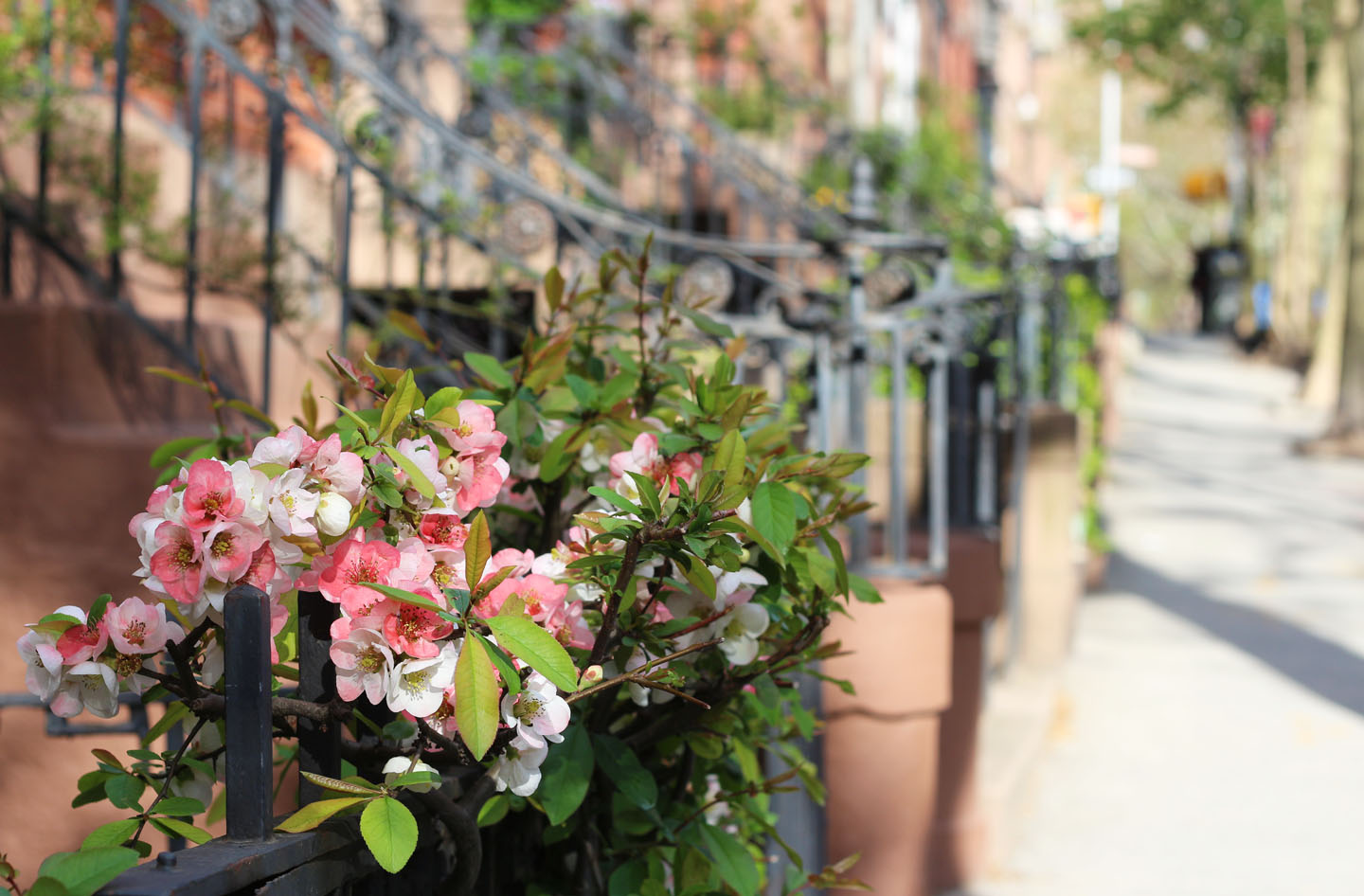
Also on Joralemon Street - exceptional for its gardens and flowers, a beautiful espaliered ornamental quince.